
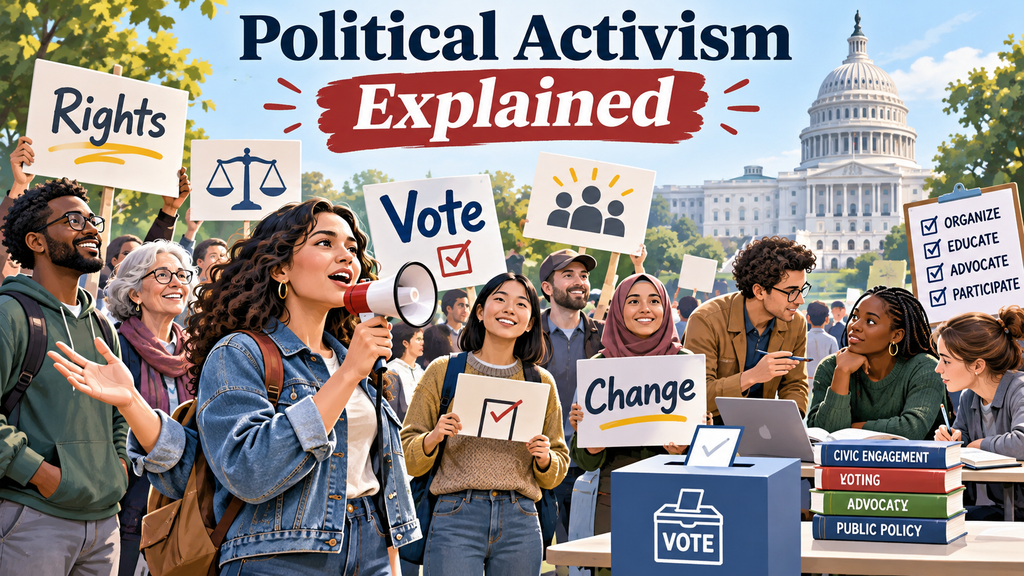
If you want to get involved in politics and the whole field looks too big to enter, it helps to see the options laid out in one place. Political activism has a wide range of entry points, from a two-minute phone call to testifying before a legislature, and most of them need no experience, no money and no party membership.
This guide answers the basic question of what political activism is, then sorts the main ways to take part by time, cost and risk, with examples from the left, the right and the nonpartisan middle.
What political activism actually means, and what it doesn’t
Political activism is any action meant to influence who holds power or what public decisions get made. That covers an individual calling a legislator, a neighborhood group pressing a city council, and a national organization running a petition drive. The common element is a deliberate attempt to change an outcome through public channels.
Activism is not the same as partisanship. You can push for a local bike lane, better ballot access or a school budget change without ever naming a party. It is also broader than protest. Marches get the photographs, but most activism happens in email inboxes, county meeting rooms and phone calls that nobody films.
Opinion alone does not count as activism. Holding a strong view on immigration or taxes is a belief. It becomes activism when you do something with it that is aimed at a decision-maker, a voter or a public process.
Why people get involved: the same motives on every side
People across the political spectrum tend to start for similar reasons. A decision affects their own life, such as a tax change, a school closing, a zoning ruling or a new law at work. Or they hold a conviction about right and wrong that they want reflected in public policy. Or they want to belong to a group of people who care about the same things.
The causes differ and the pattern repeats. One person is moved to act by a climate bill and another by a property tax increase. A parent on the left may organize against cuts to school funding, and a parent on the right may organize for school choice or for a say in the curriculum. Both are responding to a decision they believe affects their children.
Seeing this overlap makes the rest easier. The methods in this guide are neutral tools, and every side uses all of them. A tool that works for a cause you support will work for one you oppose, which is also a good reason to understand how they function.
The low-effort end: voting, calling, signing and sharing carefully
The lowest-cost actions take minutes and cost nothing. They are also the easiest place to start when you have no idea where to begin.
Vote in every election you can, including the small ones. Primaries, school board races, municipal elections and special elections often have low turnout, so each vote counts for more. If you want to understand how the machinery works first, how elections work from ballot access to certified results covers it step by step.
Call or write an elected official. Staff usually tally calls and messages by issue and position, so a short, polite message registers. State your name and ZIP code or address, name the bill or issue, and say what you want the official to do. A supporter of a gun-safety bill and a supporter of a gun-rights bill would each make the same kind of call, with opposite requests.
Sign a petition. Petitions range from local requests, such as a crosswalk outside a school, to statewide efforts to put a question on the ballot. Read what you are signing first, and check who is running the effort.
Share information carefully. Posting is the easiest action and the easiest to get wrong. Read past the headline, find the original source, and check whether the claim appears in more than one outlet before you pass it on. How your news sources shape what you do is a topic of its own, covered in how the news and social media you use shape political participation.
Joining others: local groups, causes, parties and campaigns
Working alongside other people takes more time than a phone call, and it usually keeps people involved longer. A group gives you tasks, a schedule and people who notice when you are absent.
Local groups and causes. These include neighborhood associations, issue organizations, advocacy groups and civic clubs. Progressive examples include tenant unions and environmental groups. Conservative examples include taxpayer associations, gun-rights groups and church-based civic committees. The League of Women Voters is a well-known nonpartisan option focused on voter information and registration. Most groups have a regular meeting you can attend once without committing to anything.
Political parties. Joining a party can mean registering with it, attending local meetings, and helping choose delegates or officers. The rules differ by state, and registration is often only the first layer. How to join a political party in the United States, and what membership means explains the details.
Campaigns. Campaigns need people to knock on doors, make calls, enter data and staff events. You pick a candidate you support and a task fits into your schedule. This works for any party, and nonpartisan efforts such as get-out-the-vote drives or serving as a poll worker are options too. Your local election office can tell you how poll worker sign-up works where you live.
Some groups join forces on shared goals even when they disagree elsewhere. The overview of coalitions and alliances in politics shows how that works and why you may see unlikely partners on a single issue.
Going public: protest, petitions, town halls and speaking up
Public actions put your name, face or voice in front of other people. That raises both their potential impact and their personal risk.
Protest and demonstrations. Marches and rallies show that an issue has people behind it, and they work best as part of a longer effort. A march for abortion access and a march against it use the same legal protections and the same logistics. For what protest accomplishes once the crowd goes home, see the role of protest in politics.
Civil disobedience. This means deliberately breaking a law, usually peacefully and openly, to make a point, and accepting the legal consequences. It carries the highest personal risk on this list, including arrest and a record. If you are thinking about it, read what civil disobedience is and how it differs from protest, riot and crime before you decide.
Town halls and public meetings. Many members of Congress and state legislators hold open events, and city councils and school boards set aside time for public comment. Prepare a question or statement that takes one to two minutes to deliver. A specific, local, first-hand point lands better than a general complaint.
Letters to the editor and op-eds. A short letter to a local paper reaches readers and often officials too. Left, right and nonpartisan writers all use this channel.
Going public may affect relationships, work and online safety. Think about how you would handle a coworker or relative seeing it before you commit.
Working the system: lobbying, testifying and ballot measures
This end of the menu involves the formal processes through which laws and rules get made. It sounds advanced, but several parts are open to anyone.
Lobbying. Lobbying means trying to influence legislation, and it is not limited to paid professionals. Unions, trade groups, environmental organizations, gun-rights groups and civil liberties organizations all do it. Private citizens can contact legislators too, though professional lobbyists usually have to register. What lobbying actually is, and how every side uses it covers the distinctions.
Testifying and public comment. Legislative committees hold hearings where members of the public can speak or submit written testimony, and agencies often take public comments on proposed rules. Testimony from someone affected by a bill can carry weight because it is concrete. The hearing is one of the stages in how a bill becomes a law, and knowing the stage tells you when your input matters most.
Ballot measures. In many states, citizens can propose or vote on laws and constitutional amendments directly. Availability and rules differ widely by state, and some states have none of these. Referendums and initiatives are explained in a separate guide. Backing or opposing a measure is a way to take part in policy directly, and it appeals to people on all sides.
Working the system takes time and patience. Many bills move slowly or stall, so this path rewards people who like details and can wait for results.
How to choose your first step and avoid burnout
You can choose a first step in under ten minutes by asking three questions: how much time you have this week, how much money you can spend (often none), and how much personal exposure you accept.
Action Typical time Cost Personal risk Vote in a local election 30 minutes or less Free Very low Call an elected official 5 minutes Free Very low Sign a petition 2 minutes Free Low Attend a local group meeting 1 to 2 hours Free, sometimes dues Low Volunteer for a campaign 2 to 4 hours per shift Free Low to moderate Speak at a public meeting Several hours with prep Free Moderate Join a march or rally Half a day Free to low Low to moderate Testify at a hearing A day or more Travel costs Moderate Civil disobedience Varies Possible fines, legal fees High
Pick one row that fits this week, do it, and then see how it felt. Staying with the same action a few times teaches you more than sampling a different one each week.
Burnout usually comes from doing too much too early or from following the news constantly. A few habits help:
- Set a fixed amount of time for political activity each week and stop when it is used up.
- Choose one issue or one level of government, such as your city council, instead of trying to follow everything.
- Take regular breaks from political news and social media, especially after something upsetting.
- Work with others so the load is shared and you can step back without everything stopping.
Taking a week off is part of staying involved for years.
Staying civil: disagreeing with neighbors while still taking part
Taking part in politics means dealing with people who disagree with you, and many of them live nearby. The skills involved are practical.
Ask questions before you argue. “What led you to that view?” tells you more than a rebuttal does, and people answer it more honestly. Most people hold their positions for reasons connected to their own experience, which you may not know.
Keep the discussion on the issue and away from the person. You can say a policy will raise costs or hurt a group without implying the other person is stupid or malicious. When a conversation starts to move toward insults, you can end it politely and nothing is lost.
Be careful online, where tone is hard to read and audiences are large. A disagreement that would take five calm minutes over a fence can turn into days of conflict in a comment thread. Many people find that the best place to change minds is a one-to-one conversation, and the best place to hold your ground is a public process like a vote or a hearing.
Disagreement is a normal part of democratic life, and showing up in a respectful way helps everyone involved.
Pick one action from the menu that fits your time this week, then read the campaign volunteering guide to see what a first shift really looks like.