 When people think about the United States government, the president is often the first person who comes to mind. Presidents give speeches, meet with foreign leaders, sign legislation, issue executive orders, and appear regularly in the news. But the president is only one part of a much larger system known as the executive branch.
The executive branch is one of the three branches of the federal government, along with the legislative branch and the judicial branch. Each branch has its own responsibilities and powers, and each plays a role in limiting the power of the others.
Understanding the executive branch can make it much easier to understand American politics. Many political debates involve questions about what the president can do, what federal agencies can do, and where the authority of the executive branch begins and ends.
So, what exactly is the executive branch, and what does it do?
The Executive Branch and the Constitution
The foundation of the executive branch can be found in Article II of the U.S. Constitution.
Article II begins by stating that executive power is vested in the president of the United States. It establishes the presidency, describes several presidential powers and responsibilities, and explains important parts of the process for selecting a president.
The Constitution’s framers created a government with three separate branches partly to prevent too much federal power from being concentrated in one place.
Congress, which makes up the legislative branch, passes laws. The executive branch is primarily responsible for carrying out and enforcing those laws. The judicial branch interprets laws and decides legal disputes.
Of course, the separation is not always quite that simple. The branches interact with one another constantly, which is where the American system of checks and balances comes into play.
The President
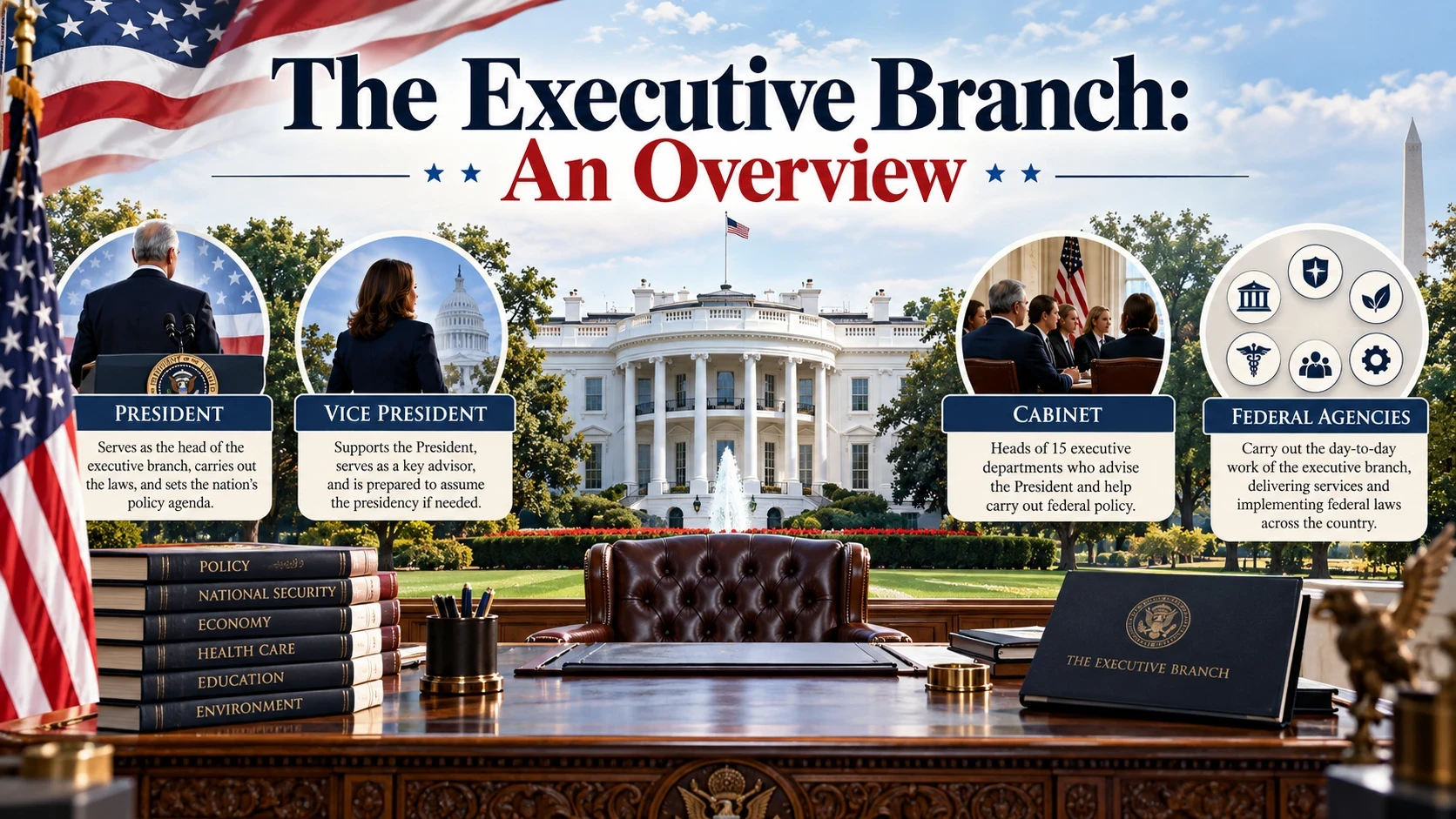
The president is the head of the executive branch.
Under Article II, the president is responsible for ensuring that federal laws are faithfully executed. The president is also the nation’s head of state and serves as commander in chief of the armed forces.
The president serves a four-year term. Under the Twenty-Second Amendment, a person generally cannot be elected president more than twice.
To be eligible for the presidency, the Constitution requires a person to be a natural-born citizen of the United States, at least 35 years old, and a resident of the United States for at least 14 years.
The presidency carries significant authority, but that authority is not unlimited.
Some presidential powers can be exercised independently, while others require the involvement of Congress, particularly the Senate.
What Powers Does the President Have?
The Constitution gives the president several important responsibilities and powers.
One of the most familiar is the president’s role as commander in chief of the U.S. armed forces. This gives the president significant authority over military operations. At the same time, the Constitution gives Congress important military powers of its own, including authority related to funding the armed forces and declaring war.
The president also plays a major role in foreign policy.
Presidents negotiate treaties with other countries, although treaties require approval by two-thirds of senators present before they can be ratified. Presidents also nominate ambassadors who represent the United States abroad.
Appointments are another major presidential responsibility.
The president nominates federal judges, ambassadors, Cabinet officials, and many other federal officers. Many of these appointments require confirmation by the Senate.
The president also has the constitutional authority to grant reprieves and pardons for federal offenses, except in cases of impeachment.
Signing and Vetoing Legislation
Although Congress writes and passes federal legislation, the president plays an important part in the legislative process.
After both chambers of Congress approve a bill, it normally goes to the president.
The president can sign the bill, allowing it to become law, or veto it. A presidential veto does not necessarily end the matter, however. Congress can override a veto with a two-thirds vote in both the House of Representatives and the Senate.
This is a good example of checks and balances in practice.
Congress cannot simply make the president irrelevant to the legislative process, but the president also does not have absolute power to stop legislation supported by a sufficiently large majority of Congress.
What Are Executive Orders?
You have probably heard the term executive order in political news.
An executive order is a directive issued by the president concerning the operations of the federal government. Presidents can use executive orders to direct executive officials and agencies or to help implement existing federal law.
Executive orders can sometimes produce significant policy changes, which is why they frequently become the subject of political and legal debate.
However, an executive order is not the same thing as a law passed by Congress.
Presidential authority remains subject to the Constitution and federal law, and executive actions may be challenged in federal court. Congress can also affect executive policies through legislation and its constitutional control over federal spending.
This distinction is important because news coverage sometimes makes it sound as though a president can simply issue an order and create any policy the president wants. The constitutional system is more complicated than that.
The Vice President
The vice president is another important member of the executive branch.
The vice president is prepared to assume the presidency if the president dies, resigns, is removed from office, or is otherwise unable to serve under the applicable constitutional procedures.
But the vice president also has an unusual role because the office connects the executive and legislative branches.
The Constitution makes the vice president the president of the Senate. The vice president does not normally vote in the Senate but can cast a vote when senators are equally divided.
The political responsibilities of vice presidents have varied considerably throughout American history. Modern vice presidents often act as presidential advisers and may represent the administration at meetings, ceremonies, diplomatic events, and negotiations.
The President’s Cabinet
Running the executive branch is far too large a job for one person.
That is where the Cabinet comes in.
The Cabinet includes the heads of the federal executive departments as well as the vice president and certain other senior officials. Cabinet officials advise the president and oversee large areas of the federal government.
Today, there are 15 executive departments, covering areas such as defense, agriculture, commerce, education, energy, transportation, labor, state, justice, treasury, and homeland security.
For example, the secretary of state deals heavily with foreign affairs, while the secretary of the treasury oversees the Treasury Department. The secretary of defense heads the Department of Defense.
Most Cabinet-level department heads are nominated by the president and require Senate confirmation.
This creates another check on presidential authority: although presidents choose whom they want to nominate for many high-level government positions, the Senate has the opportunity to approve or reject many of those nominations.
Federal Agencies and the Executive Branch
The executive branch extends far beyond the president, vice president, and Cabinet.
It includes a large network of departments, agencies, commissions, boards, and offices that perform the everyday work of the federal government.
These organizations handle an enormous range of responsibilities.
Federal agencies are involved in areas including national security, environmental protection, transportation, Social Security, financial regulation, public health, law enforcement, workplace rules, consumer protection, and much more.
Congress often passes laws establishing broad policies and then gives federal departments or agencies responsibility for administering those laws.
That means decisions made within the executive branch can affect people’s everyday lives even when those decisions receive relatively little national attention.
The Executive Office of the President
There is also an organization called the Executive Office of the President, or EOP.
The EOP includes the president’s immediate staff and several offices that help the president manage the executive branch and develop policy.
For example, it includes the Office of Management and Budget, which plays an important role in federal budgeting and the management of executive agencies. It also includes the Office of the United States Trade Representative.
When you hear about White House advisers and presidential staff members working on economic, national security, domestic, or other policy matters, many of them work within this broader presidential organization.
Checks and Balances on Executive Power
Perhaps the most important thing to remember about the executive branch is that presidential power exists within a larger constitutional system.
Congress can pass legislation, control federal spending, confirm or reject many presidential nominees, conduct oversight of the executive branch, and override presidential vetoes when the required supermajorities are reached.
Federal courts can hear cases challenging executive actions and determine whether those actions are consistent with the Constitution and federal law.
The Constitution also establishes an impeachment process. The House of Representatives has the power of impeachment, while the Senate conducts trials following impeachment. Article II states that the president, vice president, and other civil officers may be removed following impeachment and conviction for treason, bribery, or other high crimes and misdemeanors.
Meanwhile, the president has checks on the other branches as well, including the ability to veto legislation and nominate federal judges.
The result is a system in which the branches are separate but also dependent on one another in important ways.
Why the Executive Branch Matters
Learning about the executive branch is useful even if you do not follow politics every day.
Whenever there is a national debate over an executive order, presidential veto, federal regulation, military decision, Cabinet appointment, or Supreme Court nomination, understanding the executive branch provides valuable context.
It can also help us ask better questions.
Is the president acting under authority provided by the Constitution? Has Congress passed a law giving an executive agency certain powers? Does the Senate have to approve an appointment? Can Congress change the policy through legislation? Can a court review the action?
Those questions are often more useful than simply asking whether we agree or disagree with a particular president.
The Bigger Picture
The president may be the most visible person in the federal government, but the executive branch is much larger than the presidency.
It includes the vice president, Cabinet departments, federal agencies, commissions, advisers, administrators, and thousands of other officials and employees who help carry out federal law and operate the government.
At the same time, the executive branch does not operate on its own.
The Constitution divides power among three branches, giving each both authority and limitations. Congress, the president, and the federal courts all play different roles, and each can affect what the others are able to do.
That balance of power has been debated throughout American history, and debates over presidential authority continue today.
Knowing the basic structure of the executive branch gives us a better foundation for understanding those debates—and for understanding how the U.S. government works as a whole.