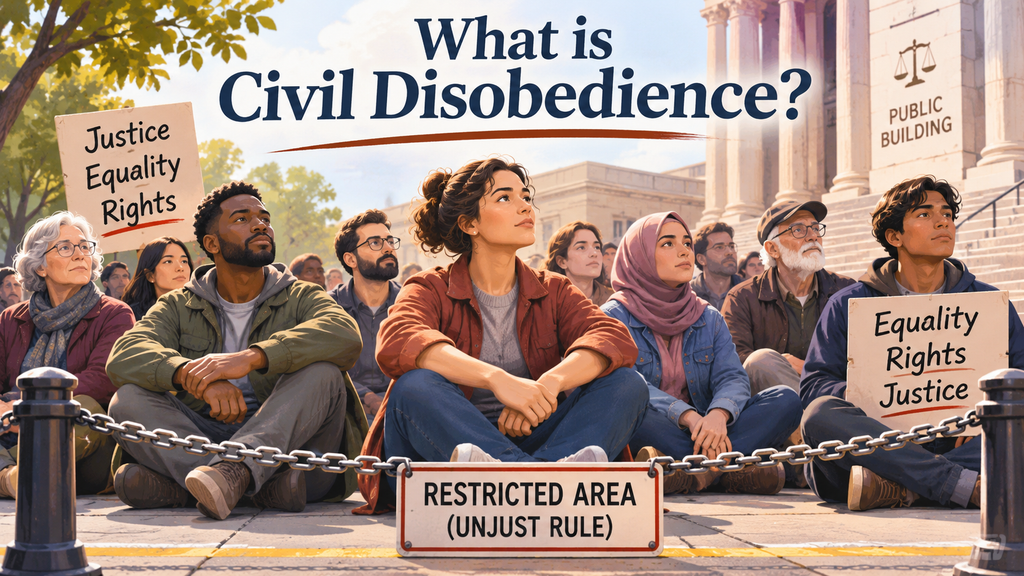
Civil disobedience is the deliberate, public, nonviolent breaking of a law to challenge that law or a related policy, followed by acceptance of the legal consequences. That short answer to “what is civil disobedience” leaves out most of what makes the idea interesting. People who admire a particular act of lawbreaking call it civil disobedience, and people who dislike the cause often call the same act a crime. This article defines the term by its parts, looks at where it came from, and walks through examples from different political directions so you can see why the argument never settles.
Civil disobedience in plain English: breaking a law on purpose, in the open
A person who believes a law is unjust has several options. They can vote, lobby, sign a petition, sue, or march. Civil disobedience is a different kind of choice, because it involves doing the thing the law forbids, or refusing to do the thing it requires, as a way of making a point.
The word “civil” does not mean polite. It refers to citizenship: the person acts as a member of the political community, aiming to change how that community governs itself. The word “disobedience” is meant literally. The law is broken, and the person doing it knows that.
That combination is why the topic produces so much disagreement. Democracies depend on people following laws they dislike while working to change them. Civil disobedience asks whether, in some cases, breaking the law is itself a legitimate way to take part.
The four marks that separate it from ordinary protest, riot, and crime
Philosophers and legal scholars phrase their definitions differently. The philosopher John Rawls, in A Theory of Justice (1971), described civil disobedience as a public, nonviolent, conscientious political act contrary to law, usually meant to bring about a change in law or policy. Most definitions boil down to four working parts.
- A deliberate lawbreaking act. The law is broken on purpose. Marching on a public sidewalk with a permit is legal, so it is ordinary protest. Blocking a road without a permit, or refusing to pay a tax, breaks a rule.
- Done openly. The person does not hide, use a disguise, or try to avoid being identified. The act is meant to be seen, because the audience is the public as much as the authorities.
- Nonviolent. The act does not injure people or threaten to. Scholars disagree about edge cases such as damage to property, and this is one of the liveliest arguments in the field.
- Willingness to accept the penalty. The person does not run, lie, or fight the arrest. Accepting the consequences signals respect for the legal system as a whole, even while one law is being defied.
Now compare the neighboring categories.
- Ordinary protest stays within the law. It can be loud, large, and effective, but no law is broken. (If you want that side of the picture, the piece on the role of protest in politics covers what marches and demonstrations do.)
- Rioting involves violence or serious disorder, often with no organized message and no one taking responsibility. It fails the nonviolence mark and usually the others too.
- Ordinary crime is typically done for private gain and in secret. A burglar hides and flees. A person practicing civil disobedience announces what they are doing and stays.
Some acts sit between categories. A person who secretly leaks documents they believe the public should see breaks the law deliberately and may act from conscience, but the act is covert and the person often avoids punishment. Some thinkers call that a different kind of act, and others stretch the definition to include it. A useful habit is to check an example against all four marks and see which it meets.
There is also a distinction between direct and indirect disobedience. Direct disobedience breaks the very law being protested, as when someone enters a segregated space that the law keeps closed to them. Indirect disobedience breaks a different law to draw attention to the target, as when someone refuses to pay a tax to protest what the government does with the money.
Where the idea comes from: Thoreau, Gandhi, King, and the thinking behind them
The phrase traces back to Henry David Thoreau. In 1846 he was jailed for a night in Concord, Massachusetts, for not paying a poll tax. He objected to slavery and to the Mexican-American War. His essay on the subject, published in 1849 as “Resistance to Civil Government” and later known as “Civil Disobedience,” argued that a person’s conscience can outrank the demands of the state. He did not say every law may be broken, only that individuals should not be willing instruments of what they see as grave wrongs.
Mohandas Gandhi turned the idea into organized mass action. He used the term satyagraha, often translated as “truth force” or “holding firmly to truth,” for nonviolent resistance to British rule in India. His best-known act was the Salt March of 1930. He and followers walked roughly 240 miles to the coast at Dandi to make salt in defiance of the colonial salt monopoly and tax. Thousands were arrested in the campaign that followed.
Martin Luther King Jr. drew on both. In his 1963 “Letter from Birmingham Jail,” written after his arrest during demonstrations in Birmingham, Alabama, he argued that there are just laws and unjust laws, and that people have a moral responsibility to disobey the unjust ones. He added a condition: the person must act openly and accept the penalty, which in his view shows the highest respect for law.
The common thread is a claim about conscience and a claim about method. The conscience claim says a law can be wrong enough that obeying it is itself a moral failure. The method claim says that if you break it, you should do so in a way that appeals to your fellow citizens rather than overpowering them.
Examples from across the political spectrum, and why people still argue about them
Civil disobedience is often remembered as a tool of the political left, partly because the civil rights movement is its most celebrated case. History is more mixed than that, and the examples below come from several directions.
- The civil rights movement. Sit-ins, the Birmingham demonstrations, and the Montgomery bus boycott era (Rosa Parks was arrested in 1955) are widely admired today. They were not universally admired at the time. Polls and commentary from the period show many Americans disapproved of the tactics, and some critics who supported equal rights still said the lawbreaking went too far or moved too fast.
- Draft-file burnings. In 1968, a group known as the Catonsville Nine burned draft records in Maryland to protest the Vietnam War, and they accepted prosecution. Supporters saw conscience in action. Critics saw destruction of government property and interference with a lawful draft.
- Sanctuary activism. Since the 1980s, some churches and activists have sheltered immigrants who face deportation. Supporters describe a moral duty to protect vulnerable people. Opponents say it defies laws passed by elected representatives, and that individuals do not get to decide which immigration laws count.
- Clinic blockades. In the 1980s and 1990s, anti-abortion groups such as Operation Rescue blockaded abortion clinics and accepted arrest. Participants described it as defending human life. Opponents said it denied others access to lawful medical care. Congress passed the Freedom of Access to Clinic Entrances Act in 1994, which made blocking access to such facilities a federal offense.
- Refusing to issue marriage licenses. In 2015, Kim Davis, a county clerk in Kentucky, stopped issuing marriage licenses after the Supreme Court ruled that same-sex couples could marry, citing her religious beliefs. A federal judge held her in contempt and she spent several days in jail. Supporters saw a conscience case, while critics noted she was a government official refusing to perform a duty of her office.
Look at who defends which example. Many people who praise the civil rights sit-ins reject the clinic blockades, and many who praise the blockades reject the sanctuary movement, though not everyone follows that pattern. The mechanics in each case are similar, but people judge them by whether they share the cause. A fair-minded reader can ask a harder question: would I accept the same tactic if the cause were one I opposed?
Why accepting the penalty matters, and what courts and governments have done in response
The fourth mark does a lot of work. A person who breaks the law and accepts punishment shows that the goal is persuasion, not escape from the law. It also costs the person something, which signals sincerity, and it gives the public time to consider the issue while the case goes through the courts.
Critics find the idea less convincing than supporters do. Some argue that if you accept the legitimacy of the courts enough to take their punishment, you have conceded that the law deserved to be followed. Others reply that accepting the penalty is not a concession that the law is right, only that the system as a whole deserves respect.
Courts generally do not treat civil disobedience as a defense. Judges apply the law as written, and a sincere moral motive usually affects only sentencing, if it matters at all. In Walker v. City of Birmingham (1967), the U.S. Supreme Court upheld contempt convictions of King and other marchers who had gone ahead with a march despite a court order, ruling by a narrow 5-4 margin that they should have challenged the order in court first. Defendants have sometimes tried a “necessity” defense, arguing that breaking the law prevented a greater harm, and it rarely succeeds.
Governments have responded in different ways. Some have changed the law, as happened with segregation statutes. Others have increased penalties or created new offenses, as with the 1994 clinic access law. Prosecutors also have discretion over whether to bring charges at all, and in practice the response often depends on public opinion, the seriousness of the act, and who holds office.
The honest debate: when, if ever, is breaking a law justified in a democracy?
People who support civil disobedience in a democracy usually make these arguments:
- Majorities can be wrong, and legal processes can move slowly while people suffer real harm.
- Voting and lobbying are not equally open to everyone, especially to people who cannot vote or whose views have little influence.
- An open, accepted act of lawbreaking can draw attention that conventional methods cannot, and it can prompt others to reconsider.
People who doubt it, or limit it sharply, make these arguments:
- In a democracy, citizens have a say in making the laws, which creates a duty to follow the ones they lose on.
- If everyone breaks laws they find unjust, the rule of law weakens, and the next person to do so might hold views you find abhorrent.
- Peaceful intentions do not guarantee peaceful results, and lawbreaking can escalate.
Both sides can also agree on some points. Most thinkers who defend civil disobedience say it makes sense mainly when legal channels have been tried or are blocked, when the injustice is serious, and when the method is proportionate. Most critics concede that some historical cases, such as resistance to slavery, look justified in hindsight. The disagreement is about where to set the threshold and who decides, since every person who breaks a law believes their reason is good enough.
How to think about civil disobedience before you take a side
A few questions help you evaluate any case without letting your view of the cause decide everything in advance.
- Does the act meet all four marks: deliberate, open, nonviolent, and accepting of the penalty?
- Were legal routes available, and were they tried?
- Who is affected by the lawbreaking, and did they have any say?
- Would you defend the same tactic if used by people whose goals you oppose?
- Is the harm the person is resisting serious enough to justify the harm of breaking the law?
Civil disobedience is one tool among many. Most political participation is lawful: voting, contacting representatives, working on campaigns, joining parties, and attending demonstrations. If you want to see how lawful public demonstration works and what it accomplishes after the crowds go home, read the guide to the role of protest in politics next.