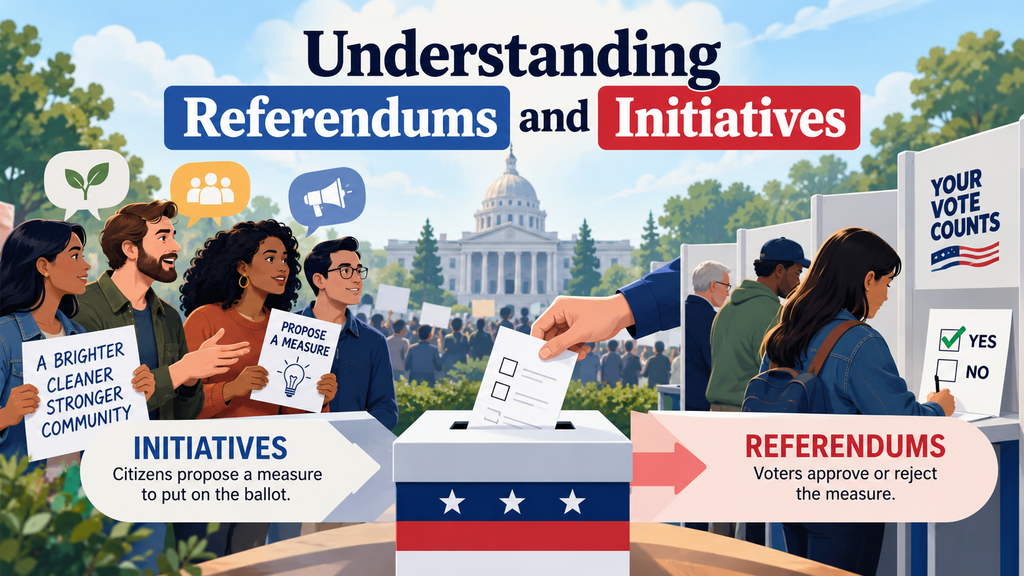
Ballot questions can look confusing the first time you see one. You get a short paragraph of legal-sounding text and a yes or no box, and the news keeps calling it a referendum or an initiative, sometimes both. This guide covers referendums and initiatives explained with one made-up ballot question, so you can see who starts each process, who votes, and what happens afterward.
What a Referendum Is, and What an Initiative Is
A referendum is a public vote on a question that a government body has already put forward. A legislature, city council, or government passes or proposes something, and voters get to approve or reject it. The vote is often the last step before the proposal takes effect.
An initiative is a way for ordinary citizens to propose a law or a constitutional change themselves. A group of residents writes the text, collects signatures from registered voters, and if enough signatures are verified, the proposal goes on the ballot. The key difference is where the idea comes from. In a referendum it usually comes from officials, and in an initiative it comes from the public.
Both differ from a regular election. In a candidate election you choose a person who will make decisions later. In a ballot question you vote on one specific decision yourself.
Terminology varies from place to place. In the United States, people also use “referendum” for a petition by citizens to challenge a law the legislature has already passed, sometimes called a popular or veto referendum. Check how your own state or country uses the words.
Who Starts the Process: Lawmakers or Ordinary Citizens?
The simplest test is to ask who gets the question onto the ballot.
- Lawmakers start a referendum. A legislature or council votes to send a question to voters, or a constitution or charter requires it to. Many places require voter approval for constitutional amendments, new taxes, or borrowing, so the question reaches the ballot automatically.
- Citizens start an initiative. Organizers file a petition and gather signatures. The number required is set by local law, often as a share of the votes cast in a past election or of registered voters.
- Citizens can also start a challenge. In places with a veto referendum, a petition can force a vote on a law that has already passed.
Officials still play a part in an initiative, but a procedural one. They check the wording, verify signatures, and schedule the vote. They do not decide whether the question deserves to be asked.
Walking One Imaginary Ballot Question From Idea to Vote
Take an invented town called Riverton and an invented question: Should Riverton raise its sales tax slightly to pay for a new public library branch? Here is how that question could reach voters by each route.
The referendum route
The town council debates a plan for the branch and votes to fund it with a small sales tax increase. Riverton’s charter says tax increases need voter approval, so the council places the question on the next ballot. The clerk prepares the official wording, and a campaign period follows with mailers, public meetings, and arguments for and against.
On election day, every registered voter in Riverton can vote yes or no. If yes wins, the tax takes effect as the council planned. If no wins, the plan stops, and the council can rework it or drop it.
The initiative route
Now suppose the council never proposed the library. A group of residents wants it anyway. They write the proposed law and file it with the town clerk, who checks that it meets the legal format. They then collect signatures from registered Riverton voters. Officials verify the signatures against the voter rolls.
If enough are valid, the question goes on the ballot, usually without any council vote. Voters decide. If yes wins, the proposal becomes law, though a court can still review it if someone argues it conflicts with a higher law. The council did not write the proposal, and it may not have wanted it, but the result stands.
The question is the same in both versions. What differs is who started it, who controlled the wording, and which officials were involved before voters saw it.
Binding or Advisory: Does the Result Actually Become Law?
It depends on the type of vote. A binding vote carries legal force. In the Riverton examples above, a yes vote changes the law directly, with no further approval needed.
An advisory vote, sometimes called a plebiscite, asks for public opinion without requiring action. The government can follow the result, modify it, or ignore it. The 2016 referendum on the United Kingdom’s membership in the European Union is a well-known case. Parliament was not legally required to act on the result, though the government committed to carrying it out, and doing so took years of negotiation and legislation.
Even a binding result can face limits afterward. Courts may strike down an approved measure that conflicts with a constitution. Some places restrict how soon a legislature can change a measure voters passed. Others let the legislature amend it like any other law. These details are set by local rules, so a headline saying voters “passed” something does not always tell you how permanent it is.
Direct Versus Indirect Initiatives and Other Kinds You Will See
Initiatives come in two main forms.
- Direct initiative: once enough signatures are verified, the proposal goes straight to the ballot.
- Indirect initiative: the proposal goes to the legislature first. Lawmakers can adopt it, in which case no vote is needed, or decline or propose an alternative, in which case it moves on to voters.
Several other types appear on ballots:
- Legislative referral: a legislature sends a proposed law or amendment to voters for approval.
- Mandatory referendum: the constitution requires a public vote on certain matters, such as amending the constitution itself. Ireland and many US states work this way for constitutional changes.
- Bond measures: voters approve or reject government borrowing for projects such as schools or roads.
- Recall: related but different. Voters decide whether to remove an elected official before the term ends.
Which of these exist depends on the jurisdiction. A voter in one state may see several types on one ballot, and a voter elsewhere may rarely see any.
Why Some Places Lean on Ballot Questions and Others Rarely Use Them
Switzerland is the usual example of heavy use. Its voters decide questions at the national level several times a year, and the practice is a long-standing part of how the country governs. In the United States there is no national initiative or referendum process, but many states allow citizen initiatives, and a number of Western states adopted them in the early twentieth century. California is well known for putting many measures before voters.
Other countries use them sparingly. In many parliamentary systems, the legislature is treated as the main lawmaking authority, and referendums are held only for special matters like constitutional changes or major questions of sovereignty.
Several factors shape these differences:
- History and constitutional design. Whether the founding rules or later reforms created a role for voting directly on laws.
- Trust in institutions. Where people distrust legislatures, citizens may push for ways to bypass them. Where legislatures are trusted, there may be less demand.
- Practical rules. Signature requirements, deadlines, and wording rules make initiatives easier or harder to use.
- Size and cost. Putting questions to voters costs money and requires informed participation, and smaller jurisdictions can find that easier to manage.
Supporters and critics of direct democracy disagree about whether these tools improve government, and that debate is separate from understanding how they work.
How They Sit Alongside Legislatures and Existing Checks and Balances
Ballot questions usually operate next to a legislature, not in place of one. Legislatures still pass most laws, set budgets, and handle the details of governing. Citizen votes tend to address a small number of questions at a time.
The other parts of a system keep working too. Courts can review measures that voters approve, which connects to the ideas in understanding checks and balances. Some places add safeguards such as limits on how many topics one measure can cover, requirements for a minimum number of signatures from different regions, or higher approval thresholds for certain changes. Legislatures may also be able to respond by amending, repealing, or building on a measure, depending on local law.
If you want to see how a ballot question fits among the powers a government already has, the article on the separation of powers is a good companion.
How to Read a Ballot Question Before You Vote on It
Ballot language is often written in legal style, and a quick skim can leave you unsure what a yes vote does. A few habits help.
- Find the official title and summary, then read the full text if you can. The summary is a short version, and the details are in the full measure. Many election offices publish both.
- Work out what yes and no each do. Some questions are worded so that yes means keeping the current rules, and others so that yes means changing them. Ask what happens to the law on each outcome.
- Identify who started it. Knowing whether it came from a legislature or from a citizen petition tells you where the wording came from.
- Look for an impact statement. Many places publish a neutral analysis of cost, tax effects, or the laws a measure would change.
- Check who is funding the campaigns. Campaign finance records are often public, and they show who is paying for each side.
- Note whether it is binding. Find out if a yes vote changes the law directly or only signals opinion.
- Check how hard it is to change later. A measure that amends a constitution can be harder to reverse than an ordinary law.
Reading the official text, then the impact statement, then arguments from both sides, in that order, keeps you tied to what the measure says before you hear anyone’s opinion of it. For how a single issue moves from problem to policy through ordinary channels, the guide to the political decision making process shows the legislative path that ballot questions can either join or go around.