
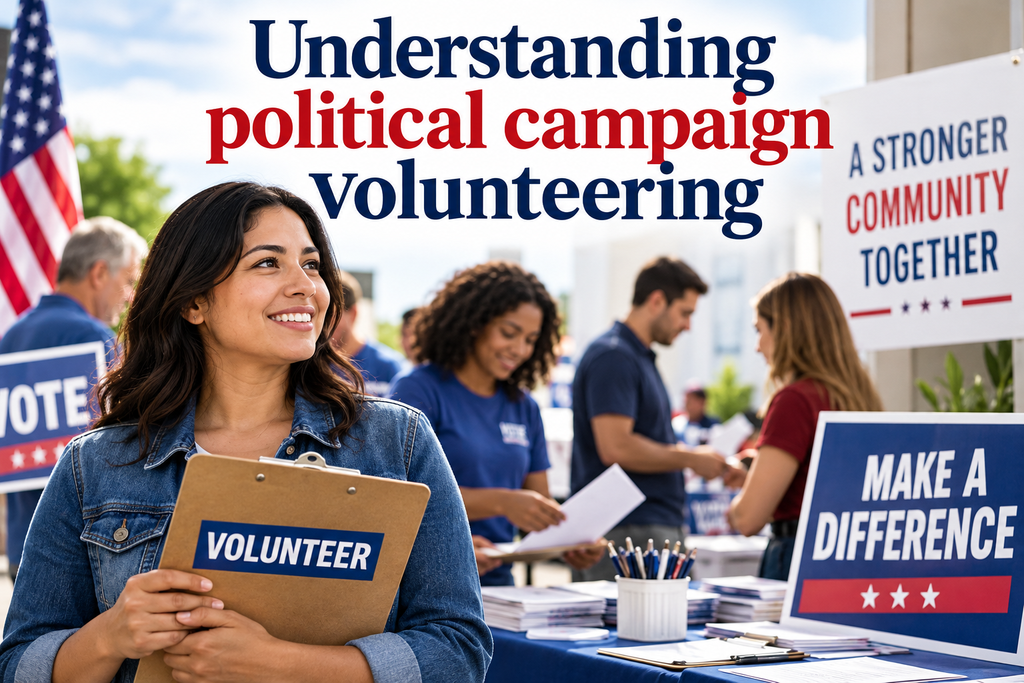
If you show up at a campaign office and say you would like to help, someone will almost certainly hand you a clipboard, a phone, or a stack of flyers within about ten minutes. Political campaign volunteering is mostly ordinary work done in small blocks of time: knocking on doors, calling voters, entering data, setting up chairs. The people doing it are neighbors, students, retirees, and people on their lunch break.
This guide covers what volunteers actually do, how to choose a campaign you can stand behind, what a first shift looks like, and how to start with a commitment small enough to try. For the bigger picture of how campaigns are organized, see what political campaigning is and how it works. This article stays on the volunteer’s side of the table.
Why campaigns depend on volunteers, whichever side they are on
Every campaign has two limited resources: money and time. Money pays for advertising, staff, and software. Time is what turns a list of registered voters into actual conversations, and a small paid staff cannot spend enough of it. A campaign with a few employees and thousands of households to reach needs people willing to do the contact work.
That is true for a presidential race and equally for a school board race, where the whole operation may be a candidate, a part-time manager, and a dozen volunteers. Parties, ballot measure committees, and issue campaigns all run the same way.
Volunteers also give a campaign something money does not buy so easily: a real local person at the door. A voter may ignore a mailer, but a neighbor who stands there and answers a question about the candidate gets a different reception. Campaigns on every side know this, which is why they spend so much effort recruiting and keeping volunteers.
The jobs volunteers really do
Most volunteer work falls into a handful of categories. The tools differ from campaign to campaign, but the tasks are the same across parties and countries.
Canvassing
Canvassing means going door to door, usually with a printed list or a phone app showing which households to visit. You introduce yourself, say who you are working for, ask whether the person has questions, and note the response. Some campaigns also ask you to leave a flyer if nobody answers. It is the most visible volunteer job and the one many newcomers fear most, though most conversations are short and polite.
Phone banks
At a phone bank, volunteers call voters from a list using a script. The goals vary by stage: finding out who supports the candidate, reminding people about an election date, or recruiting more volunteers. Many campaigns run phone banks from an office, and some let you call from home using an online system. If you dislike talking to strangers face to face, this is a common alternative.
Texting
Text campaigns send messages to voters through a campaign-approved platform. Volunteers usually reply to the responses that come in, answering simple questions like where the polling place is. The campaign supplies the messages and the tools, so you do not use your personal phone number in the way you might expect.
Data entry
Everything gathered from canvassing and calls has to be recorded so the campaign knows whom it has already contacted. Volunteers enter results into the campaign’s voter database, check lists for duplicates, and update records. It is quiet, repetitive work, and campaigns rely on it heavily because good records prevent wasted visits and repeat calls.
Events and office support
Campaigns hold rallies, town halls, fundraisers, and meet-and-greets. Volunteers set up rooms, greet guests, run sign-in tables, and clean up. Back at the office, there are envelopes to stuff, yard signs to sort, food orders to place, and visitors to welcome. If you want to help without talking to voters, this category has the most room.
How to choose a campaign: matching your values, your schedule and your comfort level
The first question is whether you actually support what the candidate or cause stands for. Read the candidate’s website, look at their stated positions on the issues you care about, and check what the campaign says about itself. You will be speaking on its behalf, so you should be able to explain your reasons without reading from a card.
Next, consider the level of government. Local races tend to be easier to join: the campaign is small, the people are nearby, and a new volunteer is noticed quickly. National races have more structure and more volunteers, which can mean more training and less individual attention. Neither is better. It depends on whether you prefer a close team or a larger machine.
Then match the work to your temperament. A few questions help:
- Do you prefer talking face to face, speaking on the phone, or working quietly behind the scenes?
- How many hours can you give each week, and are they fixed times or flexible?
- Can you get to the office or the neighborhood, or do you need remote tasks?
- Are you comfortable being publicly associated with this candidate?
That last question matters more than people expect. Volunteering can be visible, and neighbors, coworkers, and relatives may find out. If you are not ready for that, say so when you sign up, because office and data roles tend to be less public than canvassing.
Parties and campaigns also differ from each other, even on the same side. If you want to understand how parties fit into this, what political parties do and how they work explains the structure behind many volunteer programs.
What a first shift usually looks like, from signing in to being trained
Most campaigns ask you to sign up first, either online or by walking in. You give your name, phone number, and email, and often say which kinds of work interest you. A volunteer coordinator then confirms a time. Coordinators are usually busy and friendly, and they are used to people who have never done this before.
When you arrive, you sign in on a sheet or a tablet. You will probably be introduced to the shift leader and to other volunteers. Then comes a short briefing, typically ten to twenty minutes, covering the candidate’s main points, the goal for the day, and the script or talking points you will use.
Training is mostly practice and watching. For canvassing, a new volunteer is often paired with an experienced one for the first few doors, so you can hear how a conversation goes before you try it. For phone banks, you may read the script aloud once or role-play a call. You are shown how to record responses in the app or on the paper sheet, because that record is the main thing the campaign wants back from you.
Then you do the work. A typical shift runs two to three hours. At the end you return your materials, report your numbers, and leave. Many campaigns thank you personally and ask whether you can come back. You can say yes, no, or maybe. Leaving without committing to anything more is normal.
How much time it takes and how to start small
There is no standard requirement. Some people give one afternoon before an election, others spend a few hours every week for months, and a few treat it as a second job. Campaigns generally welcome whatever you can offer, and they often have more work available than people to do it.
A sensible way to begin is a single two-hour shift. That is long enough to see how the work feels and short enough that it does not disrupt your week. Afterward, ask yourself a few things: Did the task suit you? Did the team treat you well? Did you feel comfortable saying what the campaign asked you to say? If so, sign up for another. If not, try a different job or a different campaign.
Timing matters too. Campaigns tend to be busiest in the weeks before voting and in the days leading up to election day, so volunteers are needed most then. If you contact a campaign early, you will usually have more room to learn gradually. If you contact one late, you may be placed on the next shift that needs people, so expect less hand-holding.
To follow how this work fits into the wider election timeline, how elections work, from ballot access to certified results shows where voter contact sits among the other stages.
Rules, manners and safety: representing a campaign, respecting voters and knowing your limits
When you volunteer, people treat you as the campaign’s representative. That brings some responsibilities.
Stay on message and be honest. Use the information the campaign gives you. If a voter asks something you cannot answer, say you do not know and offer to pass the question along. Guessing, or inventing an answer, is worse than admitting you are unsure.
Respect voters’ choices. A voter who says no thanks has answered. Thank them and move on. Do not argue, pressure, or follow up repeatedly. Heated disagreements rarely change anyone’s mind, and they reflect badly on the candidate you are there to help.
Follow the practical rules of contact. If a home has a no-soliciting sign, check with your shift leader about how the campaign wants it handled. Stay on public paths, never go inside a home, and do not touch private property beyond the door. Campaigns also operate under election laws, which differ by place, so use only the materials and tools the campaign provides and ask the coordinator when you are unsure.
Think about your own situation. Some jobs, particularly government employment, limit political activity, and so do certain volunteer arrangements for people under a certain age. Check the rules that apply to you before you commit.
Protect your safety. Canvass in daylight where you can, go with a partner if the campaign suggests it, and carry your phone. If a situation feels unsafe, leave. No voter contact is worth risking yourself, and any reasonable campaign will back that decision. Voter lists also contain personal information, so keep them private and return or delete them as instructed.
Volunteering across the aisle: what you learn about elections from the inside
You do not have to agree with a campaign to learn from watching how it operates, but you should only volunteer for a campaign you support. The useful move for a curious beginner is to notice how much the tasks look alike across parties. Both sides recruit volunteers, build lists, make calls, knock on doors, and track results in databases. Seeing this from the inside makes it harder to believe that one side’s organizing is a mystery while the other’s is ordinary.
Volunteers also meet voters directly, and voters rarely match the stereotypes attached to their party. You hear what people say they worry about: rent, schools, health costs, road repairs, safety. Those concerns often cross party lines even when the preferred solutions do not.
If your views change over time, or you want to understand an opposing camp better, you can volunteer for a different campaign in a later election. Plenty of people do. You can also learn the other side’s perspective without working for them by reading how they describe their own goals, and how news and social media shape political participation offers a useful way to think about where your information comes from.
Other ways to help that are not tied to a candidate
Campaign work is one option among several. If you want to take part in elections without backing a candidate or party, there are other roles:
- Poll work. Local election offices recruit people to staff polling places, check voters in, and help run voting. The requirements, training, and pay vary by place, so check with your local election office.
- Voter registration drives. Nonpartisan groups help eligible people register and check their registration. Look for organizations that state clearly that they do not endorse candidates.
- Voter information and education. Community groups run candidate forums, publish nonpartisan guides to ballot measures, and answer questions about how to vote.
- Issue advocacy. If a cause matters to you more than a candidate does, local groups working on that issue often need volunteers for petitions, meetings, and letters to officials.
- Local government meetings. Attending city council or school board meetings, and speaking during public comment, is a form of participation that needs no campaign at all.
Each of these builds the same understanding of how elections and government work, and you can combine them with campaign work or choose them instead.
Your next step
Pick one local campaign or party office this week, whichever fits your views, and ask what a first two-hour shift would involve. Most will answer within a day or two, and the answer will tell you more about the work than any description can.