
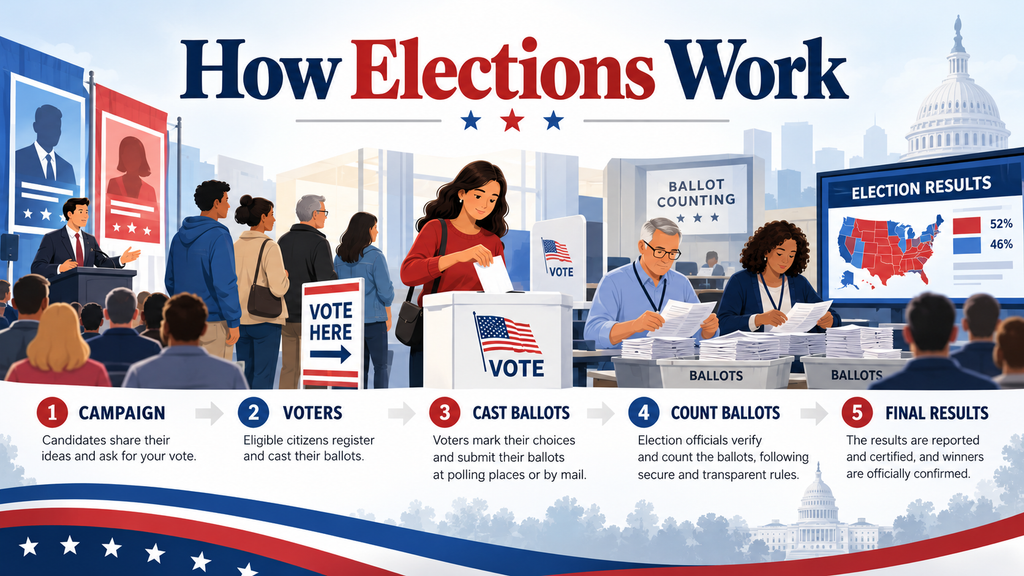
An election is a scheduled, rule-bound way for a community to choose people to hold office or to decide a question directly. The next general election in the United States falls on Tuesday, November 3, 2026, so the question of how do elections work is a practical one for a lot of people right now. The short answer is that an election is a long chain of steps, and most of them happen long before and long after the day people vote.
This guide follows the chain from start to finish, the way a voter meets it: who runs the process, who can vote, how candidates get on the ballot, how ballots are cast, and how the results become official. The United States is the worked example. Where the rules are contested, the arguments on each side are described as their supporters would describe them.
What an election decides, and who runs it
The offices on a ballot depend on the year. In the U.S., every two years all 435 seats in the House of Representatives are up, along with roughly a third of the Senate, since senators serve six-year staggered terms. The presidency is decided every four years. Midterm elections like the one in 2026 fall between presidential years. The same ballot usually carries governors in many states, state legislators, judges, county officials, school boards, and sometimes ballot measures that put a policy question straight to voters.
The people who run all of this are mostly state and local officials, not the federal government. The Constitution gives states the main responsibility for the “times, places and manner” of elections, and Congress can pass laws that override some of those choices. In practice, a state’s chief election official, often the secretary of state, sets statewide procedures. Counties or towns carry them out: they mail ballots, staff polling places, run the machines, and count the votes.
Federal law still shapes the edges. It guarantees certain voting rights, sets the national Election Day, and requires things like accessible polling places. Campaign finance rules for federal races are enforced by the Federal Election Commission. Most of the rules a voter actually experiences, though, come from the state and the local election office. That structure is a version of a broader idea, explained in federal versus unitary governments, where power is split between national and regional levels.
Who gets to vote, and how registration works
To vote in a U.S. federal election, a person must be a citizen and at least 18 by Election Day. The 26th Amendment set the voting age at 18. Beyond those basics, states set residency requirements, which usually mean you vote where you live.
Nearly every state also requires you to register before you vote. Registration puts your name and address on the voter rolls so that election workers know which ballot you should receive and where you vote. North Dakota is the usual exception, since it does not have voter registration. Everywhere else, you register with your state, often online or at the motor vehicle office. Deadlines vary. Some states close registration weeks before the election, and others allow same-day registration at the polls or early voting sites.
Two areas draw real disagreement, and each side has an argument worth knowing:
- Voter identification. Supporters of ID requirements say they help confirm that each voter is who they claim to be and build public confidence in the result. Opponents say documented cases of in-person impersonation are rare, and that some eligible voters have a harder time getting the required ID. States run the full range, from no ID requirement to strict photo ID, and many fall in between.
- Maintaining the rolls. Officials remove people who have moved away or died so the lists stay accurate. Supporters call that basic upkeep. Critics worry that aggressive removal can drop eligible voters by mistake. Federal law sets some limits on how and when states can do it.
Rules about voting after a felony conviction also differ widely by state. In some states a person can vote while incarcerated, in others rights return after release or after finishing a sentence, and in others it depends on the offense.
How candidates get onto the ballot
A name does not appear on a ballot automatically. Each state sets its own requirements, and they differ by office. A candidate usually has to meet the legal qualifications for the job (a minimum age and residency, for example) and then file paperwork. Many states also require a filing fee, a petition with a certain number of voter signatures, or both.
Most candidates for major offices run as the nominee of a political party. Parties exist largely to organize this process: they recruit candidates, raise money, and give voters a recognizable label. The article on what political parties are and what they do covers that role in more depth. Candidates who run outside the major parties, as independents or for smaller parties, generally reach the ballot by collecting petition signatures. The number required varies a great deal, and critics argue that high thresholds protect the two big parties. Defenders say some threshold is reasonable so that ballots stay manageable and every name on them has real support.
Primaries
When several people from the same party want one office, the party’s nominee is often chosen in a primary election. The types differ by state:
- Closed primaries: only voters registered with the party can vote in its primary.
- Open primaries: voters can choose which party’s primary to vote in, regardless of registration.
- Semi-closed primaries: party members vote in their own primary, and unaffiliated voters may choose one.
- Top-two primaries: all candidates appear on one ballot, and the two with the most votes advance to the general election, whatever their party. California and Washington use this approach.
Supporters of closed primaries say a party’s nominee should be picked by its own members. Supporters of open systems say more voters should have a say, especially in places where one party dominates and the primary is the real contest. For president, primaries and caucuses select delegates who then formally nominate a candidate at the party convention.
The campaign season in brief
Once the nominees are set, the campaign period begins. Candidates make their case through speeches, debates, advertising, mailers, door knocking, phone calls, and online outreach. Campaigns also spend a great deal of effort on practical work: finding likely supporters, reminding them to register, and getting them to turn out. Outside groups, including advocacy organizations and political action committees, run their own efforts alongside the candidates.
Campaign rules are another place where the arguments are sharp. Some people believe spending limits and disclosure rules are needed so that money does not drown out ordinary voters. Others see spending as a form of protected speech and worry about restrictions on it. Both positions have a long legal history, and the details change with each court decision and law.
This guide stays at the overview level on purpose. For how campaigns plan, fund, and message, read what political campaigning is and how it works.
Casting a ballot: in person, early and by mail
Voters in the U.S. generally have three ways to cast a ballot, and most states offer more than one.
In person on Election Day. You go to an assigned polling place, usually based on your address, confirm your registration, and mark or feed in a ballot. Polls open and close at hours set by each state, and anyone in line when polls close is generally allowed to vote.
Early in person. Most states let voters cast a ballot at designated sites during a window before Election Day. The length of that window ranges from a few days to a few weeks.
By mail. All states offer some form of mail voting, but the rules differ. Some require an excuse, such as illness or travel. Others let any voter request a mail ballot. A small number of states mail a ballot to every registered voter automatically. Deadlines are a frequent source of confusion: some states count a ballot if it is postmarked by Election Day, while others require that it arrive by then. Check your own state’s rule before you mail anything.
A few related options matter. Military members and U.S. citizens living abroad can vote absentee under federal law. A voter whose eligibility is unclear at the polls can usually cast a provisional ballot, which is counted only after officials confirm the voter was eligible. Polling places must also provide ways for voters with disabilities to cast a private ballot.
The method of voting is separate from the system used to turn votes into winners. Most U.S. elections use plurality voting, where the candidate with the most votes wins, but other countries and a few American cities do it differently. The piece on how different voting systems turn the same votes into different winners explains those alternatives.
After the polls close: counting, canvassing and certification
When polls close, counting begins at the local level. Election workers tally the ballots cast at each precinct and early voting site, and machines or hand counts add up the votes. The totals reported on election night are unofficial. News organizations may announce projected winners based on partial returns and statistical models, but a projection is not a result.
Results often take more than one night, and there are ordinary reasons for that. Mail ballots have to be opened, their envelopes checked, and signatures verified in many states, and state law decides how early that work can start. Some states allow officials to process mail ballots before Election Day, and others do not allow it until the polls open or close. Ballots that arrive after Election Day under a postmark rule are counted later. Close races take longer still.
The official process that follows is called the canvass. Local officials review the returns, reconcile the number of ballots with the number of voters, resolve provisional ballots, and correct clerical errors. Many states also run post-election audits, which check a sample of ballots against the machine counts. If a margin is very narrow, a recount may happen automatically under state law, or a candidate may be able to request one.
Certification is the formal declaration of the final result. Counties typically certify first, then the state certifies, usually through the secretary of state, a state board, or the governor, depending on the state. Deadlines are set by state law. If a dispute arises, courts can review it, and the legal process runs on the same state-by-state timetable.
For the presidency, there is one more layer. States certify their results, and then electors formally cast the votes that decide the winner. That process is covered step by step in the article linked at the end of this guide.
Why the details differ by state and country
The differences above are not accidents. They follow from a federal system in which states run elections, and from a history in which each state developed its own practices. The result is that two neighbors in different states can face different registration deadlines, ID rules, and ways of voting in the same federal election.
Other democracies handle the same tasks differently. Some run elections through a single national election commission and apply the same rules everywhere. Some use proportional representation, where seats go to parties in proportion to their share of the vote. Others hold elections on a weekend or make voting compulsory. In parliamentary systems, voters choose a legislature, and the leader of the government comes from it, which is explained in what a parliamentary system is. Local elections, which often decide the most day-to-day services, have their own rules too, as the introduction to local governments describes.
To check the rules that apply to you, use official sources:
- Your state or local election office. Search for your state’s secretary of state or election division. It lists registration deadlines, ID rules, polling locations, and mail ballot deadlines.
- Vote.gov. The federal government’s site links to registration information for each state.
- Your sample ballot. Local election offices usually publish one before each election, so you can see every race and measure you will be asked to decide.
Questions about elections that people on every side ask
Why does it take so long to get final results? Counting accurately takes time, and rules on when mail ballots can be processed and counted differ by state. Officials generally treat accuracy as more important than speed. Some people want faster results and favor changes to processing rules, while others favor allowing time for every valid ballot to be counted.
Is mail voting secure? Supporters point to signature checks, ballot tracking, and the long use of absentee voting by military voters. Skeptics worry about chain-of-custody and verification, especially when ballots are sent to every address on the rolls. States address these concerns in different ways, and the safeguards they use vary, so it helps to read your own state’s procedures.
Why is Election Day on a Tuesday? Congress set a uniform date for choosing presidential electors in the 19th century, and the date fit the farm calendar of the time. Some people today argue for moving voting to a weekend or making Election Day a holiday to raise turnout. Others say the extended early voting options already cover the need.
Why do so many people not vote? Reasons include work schedules, registration hurdles, distance from polling places, and a sense that a single vote changes little. People disagree about the remedy. Some favor making voting easier, such as automatic registration or longer early voting. Others favor keeping current rules and putting more effort into persuading and informing voters.
Can a ballot measure change the law directly? In many states, yes. Voters can approve or reject proposed laws or constitutional changes without going through the legislature. The article on referendums and initiatives explains how those work.
Ready for the next layer? Read how the Electoral College works, step by step, from Election Day to Inauguration: How the Electoral College Works, Step by Step