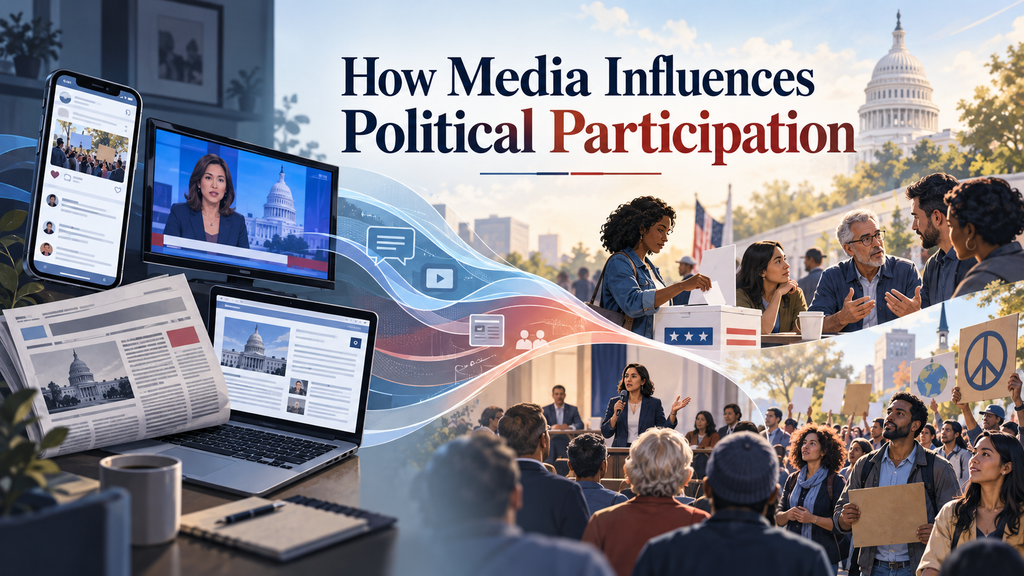
Most people never decide to take part in politics in one big moment. They do it through small acts that depend on what they happened to see, read, or hear first. So how does media influence political participation? It controls what people know about, what feels urgent, who seems to be doing something about it, and whether any of it seems worth the effort.
This article follows those effects one at a time. It uses examples from the left and the right, because the mechanisms work the same way no matter whose side is using them.
What Counts as Political Participation
Voting is the act most people picture, but it is one item on a long list. Political participation covers any action meant to influence who governs or what government does. That includes:
- Registering to vote and actually voting, in every election, not only the presidential one
- Volunteering for a campaign, a party, or a cause
- Donating money to a candidate or group
- Contacting an elected official by phone, email, or letter
- Attending a school board meeting, a city council session, or a town hall
- Signing a petition or collecting signatures
- Joining a march, a rally, or a protest
- Talking about issues with neighbors, coworkers, and family
- Sharing or posting political content online
- Running for office
Choosing not to engage is also a pattern worth understanding. Some people skip elections, some stop reading the news, and some do both. Media plays a part in every one of these choices, which is why it helps to look at the effects separately.
Media as the Front Door
Before anyone can act politically, they need basic information: an election exists, a deadline is coming, a candidate is running, a measure is on the ballot. Most people learn these things through some form of media, whether a local paper, a TV segment, a text from a friend, a campaign ad, or a post in a feed.
This matters most for the parts of the ballot that get little attention. A presidential race fills every channel for months. A county commissioner race, a judge’s retention vote, or a bond measure for a school district may get a few paragraphs in a local outlet, or nothing. Voters who never see coverage of those races often leave them blank or guess.
Campaigns know this and spend heavily to reach voters directly. If you want to see how that works from the inside, what political campaigning is and how it works covers the advertising, canvassing, and messaging side. For the mechanics of what actually happens between registering and results, see how elections work.
The front door also determines who gets in. People who follow the news closely tend to participate more, and people who rarely encounter political information tend to participate less. Access to coverage is therefore a participation issue as well as an information issue. Towns that have lost their local newspaper often have fewer places where a candidate forum, a zoning dispute, or a budget vote gets reported at all.
Agenda Setting and Framing
Media cannot tell people what to think in any simple way, but it has a strong influence on what people think about. Political scientists call this agenda setting. When a topic gets constant coverage, it comes to feel important to the public. When a topic gets little coverage, it fades from view, even if it affects many households.
Agenda setting changes participation because people act on issues that feel urgent. A week of heavy coverage of a crime wave can send people to a city council meeting. A run of stories about rising grocery prices can lead people to contact a representative. Coverage of a court decision can send a flood of donations to groups on either side of the ruling. The same event, covered lightly, might produce none of that.
Framing is the second piece. It is the choice of words, images, and context that shape how a story is understood. The same policy can be described in different ways:
- A tax on large inheritances is called an “estate tax” by some outlets and a “death tax” by others.
- A restriction on abortion may be described as protecting unborn life or as limiting reproductive rights.
- A border policy may be described in terms of security, in terms of humanitarian concerns, or in terms of economics.
Each frame suggests a different kind of response. A story framed as a threat tends to prompt defensive action, like voting against something or donating to stop it. A story framed as an opportunity tends to prompt support for it. Neither side of the political spectrum is free of this. Every outlet and every campaign picks a frame, and noticing the frame is a basic skill for anyone trying to read the news carefully.
When Media Mobilizes
Media gets people moving in several straightforward ways.
Reminders and deadlines. A news story about a voter registration deadline, a change in polling locations, or an early voting window gives people the practical details they need to vote. Many people who do not vote have no objection to voting. They simply did not know the date or the process.
Rallies and movements. Media can turn scattered frustration into organized action. The Tea Party rallies that began in 2009 spread through talk radio, cable news, and early social media. The Women’s March in 2017 grew largely through social media networks. The two movements had opposite politics and used a similar path: coverage and sharing made a large number of people feel that others were acting too, and that made showing up easier.
Petitions and online campaigns. A single link can collect thousands of signatures or donations from people who would never have attended a meeting. These actions take little effort, and critics argue they are shallow. Supporters point out that they bring in people who would otherwise do nothing, and that some of them go on to do more. Both views have some truth.
Social proof. People are more likely to act when people they know are acting. A friend posting about volunteering at a polling place, a neighbor with a yard sign, or a coworker mentioning a town hall tends to make the same action feel normal. Social media makes those signals visible far beyond a person’s physical neighborhood.
Mobilization also works through organizations that rely on media to reach supporters. Lobbying and advocacy groups on every side of the spectrum use email lists, social posts, and press coverage to push members to call or write to lawmakers.
When Media Demobilizes
The same system that gets people involved can also push them away.
News fatigue. Constant coverage of conflict, scandal, and crisis wears people down. Many readers respond by cutting back on news entirely, and if the news was their main link to politics, their participation often falls with it. Fatigue happens to people of every political leaning, usually when a topic they care about stays in the headlines for a long time without visible resolution.
Cynicism. Coverage that focuses on strategy, polls, and the horse race, as opposed to policy and results, can leave the impression that politics is a game played by insiders. If a voter believes every politician is acting only for advantage, voting or volunteering feels pointless. Stories about corruption, even accurate ones, can have a similar effect when they are not paired with stories about how people fixed a problem.
Helplessness. Large national stories can make local action seem trivial. A person who spends an hour reading about a distant, unsolvable problem may feel less inclined to attend a meeting about a problem on their own street, even though the meeting is where their voice counts for more.
Disgust with the tone. Heated, insulting, or hostile coverage and commentary can lead people to withdraw rather than argue. People who dislike conflict often drop out of political conversations altogether, which leaves the conversation to those who are most intense about it.
The common thread is that media can leave people informed but unable to see a useful action. Information without a next step tends to produce stress more than participation.
Social Media, Algorithms, and the Echo Chamber Question
Social platforms decide what appears in a feed using signals like what a person has liked, shared, watched, or lingered over. Those systems are built to hold attention, and content that provokes strong emotion tends to hold it well. That affects participation in two ways: emotional posts spread quickly and can drive action, and constant exposure to outrage can push the same people toward exhaustion.
The echo chamber concern says that people end up seeing only views they already agree with. Both the left and the right worry about this, and each often believes the other side’s feed is the problem. The evidence is more mixed than the popular version. Many people do encounter opposing views online, and some studies suggest that seeing the other side can sharpen disagreement instead of softening it. People also shape their own feeds by choosing whom to follow, which matters as much as anything the algorithm does.
Both sides have well-developed media ecosystems: cable channels, podcasts, newsletters, forums, and creators who speak to their own audiences. Inside those ecosystems, participation can grow, because people are surrounded by others who share their concerns and encourage action. The risk is that people see the opposing side only through the weakest or most extreme examples, which can make compromise and conversation with neighbors harder.
A fair summary is that social media makes it easier to join and easier to burn out, and which of those happens depends on how a person uses it.
Healthy Media Habits That Make Participation Easier
Staying informed does not require following every story. A few habits make it easier to take part without wearing out.
- Follow local news. Local coverage reports on school boards, zoning, county budgets, and city elections, which are the places where one person’s involvement has the most effect. If a local outlet charges for access, one subscription may be worth more to a participating citizen than several national ones.
- Compare sources on the same story. Read how at least two outlets with different leanings cover the same event. Notice which facts both include, which only one includes, and which words each chooses. Differences in framing become easier to spot.
- Set a limit. Pick a time of day for news and stop afterward. Checking continuously raises stress without adding much knowledge.
- Attach one action to what you read. If a story concerns a bill, look up your representative’s contact page. If it concerns an election, check your registration. A small action turns information into participation and counters helplessness.
- Go to the source. When a story describes a bill, ruling, or budget, find the document or the official summary. Understanding how a bill becomes a law also shows you where in the process an action by a citizen can count most.
- Adjust your feed on purpose. Follow a few accounts that report facts plainly, mute accounts that mainly produce anger, and add a source or two from outside your usual circle.
- Talk with people in person. A conversation with a neighbor usually involves more listening and less performance than an online argument, and it keeps politics tied to real people.
None of these habits requires a particular political view. They work for anyone who wants to keep up with public life while still having energy left to act on it.
Ready to put this into practice? Read my Ground News review to see one tool I use to compare how different outlets cover the same story: Ground News review: why it is my pick for reading politics