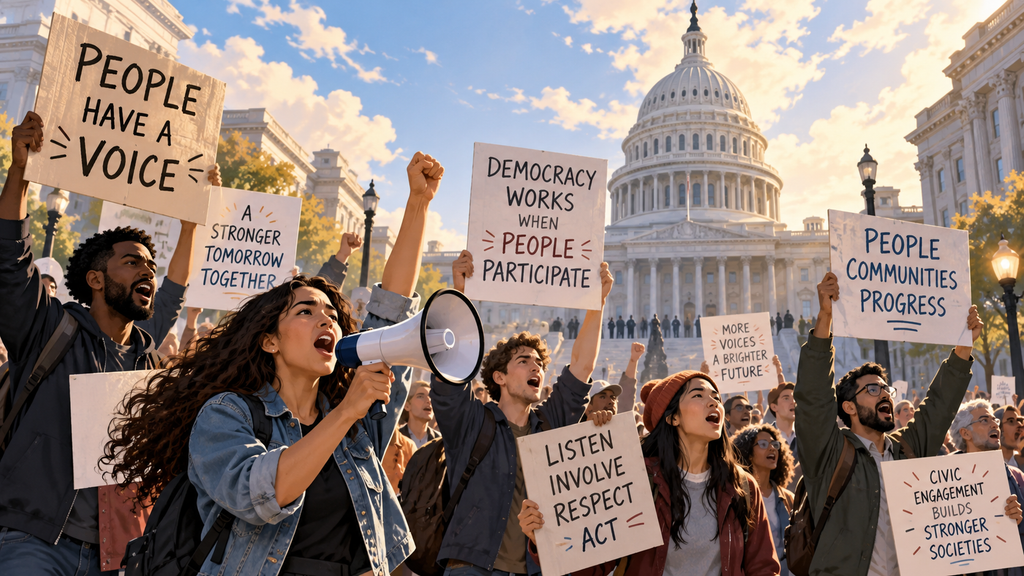
Voting is the main way citizens shape a democracy, yet people still gather in streets, carry signs and sit outside government buildings. That can look redundant, or even like a failure of the system. A better way to see it is that protest is one tool among several, with a specific job that voting, lobbying and lawmaking do not do well. Understanding the role of protest in politics means looking at what a demonstration accomplishes on the day and what it sets in motion afterward.
This article covers the legal basis for protest in the United States, what protests can and cannot do, examples from both the left and the right, and a few questions that help you judge any protest fairly, whoever is marching.
Why people protest when voting already exists
Elections are infrequent and blunt. In the United States, most federal officials face voters every two, four or six years, and a single ballot choice bundles dozens of issues together. Someone can vote for a candidate because of the economy while disagreeing with that candidate on immigration, policing or abortion. The result tells you who won, not which positions the voters actually wanted.
Voting also counts every person equally, which is the point of it, but it cannot show how strongly anyone feels. A voter who mildly prefers one policy and a voter who has organized their whole life around the issue each cast one ballot. Protest is one of the ways intensity becomes visible. Taking a day off work, traveling to a capital and standing outdoors costs something, and officials read that cost as information.
There is also the matter of timing. If a city council is about to vote next Tuesday, the next election may be a year away. A group that wants to be heard before the vote needs a tool that works between elections.
Finally, some people have been shut out of voting at various points in history, and others hold views that rarely win majorities. Protest gives those groups a way to put their case in front of the public and officials when the ballot box alone would not.
The right to protest: what the First Amendment protects, and where the limits are
The First Amendment says Congress shall make no law abridging freedom of speech, or the right of the people peaceably to assemble and to petition the government for a redress of grievances. Courts have applied these protections to state and local governments as well. In practice, that means you generally have a right to march, rally, hold signs and chant in public spaces such as streets, sidewalks and parks.
The key word is “peaceably.” The protection covers peaceful assembly and expression, and it comes with limits that courts have recognized over time:
- Time, place and manner rules. Governments can set reasonable, content-neutral rules, such as requiring a permit for a large march that closes streets, setting noise limits, or keeping protesters from blocking building entrances. The rules cannot be written or applied to favor one message over another.
- Incitement and true threats. Speech intended and likely to produce imminent lawless action, and genuine threats against specific people, are not protected.
- Violence and property damage. Assault, vandalism and arson are crimes whatever the cause behind them.
- Private property. The First Amendment restricts the government. A private business, a private university or a private employer is generally not bound by it in the same way, and trespassing rules apply.
These rules vary in their details from city to city and state to state, so anyone planning to take part should check the local permit requirements and the rules for the specific location. Nothing here is legal advice, but the general shape is worth knowing: peaceful public protest is broadly protected, and the limits are about how, where and whether it stays peaceful, not about which side is speaking.
What a protest can actually do
A demonstration does its work in three main ways, and they are easiest to understand separately.
Signalling
A protest tells officials, parties and the public that a group of people cares about an issue enough to act. Size matters, but so do persistence and breadth. A crowd drawn from many regions, ages and backgrounds signals more than a crowd from one neighborhood. Repeated events signal more than a single day. Officials who want to keep their jobs treat these signals as a rough preview of voter behavior.
Agenda-setting
Governments and legislatures cannot handle every issue at once, and the list of what gets attention is limited. Protest can move an issue up that list. Coverage by news outlets, conversation on social media and questions put to candidates all follow a visible demonstration. An issue that was easy to ignore becomes one that officials have to say something about, even if they say no.
Pressure on officials
Protest can raise the political cost of inaction. An elected official who sees large, organized, angry constituents has to weigh whether ignoring them will hurt in the next election or in the next news cycle. Protest can also create costs of a different kind, such as disrupted business or strained police resources, which push officials to negotiate. Whether this pressure is applied fairly or heavy-handedly is a fair debate, and it is one reason people disagree about particular tactics.
A protest also does something for the people who attend. It builds contact lists, introduces strangers who share a goal and trains volunteers. Those people and lists are often what carries the cause forward after the march ends.
Protests people on the left and the right both recognise
Protest is used across the political spectrum, and looking at examples from both sides makes that plain.
- The March on Washington, 1963. Civil rights organizations gathered hundreds of thousands of people in the capital to call for jobs and freedom. Congress passed the Civil Rights Act the following year. Historians weigh many factors in that outcome, but the march is a standard example of a demonstration that shaped a national debate.
- The March for Life. Opponents of legal abortion have gathered in Washington every year since the 1970s, usually around the anniversary of the Roe v. Wade decision. It is a long-running example of protest as sustained pressure: decades of annual events alongside legal, legislative and electoral work, and the Supreme Court overturned Roe in 2022.
- The Tea Party rallies, beginning in 2009. Demonstrators gathered across the country to oppose federal spending and the health care law. Many participants then moved into primary elections and local party organizations, which shows a protest movement entering the electoral system.
- The Women’s March, January 2017. Large marches took place in Washington and in cities around the country the day after the presidential inauguration. Organizers and participants later pointed to volunteering and candidate recruitment as follow-ups, another example of street activity feeding into campaigns.
- Gun policy demonstrations. Students and families have marched for stricter gun laws, and gun-rights supporters have held rallies at state capitols against them. Each side uses the same tool for opposite goals.
The tactics, language and causes differ a great deal. The underlying logic is the same: a group wants officials and neighbors to see how many people share a view, and to see it between elections.
How protest connects to lobbying, coalitions and elections
A protest rarely changes a law on its own. It usually feeds into slower channels where decisions are actually made.
Lobbying. Organized groups employ people to meet with legislators and agency staff, supply information and push specific wording in bills. A large protest can make those meetings easier to get, since an official has seen evidence of public interest. The reverse also happens: lobbyists often help organize the rally. For a closer look at that channel, see what lobbying actually is and how every side uses it.
Coalitions. A single group seldom fills a national mall. Marches usually bring together many organizations, such as unions, churches, advocacy groups and local clubs, each contributing members and money. Those same partnerships can then work together on legislation. The article on coalitions and alliances in politics explains how that teamwork is organized.
Elections. Officials respond to the possibility of losing their seats. Protest can show that a group is large and motivated enough to matter at the polls, and organizers often follow a demonstration with voter registration drives, candidate endorsements and volunteer recruitment. If you want the full picture of the voting side, how elections work covers the process from the ballot to certified results.
Seen this way, the march is the visible moment in a longer chain. For a sense of how an issue moves through that whole chain, how political decisions get made follows one issue from problem to policy.
Why some protests change policy and others fade
No formula guarantees success, and historians and political scientists continue to argue over cause and effect. Still, several patterns show up repeatedly.
- A specific demand. “Pass this bill” or “reverse this rule” gives officials something to say yes or no to. A general expression of anger is harder to answer.
- Organization that outlasts the event. Groups with staff, members and a plan for the next month can keep pressure on. A one-day crowd with no follow-up usually disperses.
- A target with the power to act. A protest aimed at the body that can actually change the policy has better odds than one aimed at an official with no authority over it.
- Breadth of support. Demonstrations that draw people beyond the already committed show that opinion is shifting, and they are harder to dismiss.
- Sustained attention. Repeated action over months or years carries more weight than a single peak.
- Public sympathy. Disruptive tactics can win attention, but they can also cost goodwill. Violence at an otherwise peaceful event often shifts the news coverage and the public conversation to the violence.
- Opposition and timing. A counter-movement, a divided legislature or a crowded political calendar can all blunt a protest that was well run.
A protest that fades has not necessarily failed completely. It may have shifted public opinion slowly, trained organizers who succeed later, or put an issue on the agenda that other actors then took up. Results can show up years afterward, and often in forms the original marchers did not expect.
How to judge a protest fairly, and how to take part or watch with a clear head
Whether you agree with a cause or not, a few questions help you assess any demonstration on the same terms.
- What exactly are they asking for? Look for a stated goal and who has the power to deliver it.
- Who is organizing it, and who is attending? Crowds are usually a mix of people with different motives, and a few loud voices rarely represent all of them.
- How big was it, according to more than one source? Crowd estimates often differ between organizers, police and independent counters, and each has reasons to lean one way.
- What happens next? Watch for lobbying, candidate recruitment or legislation in the following weeks, because that shows whether the event was part of a plan.
- Would you apply the same standard to a protest you disagree with? If a tactic bothers you on one side, check whether it bothers you equally on the other.
How you hear about a protest also shapes what you think of it. A single photo or a short clip can make a peaceful crowd look chaotic or a small crowd look huge. Reading several outlets and comparing their accounts helps, and how the news and social media you use shape political participation goes into why.
If you decide to take part, a few practical points apply to almost any event:
- Check local permit rules and the route or location, and read what the organizers say about expected conduct.
- Know the difference between public and private property.
- Bring water, a charged phone and a plan for getting home.
- Decide in advance what you will do if the event turns tense, and be ready to leave.
- Remember that attending is a start. Writing to officials, registering to vote, joining a group and showing up for local meetings are the follow-ups that carry weight.
If you would rather watch, the same habits apply. Treat the first reports with caution, wait for fuller accounts, and look for what the people involved actually say they want. Protest is one of the few political tools open to anyone who is willing to show up, and it is easier to judge once you can see where it fits among the others.