
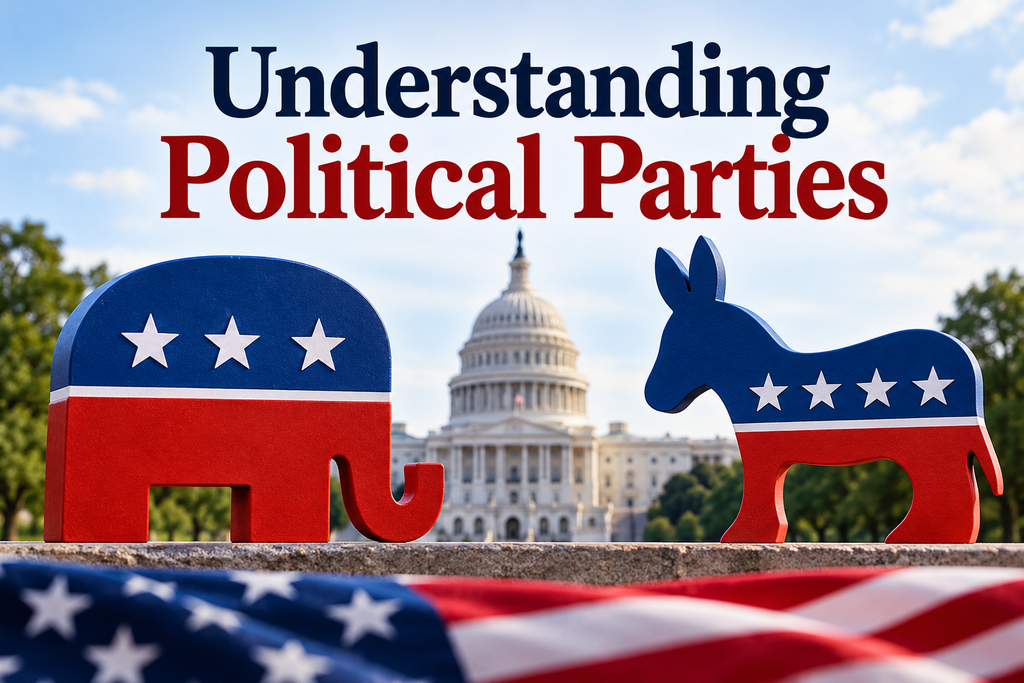
If you have ever wondered what political parties are and what they do, the short answer is that they are organizations built to win elections and then use the result to run a government or influence one. They are also among the most misunderstood parts of politics, because most coverage treats them as teams with fans and rivalries. A calmer way to look at them is as institutions with a job description.
This guide covers what a party is, the work it does between elections, why democracies end up with them, and how different systems arrange them. It also shows how to read a party’s platform without being steered by it.
What a political party actually is, in plain language
A political party is a lasting organization of people who share broad goals and compete for public office under a common name. Members raise money, choose candidates, write a statement of priorities, and try to win enough seats to put those priorities into practice.
That separates a party from an interest group. A party puts candidates on the ballot under its own label and takes responsibility for governing if it wins. An interest group, such as a teachers’ association or a business council, tries to influence decisions but does not usually run candidates under its own name.
Parties are also broader than a single issue. A group focused on one cause can become a party, but to function as one it has to take positions on taxes, health, security, schools and everything else a government handles.
The five jobs every party does behind the scenes
Parties differ in ideology, but nearly all of them do the same five kinds of work.
- Recruiting and selecting candidates. Someone has to find people willing to run for city council, state legislatures and national office, and decide which of them gets the party’s backing. Much of this happens long before voters see a ballot.
- Bundling issues into a platform. No voter has the time to evaluate hundreds of policy questions. A party packages positions into a recognizable set, so a voter can get a rough sense of a candidate from the party label.
- Organizing and mobilizing voters. Registration drives, door knocking, phone banking and reminders about polling places are party work. Turnout does not happen on its own.
- Running campaigns and raising money. Advertising, events, polling, staff and legal compliance all cost money, and parties coordinate much of that spending and expertise for their candidates.
- Governing, or acting as the opposition. The winning party tries to pass its agenda and manage the government. The losing side questions that agenda, proposes alternatives and tries to be ready for the next election. Opposition is a formal and useful role in most democracies.
When people say a party “did nothing,” they are often looking at only one of these jobs, usually the last. Most of the other four go on year-round.
Why parties exist at all: what elections look like without them
Imagine an election in which no candidate has a party label. Every candidate would be a stranger. Voters would have to research each person’s views on every issue, and there would be no shorthand for who is likely to vote which way.
The legislature would face the same problem after the election. If every member arrived independent of any group, a majority for any bill would have to be assembled from scratch each time. That is slow, and it makes it hard for voters to know whom to hold responsible for the outcome.
Parties solve both problems. They give voters a shortcut and give legislators a ready-made way to organize. The shortcut has costs, because a label can hide real differences between candidates, but the alternative is a heavy burden of information on every voter.
Early American leaders disliked the idea. George Washington warned against the “spirit of party” in his farewell address, yet organized parties emerged within a few years of his presidency. This pattern repeats across democracies: wherever people compete for votes and need to govern together, parties tend to form.
Some local elections are officially nonpartisan, with no party shown beside candidate names. Even there, voters often rely on endorsements and informal groups that do the same sorting job.
Two-party, multi-party and one-party systems compared
The number of parties that matter in a country depends heavily on how its elections are set up.
Two-party systems
The United States is the best-known example. Most legislative seats are won in single-member districts where the candidate with the most votes wins. Under that rule, voters often feel that backing a small party wastes their vote, so support concentrates in two large parties. Political scientists call this tendency Duverger’s law. Smaller parties still exist, but they rarely win many seats.
Multi-party systems
Many countries use proportional representation, in which parties win legislative seats roughly in line with their share of the vote. Small parties can win seats, so voters have more choices. The tradeoff is that no single party often wins a majority, so parties must negotiate to form a government. Countries such as the Netherlands and Israel are commonly cited examples. If you want to see how this plays out in a legislature that selects its leader from within, the piece on what a parliamentary system is is a useful companion.
One-party systems
In a one-party system, a single party holds power by law or in practice. China, Vietnam and Cuba are examples. Elections, where they are held, do not offer a real choice of who governs, and the party and the state are closely intertwined. Whether you call this a political party in the same sense depends on what you think the term requires, because it does not compete for power in the way the first two systems do.
No arrangement is neutral. Each one shapes which voices get heard, how quickly governments can act, and how easily voters can remove those in power.
Inside a party: platforms, primaries, committees and the people who run them
A party is a structure with several layers, and most of the work is done by people the public never sees.
- The platform is a written statement of the party’s goals and positions. In the United States, national conventions adopt a platform every four years.
- Primaries and caucuses are the contests that decide who becomes the party’s nominee. Rules vary by state and by party. Some primaries are open to any registered voter, and others only to registered party members.
- Committees run the organization. The Democratic National Committee and the Republican National Committee handle national fundraising, convention planning and coordination, and state and local committees do the same work closer to home.
- Local organizers and volunteers staff phone banks, register voters and host candidate events. County and precinct leaders are often the first contact a new voter has with a party.
- Party leaders in the legislature decide who sits on which committee, which bills reach the floor, and how members are encouraged to vote.
In many other countries, members choose the party leader directly, and that leader becomes a candidate for head of government. The details differ, but the pattern is the same: a mix of paid staff, elected officials and volunteers keeps the machine running.
How to read a party platform without taking the bait
A platform is a persuasive document. It is written to attract voters, so it helps to read it deliberately. These habits work for any party, in any country.
- Read the primary document. Summaries and commentary add interpretation. The party’s own text shows what it says it wants.
- Look for verbs and specifics. “Strengthen the economy” is an aspiration. “Reduce the tax rate on small businesses” is a proposal you can check. The more specific the commitment, the easier it is to judge later.
- Separate goals from methods. Two parties may share a goal, such as lower health costs, and disagree entirely about how to reach it. Note both parts of each statement.
- Notice what is missing. Silence on a topic tells you something about priorities, and so does the order in which topics appear.
- Compare platforms side by side. Read each party’s section on the same subject one after the other, such as housing or energy, and note where the real disagreement lies.
- Watch for loaded language. Words chosen to trigger approval or alarm are signals about audience, and they carry little information about policy.
- Check platform against record. If the party has held office, see what it did with similar promises. Neither a promise nor a record settles the question alone, but the two together are more informative.
Many platform promises become what is known as public policy only if they survive negotiation, budgets and legal review. The article on what public policy is explains how ideas move from statement to practice.
Where parties meet the rest of the system: coalitions, lobbying and the lawmaking process
Winning an election is the start of the process, not the end. Once in office, parties work within the legislature and alongside outside groups.
In a legislature, party leaders organize their members, schedule votes and negotiate with the other side. When no party has a majority, parties form coalitions to govern together, which means agreeing on a shared program and dividing up government roles.
Outside the legislature, organizations press their case on lawmakers of all parties. That activity is called lobbying, and it is legal and common in many countries. The piece on what lobbying actually is covers how it works and how every side uses it.
A party’s agenda also has to pass through the formal steps of lawmaking. In the United States, most bills stall along the way, and party control of each chamber and of the presidency changes how far an idea can travel. The walkthrough of how a bill becomes a law shows where those stopping points are.
When one party controls the presidency and both chambers of Congress, it can move faster. When control is split, compromise or stalemate is more likely. Neither outcome is automatically good or bad, but knowing which situation exists helps you judge what a party can realistically deliver.
Being a thoughtful voter when you don’t fit neatly into one party
Many people agree with one party on some issues and another party on others. That is normal, and a party label is only a bundle of positions, not a test of identity.
Some practical approaches:
- Vote by issue and candidate, not only by label. A candidate may differ from the party’s typical position, and the record often shows how.
- Rank your priorities. If you care most about two or three issues, see which candidate or party addresses them most concretely, then accept that no choice will match you on everything.
- Pay attention to local races. City councils, school boards and county offices often shape daily life directly, and the choices there are sometimes less tied to national party divisions.
- Learn your local rules. Voter registration, primary eligibility and party affiliation requirements differ by state and country. Your election office’s website explains what applies to you.
- Consider independent or third-party options. Understand how your system treats them, including the tradeoffs described earlier, and decide with that in mind.
- Read sources from more than one direction. Reading how different outlets describe the same event shows what is fact and what is framing.
Feeling that you don’t belong to a single party is not a lack of political knowledge. It can simply mean you are weighing the issues yourself.
Parties are one half of the picture. The other half is what they do once they are in the room together. To see how parties and groups team up to pass laws and run governments, read the next post, An Overview of Coalitions and Alliances: How Political Groups Team Up to Get Things Done.