
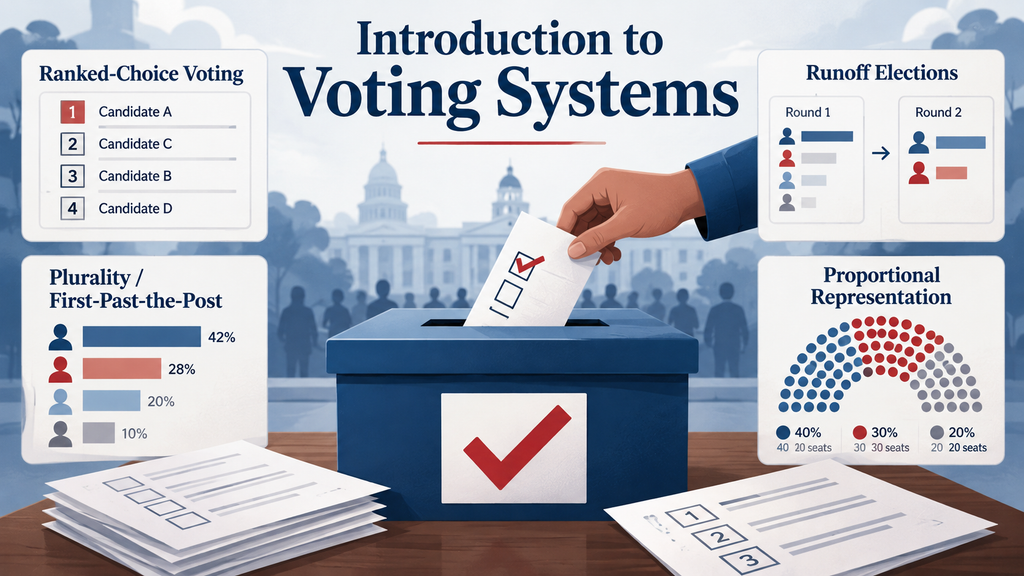
Two towns can cast exactly the same ballots and elect different people. The only difference is the counting rule. That makes the types of voting systems more than a technical footnote: the rule decides what a vote can say and how votes combine into a winner.
This article follows one imaginary election through the main families of systems, so you can watch the rules change the outcome. It does not recommend any of them. Each one has supporters on the left, right and center, and each makes trade-offs that are worth seeing clearly.
Here is the town. It has 100 voters and four candidates for one open seat: Ana, Ben, Cora and Dev. Each voter has a full ranking in mind, even if the ballot only lets them mark one name. The rankings fall into four groups:
Group Voters Ranking, first to last A 30 Ana, Ben, Cora, Dev B 28 Ben, Cora, Ana, Dev C 22 Cora, Dev, Ben, Ana D 20 Dev, Cora, Ben, Ana
Nobody changes their mind in what follows. Only the counting changes.
The simplest system: plurality, or first past the post
In plurality voting, each voter picks one candidate and the candidate with the most votes wins. No minimum share is required. This is why it is also called first past the post: there is a finish line only in the sense that someone has to be ahead.
In our town, voters mark their first choice. Ana gets 30, Ben 28, Cora 22 and Dev 20. Ana wins with 30 percent of the vote, and 70 percent of the town preferred someone else.
Supporters of plurality point to its simplicity. A ballot takes seconds to mark, the count is easy to explain and check, and the result is available quickly. Many also value that it usually gives each district one clearly identifiable representative who answers to that area. Critics point to the 30 percent winner, and to a related problem: if two similar candidates split the same voters, a third candidate can win over both of them. Voters who expect this sometimes vote for a less-preferred candidate who has a better chance, rather than their true favorite.
Plurality is widely used in practice. It elects the UK House of Commons, Canada’s House of Commons and India’s lower house, and it is the usual method for US congressional elections. In most US states, the presidential race is also a plurality contest inside each state: the statewide winner takes all of that state’s electoral votes. How that can produce a national result different from the national vote total is covered in why a candidate can win more votes and still lose the presidency.
When a majority is the goal: runoff elections and two-round voting
A runoff system sets a higher bar: the winner needs more than half the votes. If nobody clears it in the first round, the top two candidates go to a second election a few weeks later.
Apply that to the town. Round one gives the same numbers as before, and nobody is above 50. Ana and Ben advance. Now voters choose between those two, and we assume they follow their rankings:
- Group A (30) prefers Ana to Ben.
- Group B (28) prefers Ben.
- Group C (22) ranks Ben above Ana.
- Group D (20) also ranks Ben above Ana.
Ben wins the runoff 70 to 30. The same first-round votes that made Ana the plurality winner produce a different winner once a second round is added.
Supporters argue that the winner can say a real majority chose them over the only remaining alternative, and that the first round lets voters back a favorite without worrying about wasting the vote. Critics note that a second election costs money and asks voters to return to the polls, and turnout in the second round can differ from the first, so the electorate that decides is not always the one that started. Our table assumes everyone shows up again, which real elections never fully deliver.
France elects its president this way. Some US states also use runoffs for certain primaries or general elections, with rules that vary by state.
Ranked choice voting: ranking candidates instead of picking one
Ranked choice voting, also called instant runoff voting, tries to hold the runoff on a single ballot. Voters rank candidates in order of preference. If no one has a majority of first choices, the candidate with the fewest votes is eliminated and each of their ballots moves to the next-ranked candidate still in the race. This repeats until someone has a majority of the ballots still counted.
Here is the town again:
- Round one: Ana 30, Ben 28, Cora 22, Dev 20. No majority, so Dev is eliminated.
- Round two: Dev’s 20 voters ranked Cora second, so Cora rises to 42. Ana has 30 and Ben has 28. Ben is now last and is eliminated.
- Round three: Ben’s 28 voters ranked Cora second, so Cora reaches 70 against Ana’s 30.
Cora wins. That makes three systems and three different winners from the same 100 voters: Ana under plurality, Ben under a runoff, and Cora under ranked choice.
The reason is that a runoff only keeps the top two after round one, while ranked choice removes one candidate at a time and passes their ballots along. Ben made the runoff because he was second in first choices, but in ranked choice he was only slightly behind Ana when Dev’s votes moved, and Cora overtook both.
The town also shows something critics of ranked choice point to. Compare Ben with each rival one on one: he beats Ana 70 to 30, Cora 58 to 42 and Dev 58 to 42. A candidate who would win every head-to-head contest was eliminated, because the counting looks at first choices before it looks at second ones. Supporters of ranked choice respond that this kind of outcome depends on a particular spread of preferences, and that the system still ensures the winner holds a majority of the ballots left in the final round and removes the pressure to vote strategically for a front-runner. Both descriptions are accurate about different things, which is why the argument continues.
In practice, Australia uses a ranked ballot to elect its House of Representatives. Ireland uses a ranked ballot too, in a multi-seat form called the single transferable vote, which is a proportional variant. In the United States, Maine uses ranked choice for many of its elections, Alaska has used it in statewide contests, and New York City uses it in its municipal primaries.
Proportional representation: seats that mirror vote share
The systems above elect one person per district. Proportional representation (PR) starts from a different goal: when a body has many seats, each party’s share of seats should roughly match its share of votes.
Suppose the town elects a council of 10 seats, and voters choose a party list headed by each candidate. The vote shares are 30, 28, 22 and 20 percent. Dividing the seats in proportion gives 3, 2.8, 2.2 and 2.0. Each party takes its whole number first (3, 2, 2 and 2, which is 9 seats), and the last seat goes to the largest remaining fraction, which is Ben’s party at 0.8. The final council is Ana’s party 3, Ben’s party 3, Cora’s party 2 and Dev’s party 2.
Now compare a hypothetical in which the same town is cut into ten single-member districts, each with the same mix of voters as the whole town. Under plurality, Ana’s party would win every district with 30 percent in each, and take all 10 seats. The votes are identical in both cases, but the plurality count turns a 30 percent share into 100 percent of the seats, while PR turns it into 30 percent.
Supporters of PR say it gives smaller groups a voice and reduces the number of votes that elect nobody. Critics raise a few points. Because no party usually wins a majority alone, governments are often formed by coalitions negotiated after the election, so voters may not know in advance which parties will govern together. The representative-to-district link is also looser. Many PR systems set a minimum vote share for a party to win any seats, and the level varies by country, which affects how small a party can be and still be represented.
The Netherlands and Israel use list-based PR for national elections, and variations are common across Europe and elsewhere. The coalition-building that tends to follow PR elections is covered in an overview of coalitions and alliances.
Mixed systems and where you can find each kind in practice
Some countries combine both ideas. In a mixed-member system, voters usually get two votes: one for a local representative chosen by plurality, and one for a party that sets the overall balance. Seats from the party vote are used to bring the final totals closer to proportional. Germany and New Zealand use versions of this, which they call mixed-member proportional.
The reason to mix is that each half has something the other lacks. Local districts give voters a named representative to contact, and the party vote keeps the overall result in line with national support. The cost is a more complicated ballot and a rulebook that takes longer to explain, which some critics say makes the system harder for voters to follow.
A quick map of where each family appears:
- Plurality: UK House of Commons, Canadian House of Commons, India’s lower house, US congressional elections.
- Runoff: French presidential elections, and certain US state contests.
- Ranked choice: Australia’s House of Representatives, Maine, Alaska, New York City primaries, with Ireland’s single transferable vote as a proportional version.
- List proportional representation: the Netherlands, Israel.
- Mixed-member: Germany, New Zealand.
Even inside one country, different offices can use different systems, and the rules can change over time through legislation or ballot measures. If you want to know what applies to you, your state or national election authority publishes the rules for each office.
The trade-offs every system makes
No counting rule delivers every goal at once. The table in our town showed that each system answers a slightly different question:
- Plurality asks who has the most support, and accepts that the winner may have less than half.
- Runoffs ask who a majority prefers between the two leaders, at the price of a second election.
- Ranked choice asks who a majority prefers after weaker candidates drop out, at the price of a more involved count and the head-to-head quirk shown above.
- Proportional representation asks that seats reflect the full spread of opinion, at the price of coalition bargaining and a looser tie to one local representative.
Behind these sit a handful of values that people weigh differently: simplicity, majority support, fair representation for smaller groups, stable government, and a direct link between a voter and a representative. Someone who values a clear, single winner may prefer plurality. Someone who values broad representation may lean toward PR. People across the political spectrum land in different places on that list, and often not where their party affiliation would predict.
Questions worth asking about any system, including your own:
- Can a candidate win without majority support, and does that matter for this office?
- Can similar candidates split the vote and hand victory to someone neither group prefers?
- How many votes elect nobody, and how many seats would change if the rules were different?
- Does the system encourage voters to back their true favorite, or the likeliest winner?
- Who forms the government, and are they decided before or after the vote?
- How easy is the count to explain, audit and trust?
The answers will not agree with each other. Asking all of them keeps a debate about “the best system” tied to what each person wants an election to do.
Where to go next: how these systems connect to the Electoral College, parties and parliaments
Voting systems rarely work alone. They shape how many parties exist and how they behave, since the rules that reward a close two-way race differ from those that reward smaller groups. They also interact with how a government is built. A parliament that picks its leader from the legislature, as described in what is a parliamentary system, is often paired with proportional or mixed rules, though plurality-based parliaments exist too. And the role of parties themselves, from organizing candidates to forming coalitions, is explored in understanding political parties.
The Electoral College is one specific American case. It layers a state-by-state counting rule on top of a national office, so the winner of the presidency is decided by electors, not by adding up every vote in the country. Most states count their own presidential votes by plurality, which is the first system in this article applied inside fifty separate contests.
Read next: how the Electoral College works, step by step, from Election Day to Inauguration.