
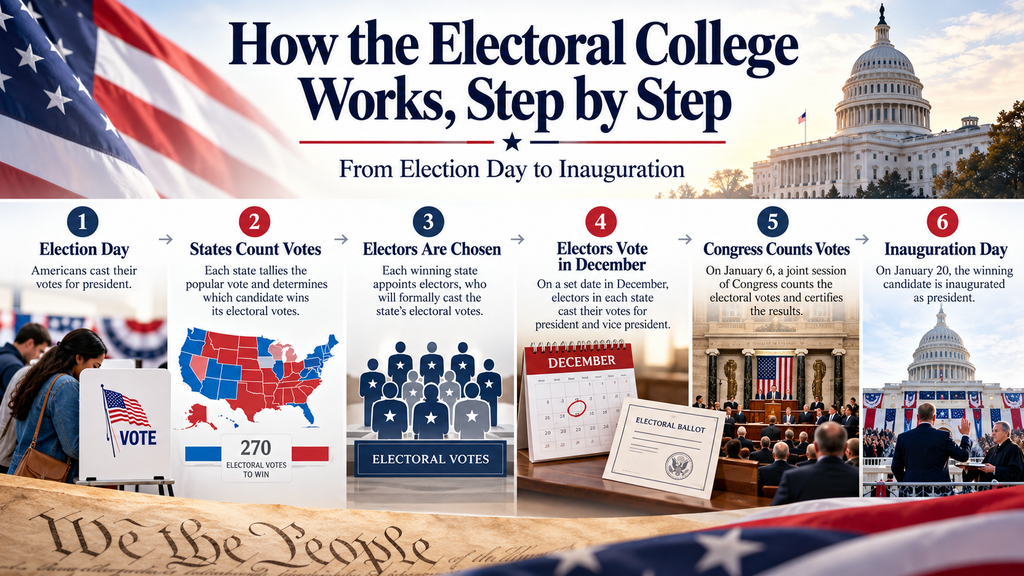
If you have ever wondered how the electoral college works, the easiest way to follow it is as a calendar. A US presidential election is a chain of events that stretches from party decisions made before the campaign to an oath taken in late January. Each link has its own rules, and each one happens in a fixed order.
This guide walks through seven steps in the order they happen. Where a step has more detail than a beginner needs, there is a link to a deeper piece.
The short version: you vote for electors, not directly for a president
When you vote for a presidential candidate in November, you are choosing a group of people called electors who have pledged to support that candidate. Those electors then cast the votes that officially select the president. There are 538 electors in total, and a candidate needs a majority of them, which is 270, to win.
Most ballots show only the candidates’ names, so the electors stay in the background. In nearly every state, the candidate who wins the state’s popular vote wins all of that state’s electors. The winner of the presidency is the first candidate to collect 270 electoral votes, regardless of the nationwide vote total.
The sections below follow the process from the beginning.
Step 1: Every state gets a number of electors
The process begins with a fixed number of electors for each state. A state’s total equals its seats in the House of Representatives plus its two senators. A state with one House seat has three electors, and a state with 50 House seats has 52.
Washington, DC is not a state and has no voting members of Congress, but the 23rd Amendment gives it three electors. That brings the total to 435 House seats, 100 senators and 3 for DC, or 538.
House seats are reassigned among the states after each census, which happens every ten years. A state that gains population can gain electors, and a state that loses population can lose them. Those totals then stay the same for the next several presidential elections.
How each state’s electors are awarded is a separate question, and the states decide it for themselves. The piece on how each state gets its electoral votes and who decides how they are cast covers that in full, including the two states that split their electors by congressional district, Maine and Nebraska.
Step 2: Parties name their slates of electors
Each state’s political parties choose their own list of electors, called a slate. That happens before Election Day, and the method depends on the state. Some parties pick electors at a state convention, some through a vote of a state party committee, and some by other procedures set in state law or party rules.
Electors are usually people with a record of party involvement: activists, local officials, donors or longtime volunteers. The Constitution bars anyone who holds a federal office, such as a senator or representative, from serving as an elector.
Each slate is pledged to its party’s presidential candidate. If that candidate wins the state, that party’s slate is the one that goes on to the next stage. The other parties’ slates simply never serve.
Step 3: Voters cast their ballots in November
Election Day falls on the Tuesday after the first Monday in November. The next presidential election is in November 2028. On that day, voters in each state choose between the candidates, and in practice they are choosing between the parties’ slates of electors.
Early voting and mail voting come before Election Day in many states, but the rules differ by state, so check with your own state’s election office for what applies where you live.
Because nearly every state gives all its electors to the winner of its statewide vote, a candidate who wins a state by a small margin gets the same electors as one who wins it by a large margin. This is why campaigns spend so much time in a handful of closely contested states. The article on swing states in presidential elections explains which states those tend to be and why.
It is also why the national popular vote and the electoral outcome can point to different winners. If you want to see how that happens, read why a candidate can win more votes and still lose the presidency.
Step 4: States count, check and certify the results
Election night totals are unofficial. In the days and weeks after, local election officials, usually at the county level, finish counting all valid ballots, including mail ballots and provisional ballots, and review the totals in a process called a canvass.
The results then go to the state, where officials certify them as correct. If a race is extremely close, a recount can be triggered either automatically or by request, depending on the state’s law. Legal challenges, when they happen, are handled in state and sometimes federal courts.
After certification, each state’s governor prepares an official document naming the winning slate of electors. It is called a certificate of ascertainment, and it is sent to the federal government.
Federal law also sets a deadline known as the safe harbor. If a state settles its disputes and names its electors at least six days before the electors meet, Congress treats that decision as conclusive. States work toward that date, so it shapes how long recounts and court cases can run.
Step 5: Electors meet and cast the official votes in December
The electors never gather in one place. Each state’s electors meet in their own state, usually at the state capitol, on the first Monday after the second Wednesday in December. This is the moment the electoral votes officially exist.
Under the 12th Amendment, the electors cast one ballot for president and a separate ballot for vice president. They sign and seal the results in documents called certificates of vote, which are sent to Congress, the National Archives and other officials.
The ceremony is usually short and routine. Electors typically vote for the candidate they pledged to support.
Sometimes an elector votes for someone else, and a reader’s natural question is what happens then. In 2020 the Supreme Court ruled in Chiafalo v. Washington that states may require electors to keep their pledge and may penalize or replace those who do not. The full picture is in the article on whether electors can vote against their state’s results.
Step 6: Congress counts the electoral votes in January
On January 6 following the election, the House and Senate meet together in a joint session to count the electoral votes. The vice president, acting as President of the Senate, presides. The people counting are the members of the newly elected Congress, which takes office on January 3.
The vice president opens the certificates from each state, and the votes are read aloud and tallied. The job is ceremonial and the vice president has no power to accept or reject votes.
Members of Congress can object to a state’s votes, but the bar is higher than it used to be. A 2022 law, the Electoral Count Reform Act, requires an objection to be signed by at least one-fifth of the members of both the House and the Senate. Each objection then needs a majority vote in both chambers to succeed. The same law also clarified the vice president’s limited role.
If the count shows a clear winner, the process moves on. If not, a different procedure begins, which is covered below.
Step 7: The 270 majority and the move to Inauguration Day
When a candidate reaches 270 electoral votes, the presiding officer announces the result and the winner is formally declared the president-elect. The vice president-elect is declared the same way.
If no candidate gets 270, for example because of a tie or because votes are split among three or more candidates, the 12th Amendment sends the decision to Congress. The House chooses the president from the top three electoral vote winners, with each state delegation casting a single vote. The Senate chooses the vice president. This has happened only a few times in American history, and the details are in the piece on what happens if no candidate wins an electoral college majority.
Once the winner is declared, the president-elect prepares to take office. Inauguration Day is January 20, set by the 20th Amendment, and the new president’s term begins at noon. The president-elect takes the oath of office set out in the Constitution, and the transition of power is complete.
Seen from start to finish, the sequence is: states receive their electors, parties name slates, voters vote, states certify, electors meet, Congress counts, and the winner is sworn in. Each step has its own rules and its own deadline, and most of them pass without much notice.
If you want to understand why the country chose this system in the first place, the article on why the United States uses the electoral college covers its origins.