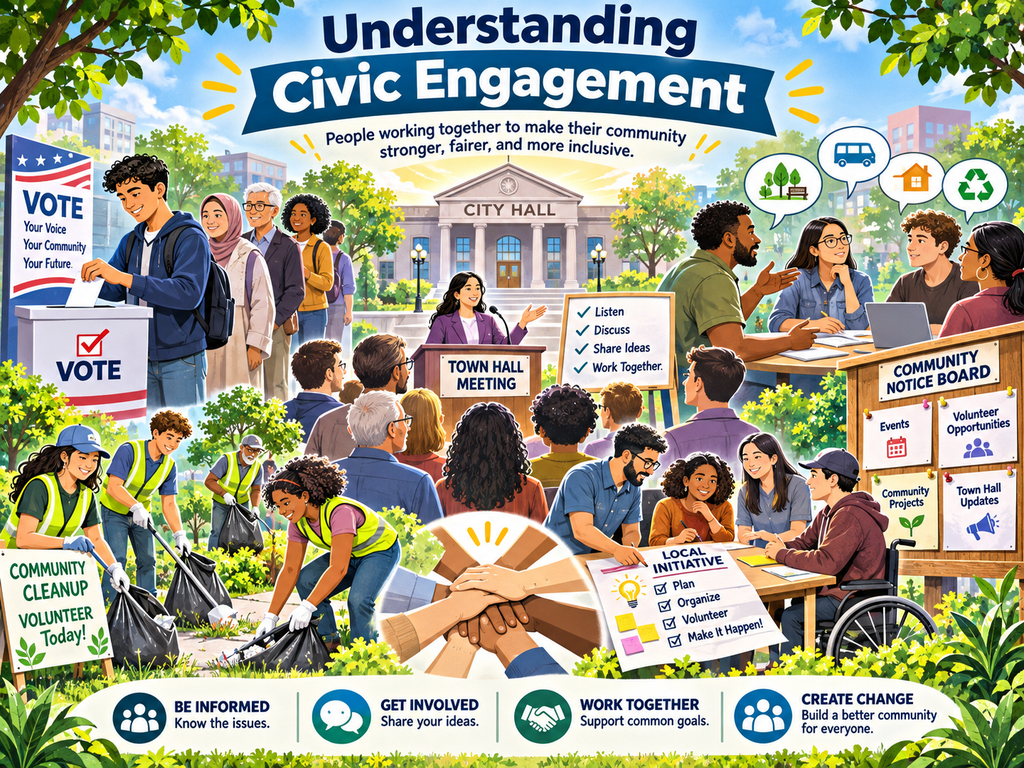
If you have ever typed “what is civic engagement” into a search bar, you probably expected a definition tied to politics. The short version is broader: civic engagement is everything people do to look after shared community life. That includes voting and campaigning, and it also includes serving on a jury, answering the census, joining a neighborhood association, and carrying groceries for a neighbor who cannot get out.
This article is a map of that wider territory. Our earlier posts each cover one form of participation in depth. Here the goal is to show how the forms fit together, help you see which ones you may already do, and suggest a starting point that suits your time and temperament. Nothing here tells you what to believe. Civic engagement works for people across the political spectrum, and the tools are the same whatever you want to use them for.
What Civic Engagement Means, and Why It Is Bigger Than Politics
Political engagement is about influencing government: who holds office, what laws pass, how public money is spent. Civic engagement includes all of that and adds the shared life around it. A town has a library, a park, a school, a volunteer fire department, a food pantry, and a street that floods when it rains. People who work on any of these are taking part in civic life.
One useful way to sort the activity is by what it aims at:
- Government-facing actions try to affect public decisions: voting, contacting an official, speaking at a meeting, joining a campaign.
- Community-facing actions solve shared problems directly: volunteering, organizing a cleanup, running a youth sports league.
- Duties and obligations keep the system working: jury service, filling out the census, paying attention to public notices.
- Informal care builds the trust that makes the rest possible: knowing your neighbors, checking in on someone, showing up when a local event needs hands.
The categories overlap. A parent who organizes a crosswalk petition is doing community work and government-facing work at once. Seeing the full range matters because many beginners believe civic life means arguing about national politics, and then conclude it is not for them. Most of it happens at a much smaller scale.
The Everyday Forms People Overlook
Several of the most important forms of participation do not feel like activism at all.
Jury duty
Courts summon ordinary residents to serve on juries, and the summons is a legal obligation. Many courts draw names from lists such as voter registration and driver’s license records, though the details differ by state and county. A jury is one of the few places where a group of strangers is directly handed a government decision, such as whether the evidence supports a verdict. Showing up, listening carefully, and deliberating honestly is civic engagement in a very literal sense. If you receive a summons, read the instructions closely, because courts have their own rules about deferrals and exemptions.
The census
The Constitution requires a count of the population every ten years. The results are used to divide seats in the U.S. House of Representatives among the states, and they inform how a number of government programs are planned and funded. Answering the questionnaire takes little time, and it is a form of participation that applies to everyone living in the country, whatever their politics. The next count is scheduled for 2030, and in the meantime the Census Bureau runs smaller surveys that households may be asked to complete.
Neighborhood groups
Homeowner associations, tenant associations, block clubs, parent-teacher groups, and online neighborhood forums are where many residents first practice collective decision-making. They deal with concrete matters: a broken streetlight, a rule about parking, a plan for a community garden. The habits learned there, such as running a meeting, listening to objections, and following through, carry directly into other civic work.
Helping a neighbor
Shoveling a sidewalk, driving someone to an appointment, or organizing a meal for a family after a hospital stay all strengthen the ties that make communities function. Researchers and writers on community life often describe this as building trust between neighbors. You do not need a research citation to see the practical effect: people who know each other find it easier to work together when a larger problem comes up.
Voting and the Work Around It
Voting is the most recognized form of civic participation, and for good reason: it is how most Americans choose the people who make public decisions. If you want the case for why a single ballot counts, we cover it in why voting matters even when one ballot feels small.
There is also a body of work around the act of voting that gets less attention:
- Registering and keeping your registration current. Deadlines and requirements vary by state, so check with your state or county election office.
- Learning what is on your ballot. Many ballots include local offices, judges, and ballot measures that are not covered heavily in the news.
- Making a plan to vote. Know your polling place or your state’s mail or early voting options, and the dates that apply.
- Working at the polls. Election offices recruit residents as poll workers, and the role is open to people of any political view.
Local races and measures are often decided by smaller numbers of votes than national contests, and they affect things you encounter daily: school budgets, zoning, road repairs, and police and fire services. That is a good reason to read down the whole ballot rather than stopping at the top.
Local Government Is the Easiest Door
If you want a practical entry point, local government is hard to beat. The meetings are usually open to the public, the agendas are posted ahead of time, and the number of people attending is often small enough that one person’s comment gets noticed.
Most local governing bodies, including city councils, county boards, and school boards, are required by state law to meet in public. Many set aside time for public comment, when residents may speak briefly about an agenda item or a topic of concern. Rules differ from place to place, so look for the following on your city, county, or school district website:
- The meeting calendar, including dates, times, and locations.
- The agenda, which is usually posted several days before the meeting.
- Public comment rules, such as whether you must sign up in advance and how long each speaker gets.
- Minutes and recordings of past meetings, which let you see how the body works before you attend.
You do not have to speak the first time. Attending one meeting as an observer teaches you the format, the vocabulary, and which issues come up repeatedly. When you do decide to speak, a short, specific comment tends to be more useful than a long general one: name the agenda item, say what you would like the board to do, and give one or two reasons.
School boards deserve a mention of their own. They oversee budgets, hiring of the superintendent, curriculum policies, and facilities decisions, and parents and non-parents alike pay for them through local taxes. Residents hold a range of views about what schools should do, and the public meeting is the place where those views are heard on the record.
Taking Part Between Elections
Civic life does not pause after Election Day. Between elections, officials still make decisions, and residents can still contribute to them. The options are varied:
- Writing, calling, or emailing an elected official about a specific bill or local issue.
- Attending a town hall or a candidate forum.
- Joining or forming a community group focused on a single issue.
- Signing or circulating petitions where your state or city allows them.
- Taking part in peaceful demonstrations.
For a broader look at this territory, our guide to political activism and the many ways ordinary people take part between elections explains the range from letter-writing to organizing. If you would rather work inside an election effort, political campaign volunteering is a structured way to start, with defined shifts and tasks, and campaigns of every stripe tend to welcome beginners.
A practical note on contacting officials: a message that is specific, polite, and tied to a particular decision generally does more than a general expression of frustration. Say who you are, that you live in their district or town, what you are asking for, and why.
Staying Informed Without Burning Out
Participation works better when it rests on accurate information, but constant news intake wears people down. Many beginners feel they must follow everything before they are allowed to do anything, and that expectation tends to end in exhaustion.
A more sustainable approach is to narrow your focus:
- Choose a level. Local, state, or national. Local news and official local sources are often the most useful for someone who plans to attend meetings.
- Use primary sources when you can. Agendas, meeting minutes, and the text of a proposed ordinance tell you directly what is being decided.
- Compare more than one outlet when you read about a contested issue, and notice what each emphasizes.
- Set limits. Checking the news at set times, rather than all day, leaves more energy for acting.
The tools you use to get information also influence how you participate. Our piece on how the news and social media you use shape whether and how you take part in politics goes into this in more detail. Even a short check of your own habits, such as which sources you read and how they make you feel, can reveal why some people stay engaged for years while others drop out after one heated election.
Choosing Your Starting Point by Time, Energy and Temperament
Instead of asking what you ought to do, ask what fits. Three questions usually narrow the choices quickly.
How much time do you have?
- Almost none this month: confirm your voter registration, read your sample ballot, and answer the census or any government survey you receive.
- A few hours a month: attend one local meeting, read the agenda for another, or join a neighborhood group.
- A few hours a week: volunteer for a campaign, serve as a poll worker, or take a role in a community organization.
What is your energy like around other people?
- If large groups tire you, written options work well: emailing an official, writing a public comment, or helping with behind-the-scenes tasks for a group.
- If you enjoy conversation, consider canvassing, hosting a neighborhood gathering, or speaking at a meeting.
- If you prefer to work on practical problems, a cleanup, a food drive, or a tutoring program gives you tangible tasks.
What kind of issues pull your attention?
Start with something you can see from your own front door: a school, a park, traffic, housing, a library branch. Local problems are concrete, and a concrete problem is easier to act on than a general sense of concern.
No single combination is right. Someone who serves on a jury once in their life, votes in every election, and knows the names of their neighbors is a fully engaged citizen. Someone who attends every council meeting is too. The point is to pick one thing and do it, then add more if you want to.
What Civic Life Looks Like When People Disagree and Still Show Up
Any public meeting will contain disagreement. Residents differ about taxes, development, school policies, and a hundred other questions, and these differences are the reason civic institutions exist. A school board room or a jury room is built to handle disagreement through procedure: speaking turns, time limits, votes, and written records.
A few habits help in these settings, whatever your view:
- Listen to the whole comment before reacting. You may learn something about the issue or about the person who raised it.
- Address the decision, not the person. Comments about a proposal land better than comments about someone’s character.
- Accept that you will sometimes lose a vote. Participating is not the same as winning, and the people who keep showing up after a loss often shape the next round.
- Look for shared ground on local matters. Neighbors who disagree on national politics often agree that a road needs repair or a playground needs a new fence.
Disagreement is not a sign that civic life is broken. It is the ordinary condition of a community with many different people in it, and taking part means being willing to work in that condition.
Pick one action from this article that fits your week, such as finding the date of your next local council or school board meeting, and then read our guide to how elections work to see where it fits.