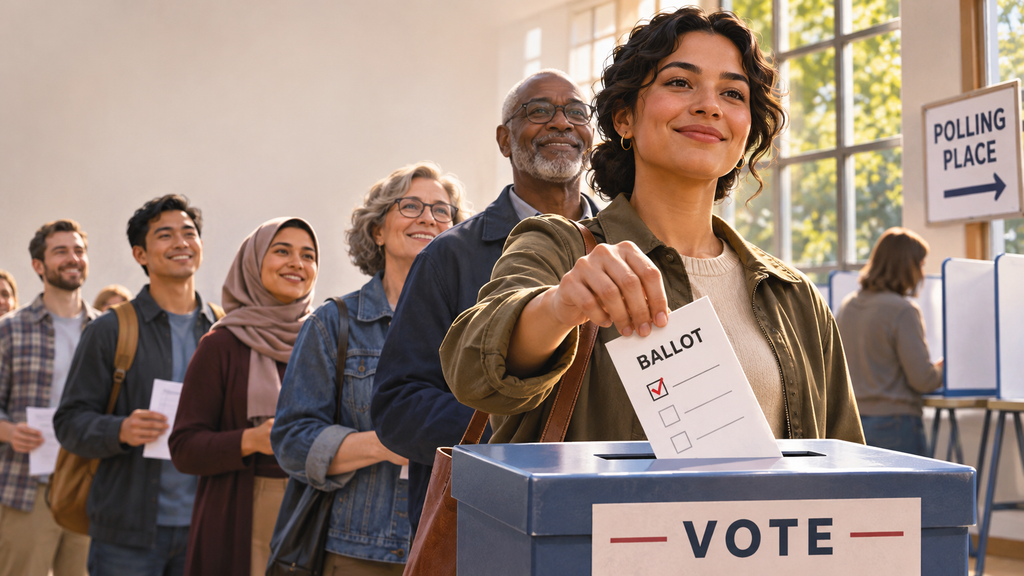
If you have ever wondered why voting is important, the most direct answer is that elections decide who holds public power and what they are allowed to do with it. Those decisions reach into ordinary life: what your property taxes pay for, how long your commute takes, what your local school teaches, and how your community responds to an emergency. A ballot is one of the few moments when everyone gets the same say, whatever their income, job, or party.
This article makes the case for voting without telling you whom to vote for. It also takes the common reasons people skip an election seriously, because most of them contain something true.
What a vote actually decides, from the school board to the White House
A single ballot in the United States can cover offices at many levels of government, and each level controls different things.
- The president leads the executive branch, which carries out federal law, and nominates federal judges and top agency officials, subject to Senate confirmation.
- Members of Congress write federal laws, set federal spending, and confirm those nominees.
- Governors and state legislators shape state budgets, state taxes, public universities, and much of how elections themselves are run in your state.
- County and city officials handle things like local roads, policing priorities, zoning, and trash collection.
- School board members oversee the budget and policies of your local public schools, and they typically hire or fire the superintendent.
Seen together, the pattern is that the governments closest to your daily routine are often the ones you hear about least. Federal politics gets the headlines, but the bus route, the library hours, and the rules for building on the empty lot down the street are usually decided locally.
Voting is also how the people who make these decisions are held to account. An official who knows that a large share of residents will vote has a reason to pay attention to them. An official who knows that few people will vote has less of one.
The ballot you never hear about: local and down-ballot races
“Down-ballot” refers to the offices listed below the high-profile races on your ballot. These might include county commissioner, city council seat, sheriff, county clerk, school board, water district board, and, depending on where you live, judges and local ballot measures.
These races matter for a practical reason. They often have fewer voters, less media coverage, and smaller margins. In a presidential race, millions of votes are spread across the country. In a school board election, a few hundred or a few thousand votes may settle the result, so each ballot carries a far larger share of the outcome. Close local races, ties, and recounts do happen.
Turnout in local elections also tends to be lower than in presidential years, which means the people who do show up have an outsized influence. If you skip these races, the decisions are still made. They are made by the smaller group that voted.
Some of these offices are also ones people feel strongly about without realizing they are elected. Depending on your state and county, you may vote directly on who serves as sheriff, who prosecutes local crimes, or who sits on a local court. Your local election office can show you exactly what your ballot includes.
If you want to understand how a race gets onto the ballot in the first place, our guide to how elections work walks through it from start to finish.
“My single vote won’t matter”: what that argument gets right and wrong
This is the most common reason for not voting, and it deserves a fair hearing.
What it gets right
In a large election, the chance that your one vote is the deciding vote is very small. If you vote expecting that your ballot alone will swing a national race, you will almost certainly be disappointed. That is simple arithmetic, and pretending otherwise does not persuade anyone.
What it gets wrong
The argument treats a vote as a lone act, when it is really a share of a total. Elections are decided by the sum of many individual choices, and the sum only exists because individuals each add to it. If everyone who reasoned “my vote won’t matter” stayed home, the result would change, because that group is large.
There are also effects beyond who wins:
- Margins send signals. Officials and parties pay attention to how big a win was, which groups turned out, and which areas had low participation. A thin win and a landslide lead to different behavior afterward.
- Turnout shapes who gets attention. Candidates tend to spend time and attention on groups that vote reliably. A group that votes steadily is harder to ignore.
- Local races are closer than you may expect. As covered above, the smaller the election, the more any one ballot counts.
- Voting is a habit. People who vote once are more likely to vote again, and the habit often spreads through households and friend groups.
None of this means your vote will be the one that decides an election. It means that the real question is not whether one ballot tips the outcome, but whether you want to be counted among the people the outcome reflects.
When you don’t love your choices
Plenty of voters look at a ballot and feel that nobody on it speaks for them. That reaction is common and reasonable. A few things are worth knowing before you decide to sit the election out.
First, you rarely have to choose between a perfect candidate and a terrible one. Most voters weigh a short list of priorities, such as the economy, schools, safety, healthcare, or taxes, and pick the option that comes closest on the ones they care about most. Closest is a legitimate standard.
Second, a ballot has many lines. You might dislike the choices for one office and feel strongly about another, or about a local ballot measure where you vote yes or no directly. Skipping the whole election because of one disappointing race gives up your say on all the others.
Third, you can leave a line blank. Voting does not require you to mark every contest. If you honestly have no preference in a race, you can skip it and still vote on the rest.
Finally, voting is one tool among several. Primaries are where parties pick their nominees, and participating there can shape which choices appear in November. Rules differ by state, so check how yours works. People who are unhappy with the options can also join a party and try to change it from inside, or support candidates early. Our piece on how to join a political party explains what that involves.
Voting and speaking up are different jobs, and both count
Voting is a private, periodic act. You mark a ballot every so often, and it is counted alongside everyone else’s. It is good at one thing: choosing who holds office and settling certain questions put directly to voters.
Between elections, other kinds of participation do different work. Calling or writing to an elected official tells them what you want on a specific issue. Attending a city council or school board meeting puts your view on the public record. Volunteering, donating, signing petitions, joining a community group, and taking part in peaceful protest all influence decisions that a ballot cannot reach.
These do not replace each other. A vote does not tell an official which of ten issues you care about most. A phone call does not select who holds the seat. Someone who only votes has a voice at election time, and someone who only advocates is working without the formal power to change who is in charge. Using both is stronger than either one alone.
If you want a wider look at the options, political activism explained lists the many ways ordinary people take part between elections.
How to get ready to vote without spending hours on research
Not knowing enough is a real barrier, especially for first-time voters. The good news is that you do not need to become an expert on every race. A modest amount of preparation covers most of what you need.
- Confirm you are registered. Registration rules and deadlines differ from state to state, so check with your state or local election office early. Some states allow registration very close to Election Day, and others require it well ahead of time.
- Look at a sample ballot. Your local election office usually publishes one before each election. It shows every office and measure you will vote on, so nothing surprises you in the booth.
- Pick your top few issues. Decide which three or four topics matter most to you. You can then judge candidates mainly on those instead of trying to track everything.
- Use nonpartisan voter guides. Organizations such as the League of Women Voters publish guides that describe candidates and ballot measures without recommending anyone. Official voter information pamphlets, where your state provides them, explain ballot measures in plain terms.
- Read candidates’ own words. Campaign websites and local debates or forums show what candidates say they would do. Compare that with their records if they have held office before.
- Check where your news comes from. The sources you rely on influence what you notice and what you miss. Our article on how the news and social media you use shape political participation can help you look at your own habits.
- Make a plan. Decide when and how you will vote: by mail, early in person, or on Election Day. Knowing your polling place and hours ahead of time removes a common reason people end up not voting.
An hour or two spread over a few evenings is enough for most elections. For the races you know little about, a nonpartisan guide plus a quick look at each candidate’s stated priorities will put you in a better position than many voters who show up with no preparation at all.
Your next step
Check your voter registration status today with your state or local election office, and put your next election date in your calendar. Both take only a few minutes, and they make sure you can vote when the time comes.