
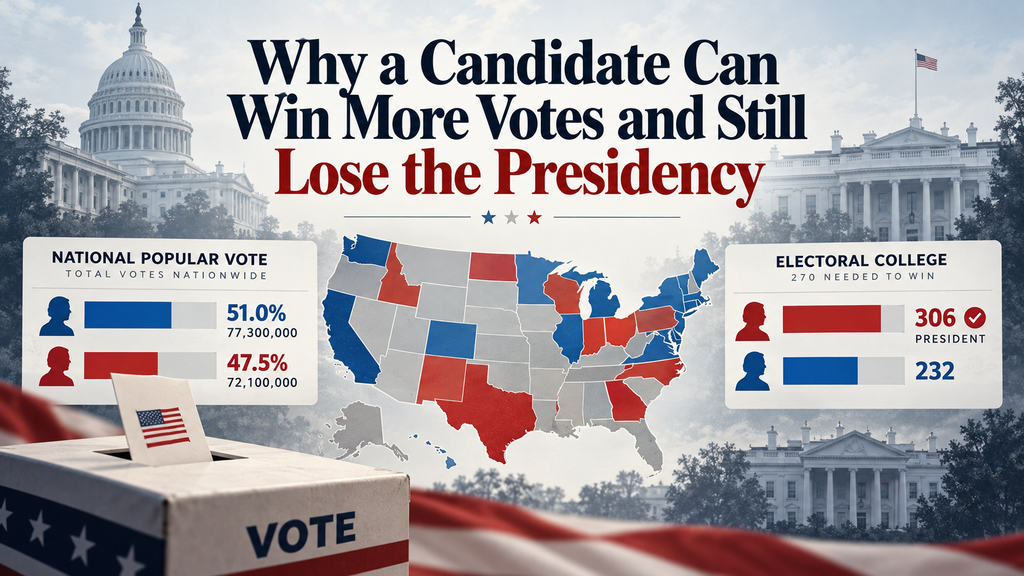
On election night, two counts run side by side. One is the total number of votes cast for each candidate across the country. The other is the number of electoral votes each candidate has collected, state by state. The electoral vote vs popular vote distinction confuses many beginners because news coverage mixes the two, and most of the time they name the same winner. In five US presidential elections, they have not.
This article explains what each count measures, shows with a small invented example how they can split, and walks through the four elections where the candidate with fewer votes nationwide still became president.
Two scoreboards, one election
Think of the popular vote and the electoral vote as two scoreboards. Both are fed by the same ballots, but they add those ballots up in different ways.
The popular vote asks: which candidate got more individual votes nationwide? The electoral vote asks: which candidate won enough states, weighted by each state’s number of electors, to reach a majority?
Only the second one decides who becomes president. The Constitution sets the rules for choosing the president through electors, and the national vote total, while widely reported, has no legal role in the outcome. That is why a candidate can lead one scoreboard and lose the other.
The popular vote: every ballot added up nationwide
The popular vote is the simplest to understand. Every state counts its ballots, and the results are added together into a national total for each candidate. The candidate with the larger total wins the popular vote.
Two features of this count are worth knowing:
- There is no single national election. Each state runs its own election, with its own officials, deadlines and counting procedures. The national popular vote is a sum of those separate counts.
- It is a margin, not a mandate. Winning the popular vote by a million votes or by ten million is reported the same way: a win. Nothing in the rules gives extra weight to a larger lead.
News outlets report the national total because it is a useful measure of how many people supported each candidate. It is a measure of public support, though, not the count that picks the president.
The electoral vote: 50 state contests plus D.C., and the 270 you need
The electoral vote works differently. Voters in each state, and in Washington, D.C., are really choosing a group of electors pledged to a candidate. There are 538 electors in total, and a candidate needs a majority of them, which is 270, to win.
Each state’s number of electors equals its seats in the House of Representatives plus its two Senate seats. D.C. gets three. That is how 435 representatives, 100 senators and 3 electors for D.C. add up to 538.
In 48 states and D.C., the candidate who wins the state’s popular vote gets all of its electoral votes, even if the margin is a single vote. Maine and Nebraska divide theirs. The details of how states assign electors, and who decides how they are cast, are covered in how each state gets its electoral votes.
The key point for this comparison is that the electoral count rewards winning states, not piling up votes. A candidate gets nothing extra for winning California by five million votes instead of one million. The same candidate gets everything in a state won by a few thousand.
Why the two counts usually agree, and when they don’t
Most of the time, the candidate who is more popular nationwide is also more popular in enough states to reach 270. A big national lead usually means wins across many regions, and those wins translate into electoral votes. In most presidential elections the two scoreboards name the same winner.
They split when a candidate’s support is spread unevenly across the map. Votes in a state won by a huge margin count once toward the national total each, but they add no electoral votes beyond the state’s fixed number. Votes in a state decided by a thin margin count the same toward the national total, yet they can swing every electoral vote that state holds.
Two other features of the system add to the effect:
- Winner-take-all rules in most states mean the losing side’s votes in a state produce no electoral votes at all.
- Every state has at least three electors regardless of population, so smaller states have more electors per resident than larger ones.
A split needs a fairly close national race, since a wide popular vote lead almost always carries enough states. That is why the examples below all come from tight elections.
A tiny made-up example: winning big in a few places versus narrowly in many
Here is an invented country, simplified to show the mechanism. It has five states, each with exactly 1,000 voters and 3 electoral votes, so 15 in total. A candidate needs 8 to win.
State Candidate A Candidate B State winner 1 900 100 A 2 900 100 A 3 450 550 B 4 450 550 B 5 450 550 B
Add up the votes. Candidate A has 3,150 and Candidate B has 1,850, so A wins the popular vote with 63 percent.
Now add up the electoral votes. A won two states and gets 6. B won three states and gets 9. B reaches the majority of 8 and becomes president while trailing by 1,300 votes nationwide.
A’s extra votes in states 1 and 2 were real votes, and they counted in the national total. They just could not earn more than 3 electoral votes each. Real elections are messier, with states of very different sizes, but the pattern is the same: a candidate whose votes are concentrated can lead the national count and still fall short in the states.
Elections where the popular vote loser won: 1876, 1888, 2000 and 2016
In four presidential elections, the candidate with the most votes nationwide lost the electoral vote. Each has its own circumstances.
1876: Tilden and Hayes
Samuel Tilden won the popular vote by roughly 250,000 votes over Rutherford B. Hayes. Returns from South Carolina, Florida and Louisiana were disputed, and Congress set up a commission to resolve the question. Hayes ended up with 185 electoral votes to Tilden’s 184, a one-vote margin, and became president. This is the only one of the four where the result of the electoral count itself was contested for months.
1888: Cleveland and Harrison
Grover Cleveland, the sitting president, won the popular vote by around 90,000 votes. Benjamin Harrison won the electoral vote 233 to 168. Cleveland’s strength was concentrated in states he won by large margins, while Harrison won a number of closer, larger states that carried more electors.
2000: Gore and Bush
Al Gore won the popular vote by about 540,000 votes. George W. Bush won the electoral vote 271 to 266, after the outcome came down to Florida, where the margin was a few hundred votes. A recount dispute ended at the US Supreme Court, which halted it, and Florida’s electoral votes went to Bush. Gore received 266 rather than 267 because one D.C. elector abstained.
2016: Clinton and Trump
Hillary Clinton won the popular vote by about 2.9 million votes, the largest gap of the four. Donald Trump won a majority of electoral votes, finishing with 304 to Clinton’s 227 as the electors cast them, after narrow wins in several states. Her lead came largely from very large margins in a smaller number of states.
Together these four show that a split can come from a one-vote electoral margin, a recount fight, or a comfortable electoral win paired with a large popular vote deficit. The mechanism, though, is the one in the small example above.
Why this makes campaigns focus on certain states
Because the electoral count rewards winning states rather than collecting votes, campaigns do not spend equal effort everywhere. A state that reliably votes one way offers little reason to visit or advertise, since extra votes there add no electoral votes. A state where the polls are close, and where a win would move many electors, gets most of the attention.
That concentration is the practical result of having two scoreboards. Candidates plan around the one that decides the presidency. The full picture of how this shapes spending, travel and messaging is in how the Electoral College affects campaign strategy, and the states that draw the most attention are explained in the role of swing states in presidential elections.
It also means that national popular vote totals, taken alone, can be a poor guide to what campaigns were actually trying to do. A candidate who was never aiming at the national total may not have run the campaign that would have maximized it.
Questions readers ask next
Has the popular vote ever decided who became president? Not by itself. Under the Constitution, the president is chosen by the electoral vote, and no national popular vote count has ever determined the outcome of a presidential election.
Does a candidate need a majority of the popular vote? No. Candidates often win with less than half of all votes cast, especially when third-party candidates draw support. What matters is reaching 270 electoral votes.
What if nobody gets 270? The House of Representatives chooses the president from among the top candidates, with each state delegation casting one vote. That process is laid out in what happens if no candidate wins an electoral college majority.
Are electors required to vote for the candidate who won their state? Many states have laws requiring it, and the question has been tested in court. The details are in whether electors can vote against their state’s results.
Is this a flaw that people want to fix? There is a long record of proposals to change or replace the system, from constitutional amendments to state-level agreements. The history of Electoral College reform proposals covers what has been suggested and why none has been adopted as a constitutional change.
Where can I check other claims I hear about the Electoral College? Common myths and facts about the Electoral College sorts out the statements that come up most often in election coverage.
The next time a news anchor reports both numbers on election night, you will know which one decides the presidency and which one measures national support. When they point to different candidates, as in 1876, 1888, 2000 and 2016, the cause is the way votes are grouped into states, not a counting error.