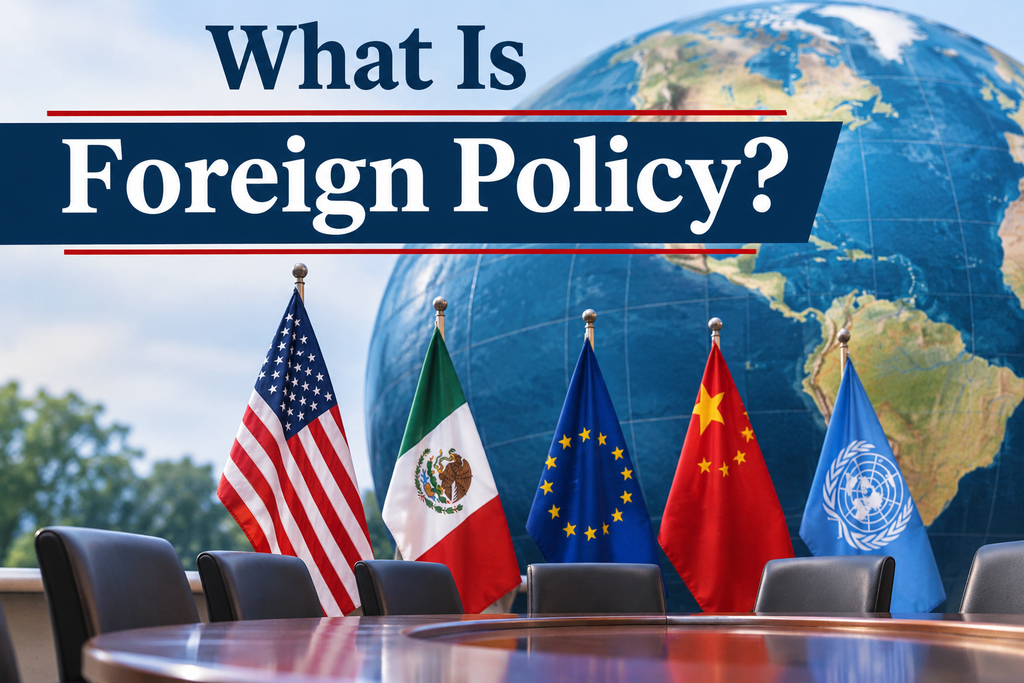
What is foreign policy? It is the set of choices a government makes about how to deal with other countries, international organizations, and people outside its borders. Those choices include what to say to another government, what to buy from it, whether to help it, and whether to punish it. They also cover which agreements to sign and which groups to join.
Foreign policy can sound distant, like something that happens in marble buildings between people in dark suits. Its effects show up in grocery prices, in travel rules, and in the news you scroll past every morning. This guide explains the basic tools, who uses them in the United States, and where thoughtful people disagree.
Foreign policy in plain language: what it covers and what it doesn’t
Foreign policy covers a country’s relationships with the rest of the world. A government has to decide whether a particular country is a friend, a competitor, or something in between, and then act on that view. It also decides how to take part in groups such as the United Nations or trade organizations, and how to respond when something happens abroad, like a natural disaster, a coup, or a trade dispute.
Several nearby topics have their own explainers. Decisions about the armed forces and military spending fall under defense policy. Decisions about who may enter and stay in the country fall under immigration policy. Both overlap with foreign policy, and this article leaves them mostly aside so it can focus on everyday tools and the choices between them.
Domestic policy, such as schools, health care, and housing, is mostly separate too. The two sides still touch. A decision about tariffs is a foreign policy decision that changes what things cost at home.
The toolkit: diplomacy, trade, aid, alliances, and sanctions
A government has a limited set of ways to influence other countries. Most of foreign policy comes down to choosing among five of them.
Diplomacy is talking. It includes ambassadors, embassies, formal negotiations, and private conversations between officials. Diplomacy is cheap compared with most alternatives and keeps channels open even between rivals. Its limit is that talking only works if the other side has some reason to agree.
Trade policy governs what a country buys from and sells to others. Tools include tariffs, which are taxes on imported goods, and trade agreements, which set the rules between countries. Trade can build mutual interest, since countries that depend on each other have reasons to keep the peace. It can also create dependence, which a government may later regret.
Aid is help given to another country. It can be money, food, medical supplies, or technical expertise, and it may respond to an emergency or support long-term development. Governments give aid because they care about the people receiving it, because it builds goodwill, or because a stable neighbor is good for everyone. Critics ask whether the money reaches the people it is meant for and whether it should be spent at home instead.
Alliances are formal commitments between countries to support one another. NATO, a group of North American and European countries, is the best-known example. An alliance can discourage conflict by making the cost of aggression clear. It also binds each member to obligations that may be inconvenient later.
Sanctions are penalties meant to change another government’s behavior. They can freeze assets, ban certain trade, or cut off access to financial systems. Sanctions sit between diplomacy and military action, which makes them attractive. Whether they achieve their goals depends heavily on the case, and they often hurt ordinary people in the target country.
Governments rarely use one tool alone. A single policy toward a single country might combine talks, trade restrictions, and aid at once.
Who decides in the United States: President, Congress, and the agencies in between
The Constitution splits foreign policy power between the president and Congress, which is why the answer to “who decides” is rarely one person.
The president leads day to day. The president negotiates with other governments, nominates ambassadors, and directs the executive branch’s response to world events. Presidents also sign many agreements with other countries without a Senate vote, called executive agreements.
Congress holds several powers of its own:
- The Senate must confirm ambassadors and approve treaties by a two-thirds vote.
- Congress controls spending, so foreign aid and diplomatic budgets need its approval.
- Congress has the power to regulate commerce with other nations, which includes tariffs and many trade rules.
- Congress passes laws that set sanctions, and it holds the power to declare war.
Between them sit the agencies that do the work. The State Department runs diplomacy and embassies. The Treasury Department administers many sanctions. The Commerce Department and the U.S. Trade Representative handle trade matters, and intelligence agencies supply information that shapes decisions. The National Security Council, a White House body, helps the president coordinate all of them.
Outside pressure matters as well. Businesses, advocacy groups, and voters all try to influence these decisions, and lobbying is one of the ordinary ways they do it. If you want to see how a proposal in Congress moves from idea to law, how a bill becomes a law walks through that process.
What a country is actually trying to achieve: security, prosperity, values, and the tension among them
Foreign policy goals usually fall into three groups.
Security means protecting the country and its people from threats. Diplomacy, alliances, and sanctions all serve this goal, along with military tools covered elsewhere.
Prosperity means helping the economy grow. Open markets, trade agreements, and stable relationships with major trading partners are the main instruments.
Values means promoting or defending ideals such as human rights, democracy, and the rule of law. A government might condition aid on reforms, criticize another country’s treatment of its citizens, or welcome refugees.
These goals often pull against each other. Suppose a country is an important trading partner but has a poor record on human rights. Pressing hard on rights might cost trade and perhaps cooperation on security. Staying quiet protects prosperity but may give up on values. Officials rarely get to pursue all three fully, and much of the real debate is about which goal should win in a particular case and how much each is worth.
The three goals are also not always opposed. A stable, prosperous trading partner may be more secure, and a country that keeps its promises abroad may be more trusted. The tension shows up when choices are close.
Where reasonable people disagree: engagement versus restraint, cooperation versus going alone
Two questions run through most foreign policy debates. How involved should the country be in the world? And should it work through partners and institutions, or act on its own?
Scholars often describe a few broad schools of thought. They are simplified, and real people mix them.
- Realism starts from the view that countries pursue their own interests in a world without a higher authority. Realists tend to focus on power, balance among major countries, and practical results over ideals.
- Liberal internationalism holds that cooperation through alliances, institutions, and trade serves a country’s long-term interests and can spread stability and democratic values. Supporters usually favor active engagement.
- Restraint argues the country should take on fewer commitments abroad, keep its focus on its own security and economy, and avoid costly entanglements. Supporters point to the risks and expenses of overreach.
Each view has a serious case. Engagement supporters say that problems abroad rarely stay abroad and that walking away leaves a gap others will fill. Restraint supporters say that wide commitments cost money, create risks, and can fail to achieve their aims. On the second question, those favoring cooperation say shared action spreads costs and adds legitimacy, while those favoring independence say consensus is slow and can water down a country’s own priorities.
These positions do not line up neatly with political parties. Within each major party, people hold different views on all of them, and the balance has shifted over time.
How foreign policy reaches your daily life, from prices to news headlines
Foreign policy can feel remote, but several of its effects are close to home.
Trade decisions affect prices and choices. Tariffs on imported goods can raise what shoppers pay or change which products are available, and trade agreements can do the opposite. Businesses that depend on imported parts or sell to foreign customers feel these decisions directly, and so do their workers.
Events abroad can also shift costs. Disruptions to shipping, energy supplies, or major producers can show up in the prices of fuel and goods. Government responses to those disruptions are foreign policy choices.
Travel and communication rules depend on relationships between governments, including visa arrangements and whether an embassy can help a citizen in trouble abroad. Tax dollars pay for diplomacy, aid, and the agencies that run them, so the budget is a place where foreign policy meets every taxpayer.
The last connection is the news. Many headlines about summits, sanctions, treaties, or tensions are foreign policy stories. Knowing the vocabulary makes them easier to follow, and how outlets choose to frame them affects your view, as explained in how the news and social media shape political participation.
How to read a foreign policy story without picking a side too early
A few questions help you keep your footing when a story moves fast.
- Which tool is being used? Is this diplomacy, a trade action, aid, an alliance matter, or sanctions? Naming the tool shows what kind of decision it is.
- Which goal is it serving? Security, prosperity, and values can all be argued for the same action, and officials may emphasize whichever is easiest to defend.
- Who has the authority? Check whether the president, Congress, or an agency is acting. An announcement is not the same as a law or a signed agreement.
- What are the trade-offs? Most choices cost something. If an article names only benefits or only costs, look for a second source.
- What would supporters and critics each say? If you can state both cases fairly, you understand the issue better than a headline can teach.
It also helps to separate what has happened from what is predicted. Forecasts about what a policy will do are often uncertain, and informed people disagree about them.
If you want to continue with a neighboring topic, read the related post on understanding defense policy, which explains who decides how a country protects itself. And follow the blog for more plain-language politics explainers.