Social policy is the set of laws, programs and public rules a society uses to help people through the risks that most lives eventually include, and to decide who pays for that help. If you have ever asked what social policy is, that one sentence is the working answer. Everything else is detail about which risks, which people, and which rules.
You already live inside it. If you went to a public school, drove past a posted minimum wage, saw a deduction labeled for retirement or unemployment on a pay stub, or used a clinic with public funding, you have dealt with social policy. Most of it runs quietly in the background until the day you need it, which is also when people tend to learn how it works.
The life risks a society decides to share
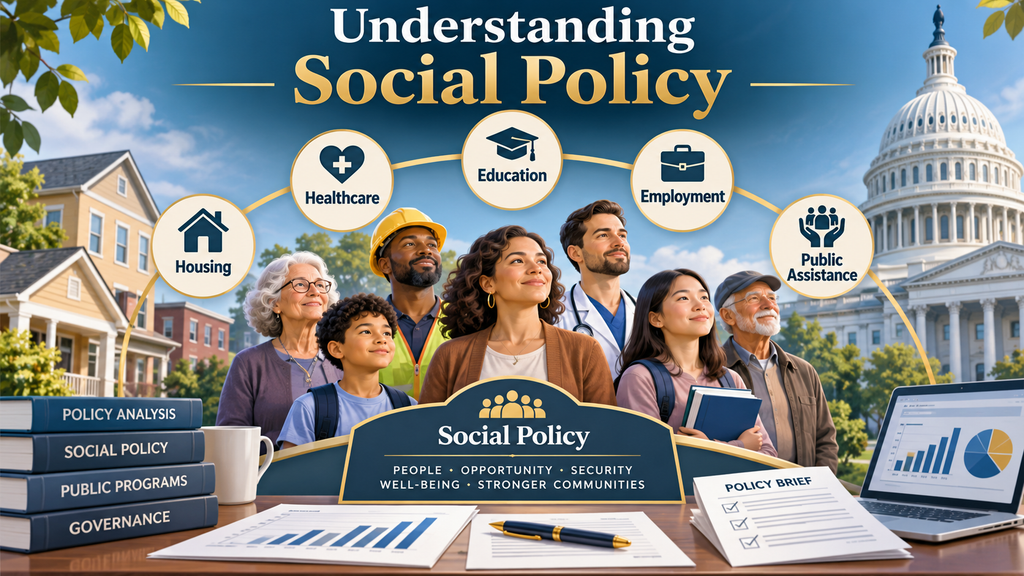
Some events are hard to predict for one person but certain across a whole population. Someone will lose a job. Everyone who lives long enough will get old. Some people will get seriously ill, some will be born with or develop a disability, and many will raise children. Social policy is a society’s decision to handle these risks together instead of leaving each household to handle them alone.
The main areas usually look like this:
- Work: unemployment benefits, workplace safety rules, minimum wage laws, job training.
- Age: public pensions, retirement savings rules, support for older people who need daily care.
- Health: public insurance, rules for private insurance, public health programs.
- Children and families: schooling, child care, child benefits, parental leave.
- Disability: income support, accessibility requirements, support for caregivers.
Societies differ on how much of each risk they share, and on which ones they treat as shared at all. A country might cover health care broadly and leave child care mostly to families. Another might do the reverse. Nothing about the list is fixed, and the arguments over where its edges fall are what most political debate about this topic is made of.
You will also hear “welfare” and “safety net.” Welfare is sometimes used for all social programs and sometimes only for cash or food help to low-income people, so it is worth checking which meaning a speaker has in mind. Safety net usually means the programs that step in when a person’s income or circumstances drop sharply.
Four questions every social program has to answer
Programs look very different on the surface, but each one is built by answering the same four questions. Once you can spot them, an unfamiliar program becomes much easier to read.
- Who qualifies? Everyone, or only people who meet some test such as income, age, disability or work history.
- Who pays? Taxes on income, payroll taxes on workers and employers, premiums paid by participants, or donations.
- Who runs it? A national agency, a state or local government, an employer, a private company under government rules, or a charity.
- What is expected in return? Nothing beyond eligibility, or conditions such as looking for work, attending school or reporting income.
Different answers produce different programs, even for the same risk. A retirement program funded by payroll taxes and open to anyone who has worked is built very differently from one that only supports people with no savings, though both address old age. The next sections take each question in turn and give the strongest reasoning on each side.
Universal or targeted: should help go to everyone or only those who need it most?
This is the question about who qualifies. A universal program is open to everyone in a category, such as every child of school age or every person above a certain age. A targeted program, also called means-tested, is open only to people below an income or asset limit.
The case for universal programs rests on a few arguments. They are simple to administer because nobody has to prove need. They avoid the stigma that can attach to programs only poor people use. And they tend to keep broad political support, because most voters expect to benefit from them. People who favor this approach often point out that a program everyone uses is harder to cut and more likely to be funded well.
The case for targeted programs rests on cost and focus. If the goal is to help people who cannot afford something, spending on people who could afford it anyway uses money that could have gone further. Supporters argue that a fixed budget does the most good when it is concentrated on those with the greatest need, and that it allows more generous help per person.
Each side has a real weakness to answer. Targeting requires paperwork and eligibility checks, and some people who qualify never get through the process. It can also create a sharp edge: if earning a little more cancels a benefit, working more may leave a family no better off. Universal programs cost more in total and send some help to people who do not need it. Neither design avoids a trade-off. The choice depends on which trade-off a voter finds easier to accept.
Who pays and who runs it: taxes, employers, states, charities and families
These are two separate questions that people often blur together. A program can be funded by one party and run by another. A national government might provide money while states or local offices decide how to deliver the service.
On funding, the main sources are general taxes, dedicated payroll contributions, and premiums or fees. Payroll-funded programs are often described as insurance, because people pay in while working and draw benefits when a qualifying event happens. Programs paid from general tax revenue are usually described as assistance. Supporters of the insurance model say it ties benefits to contribution, which many people see as fair and which builds public attachment to the program. Supporters of general funding say that insurance models leave out people with little or no work history, who may need help most.
On administration, there is a similar split. Running a program centrally tends to produce consistent rules across a country. Running it locally lets officials adjust to local conditions and try different approaches, though benefits and access can then vary depending on where someone lives. Some programs use private companies or nonprofit groups to deliver services under public rules. Advocates say this brings flexibility and competition; critics worry about accountability and uneven quality.
Outside government, employers, charities and families carry a large share of the work in most societies. Employers may offer health coverage or retirement plans. Religious and community groups run food pantries and shelters. Families provide care for children, older relatives and people with disabilities. Part of any debate over social policy is how much the public system should do, and how much it should leave to, or support in, these other institutions.
Where reasonable people disagree, and the values underneath each view
Disagreements over social policy often look like arguments about facts, but many come from differences in values. Naming those values makes the debate easier to follow, even if you end up preferring one view.
Responsibility and security. One view holds that individuals and families should be primarily responsible for their own well-being, and that heavy public support can weaken that responsibility. Another holds that many hardships come from events no one controls, such as a factory closing or a sudden illness, so shared protection is both fair and practical. Both views usually accept some programs; they differ on where the line falls.
Fairness as contribution versus fairness as need. Some people see fairness mainly as getting out what you put in, and favor programs tied to work and payments. Others see fairness mainly as meeting basic needs regardless of record, and favor programs open to anyone who falls short.
Conditions on help. Supporters of work requirements or other conditions argue that they encourage independence and help keep public support for programs. Opponents argue that conditions add paperwork that can cut off people who truly qualify, and that many recipients already work or cannot. Researchers study these effects in specific programs, and findings vary by design and setting, so be wary of anyone who claims a single result applies everywhere.
Size of government and cost. Funding social programs means taxes or borrowing. Some voters weigh the burden of higher taxes more heavily, and some weigh the cost of unmet need more heavily. Both are real costs, counted differently.
None of these positions is obviously foolish, and most people hold a mix of them that shifts depending on the program. Someone might favor universal school funding and strict conditions on cash aid, or the reverse.
How to read a social policy news story without picking a side too early
News coverage of a social program often arrives as a fight over a headline number or a single word. A few habits make it easier to read fairly.
- Find the four answers. Look for who qualifies, who pays, who runs it and what is required. If the story proposes a change, work out which of the four it alters.
- Check what a number is counting. A figure for total spending, spending per person, and spending as a share of the economy are all different measures. Ask what the number is compared to and over what time period.
- Separate the goal from the design. Two people can agree a program should help struggling families and still disagree about whether this particular design does it. Many arguments are about design, not goals.
- Look for who is quoted. Notice whether the story includes the people who use the program, the people who administer it, and those who pay for it, or only advocates on one side.
- Notice loaded words. Terms like “handout,” “entitlement,” “benefit” and “investment” can carry a verdict inside the word. When you see one, find the plainer description of what the program does.
- Ask what would count as evidence. If someone says a program works or fails, ask how success was measured and over what time.
Holding off on a verdict while you map the four answers does not mean you have no opinion. It means your opinion is based on what the program actually does.
Where to go next: health, education and housing as worked examples
Health, education and housing are the same four questions applied to different needs. Our health policy overview shows how coverage, funding and decision-making are divided. The education policy explainer shows how a largely universal program is funded and run across several levels of government. The housing policy guide covers a case where local rules and market forces shape what help is even possible. Reading them with the four questions in mind will show how much they have in common.
Pick one program in your own area, such as unemployment insurance or school meals, and find out who qualifies and who pays for it. Then read our guide on getting involved in politics when you have an hour a week.