
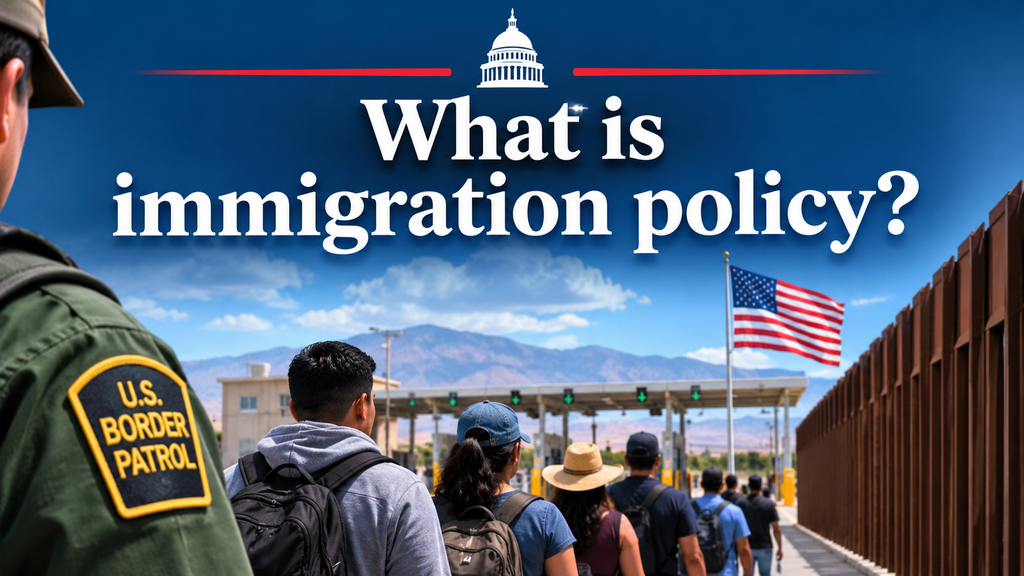
Immigration policy is the set of laws, regulations, and government decisions that determine who may enter a country, how long they may stay, whether they may work, and who may become a citizen. Almost every immigration argument you hear is about one of those four questions, even when the speakers do not say which one.
This article defines the main terms, shows which parts of the United States government control which pieces, and lays out the strongest case each side makes on the big trade-offs. It does not argue for any current law or tell you what to conclude.
Immigration policy in plain words: the rules for who may enter, stay, work, and become a citizen
Think of immigration policy as four kinds of rules that apply at different moments in a person’s life.
- Entry: who is allowed to cross the border or arrive at an airport, and what documents they need.
- Stay: how long a person may remain, and what happens when permission runs out.
- Work: whether a person may hold a job, and under what conditions.
- Citizenship: who gets full membership, including the right to vote and a passport, and how.
A few terms come up constantly. An immigrant is someone who moves to a country intending to live there. A visa is a permission document, usually issued abroad, that lets a person seek entry for a stated purpose such as study, a visit, or a job. A citizen is a full member of the country with rights that non-citizens do not have. Everyone else in the country is a noncitizen, whether they are a permanent resident, a student, a visitor, or someone without legal permission.
Immigration policy is one kind of public policy: a decision, backed by law, about how a society handles a particular problem or goal. What makes it unusual is that it sets the boundary of who counts as part of the society in the first place.
The main pieces of the system: legal pathways, border and enforcement, and status and citizenship
The system is easier to follow if you split it into three parts.
Legal pathways
These are the lawful routes by which someone can come to the United States. They fall into a few families:
- Family-based: citizens and permanent residents sponsoring certain relatives.
- Employment-based: employers sponsoring workers for temporary or permanent positions.
- Humanitarian: refugees, who apply for protection from outside the country, and asylum seekers, who request protection after arriving or at the border.
- Temporary visas: students, tourists, business visitors, and seasonal or specialty workers who are expected to leave when their permission ends.
- Lottery: a diversity visa program that distributes a limited number of visas by random selection among eligible applicants.
Many of these routes have annual limits or waiting lists, which is why the same category can take very different amounts of time depending on the applicant’s circumstances.
Border and enforcement
This part covers how the rules are applied. It includes inspection of travelers at official ports of entry, patrols between those ports, detention of some people while their cases proceed, and removal (the legal term for deportation) of people found to be in the country unlawfully. It also includes enforcement away from the border, such as employer rules for verifying that workers are authorized to work.
People can be in the country without authorization in more than one way. Some entered without inspection. Others entered legally on a temporary visa and stayed after it expired, which is called a visa overstay.
Status and citizenship
Status is a person’s legal standing. A lawful permanent resident, often called a green card holder, may live and work in the United States indefinitely but is not a citizen. Other people hold temporary protections or temporary work permission. Citizens either acquire citizenship at birth (the Fourteenth Amendment is the constitutional basis for citizenship by birth on U.S. soil, and children born abroad to citizens can also qualify under statute) or become citizens through naturalization. Naturalization generally requires a period of lawful permanent residence, usually five years, along with an English and civics test and other requirements.
Who decides in the United States: Congress, the president and agencies, the courts, and states and cities
Authority over immigration is divided, and much of the confusion in the news comes from not knowing which part of government is acting.
Congress writes the laws. The main statute is the Immigration and Nationality Act, which Congress has amended many times. Congress decides the categories of visas, the annual limits, the grounds on which someone can be denied entry or removed, and how much money agencies receive to carry out the law. Changing any of those requires passing a bill, a process explained in our walkthrough of how a bill becomes a law.
The president and executive agencies carry out the law and fill in its details. Several departments share the work:
- The Department of Homeland Security includes U.S. Citizenship and Immigration Services (applications for status and citizenship), Customs and Border Protection (ports of entry and the border), and Immigration and Customs Enforcement (enforcement inside the country).
- The State Department issues visas at consulates abroad.
- The Department of Labor has a role in some employment-based categories.
- The Department of Justice runs the immigration courts, where judges decide whether a person may be removed or qualifies for relief such as asylum.
Because agencies cannot do everything at once, the president and agency leaders set priorities: which cases to pursue first, how to process applications, and how to use discretion. The president also sets the yearly ceiling on refugee admissions after consulting Congress. Presidents of different parties use these powers differently, which is why enforcement and processing can change without any new law.
The courts interpret the statutes and decide whether government actions are consistent with the law and the Constitution. Federal courts hear challenges to laws, regulations, and enforcement actions. Note that the immigration courts themselves sit inside the Justice Department, which is part of the executive branch, and their decisions can be appealed to the federal court system.
States and cities have a more limited role, because immigration is primarily a federal responsibility, a principle the Supreme Court has emphasized in cases about state attempts to create their own immigration enforcement rules. States and localities still make many decisions that touch immigrants’ daily lives: whether local police cooperate with federal immigration authorities, who qualifies for in-state college tuition, what kinds of driver’s licenses are issued, and how local services are funded. These rules differ widely from one state to the next.
The questions every side is really answering: how many, who gets priority, how to enforce, and what to do about people already here
Beneath the slogans, immigration debates keep returning to four practical questions.
- How many people should be admitted? This covers both permanent immigration and temporary workers, students, and visitors. Any answer involves a number, and the number can be raised or lowered by Congress.
- Who should get priority? A system with limited slots has to rank applicants. It might favor relatives of people already here, workers with particular skills, people fleeing danger, or people chosen by lottery, and it can mix these in different proportions.
- How should the rules be enforced? Options include more border personnel and barriers, more or fewer detentions, workplace verification, penalties for overstaying a visa, and how aggressively to pursue people already living inside the country.
- What should happen to people who are already here without authorization? The choices range from removal, to a path to legal status under conditions, to some middle arrangement, and the answer is often tied to the other three.
Two people can agree on one question and disagree sharply on another. Someone who wants high legal immigration may also want strict enforcement, and someone who wants lower numbers may still favor a way for long-settled residents to stay.
Where thoughtful people disagree, each side in its strongest terms
What follows is the best version of each argument as its supporters would put it. You can judge them yourself.
On how many and who gets priority
People who favor lower or more selective immigration argue that a country has the right to decide how many newcomers it can absorb, and that the pace matters for schools, housing, public services, and wages in certain occupations. They say a system should prioritize applicants according to the country’s needs, and that clear limits make public support for immigration more durable.
People who favor higher or more flexible immigration argue that immigrants fill labor shortages, start businesses, and add to the population in places where it is shrinking or aging. They point out that long waits and low caps leave families separated and employers unable to hire, and they see keeping family ties as a good in itself.
On enforcement
Supporters of stricter enforcement argue that laws that are not enforced stop meaning anything. They say it is unfair to the people who wait years for a visa when others bypass the process, and that visible enforcement discourages unlawful entry and protects public trust in the system.
Supporters of more restrained enforcement argue that enforcement is costly and can fall hard on families and communities, including citizens who live with someone without status. They say resources are better spent on faster processing and on people who pose real safety risks, and they stress obligations to people seeking protection from persecution.
On people already here
Those who favor a path to legal status for long-settled residents argue that these people work, pay rent, raise children, and are woven into communities, and that removing millions of them is impractical and harsh. Giving them legal standing, in this view, brings them under the same rules as everyone else.
Those who oppose it argue that it rewards breaking the law, is unfair to people who followed the rules, and may encourage more unlawful entry in the future. They say any such arrangement must come after enforcement is shown to work.
Some parts of the debate are factual as well as moral, such as the economic effects of immigration on wages, budgets, and growth. Researchers study these, and findings can vary by time period, skill level, and place. That is a reason to be careful with any single number repeated in a headline.
How to read the next immigration headline, and where to find the actual rules yourself
A few questions will tell you most of what you need.
- Which part of government is acting? A bill in Congress, a presidential order, an agency rule, a court ruling, and a state law are different things with different weight.
- What stage is it at? Proposed, passed, signed, blocked by a court, or in effect are not the same.
- Is it about entry, stay, work, or citizenship? Placing it in one of the four categories clears up much of the confusion.
- Is the number compared to anything? A figure with no time period, no baseline, and no definition of who is counted tells you little. Check whether it counts crossings, individuals, apprehensions, or approvals.
- Is it a change in law or a change in priorities? Enforcement emphasis can shift under existing law.
To read the actual rules rather than summaries of them, these official sources are a good start:
- Congress.gov for the text and status of bills and the Immigration and Nationality Act.
- USCIS.gov for how applications for status and citizenship work, including forms and eligibility.
- Travel.state.gov for visa categories and consular procedures.
- The Department of Homeland Security’s Office of Homeland Security Statistics for published immigration data.
- The Justice Department’s Executive Office for Immigration Review for information on the immigration courts.
- The Federal Register for new agency rules and proposed changes.
If you want to see how an idea like this turns into law, read our walkthrough of how a bill becomes a law in the United States next.