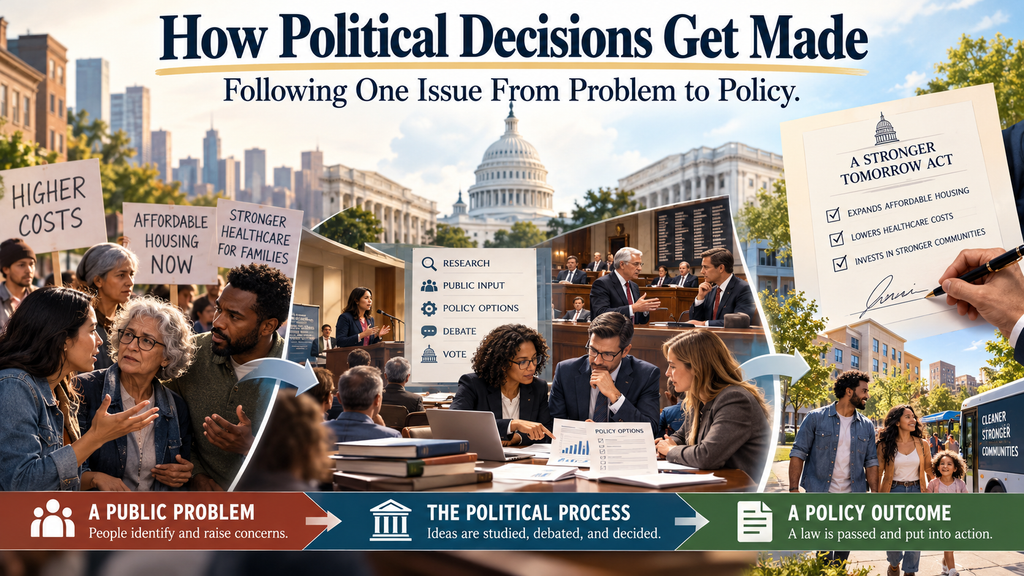
Most people picture a political decision as a single moment: hands go up, a bill passes, the matter is settled. That moment exists, but it is one stage in a longer political decision making process, and many people have already shaped the outcome before the vote happens.
The easiest way to see this is to follow one issue from start to finish. This article uses an imaginary town called Elmford and an imaginary problem: cars travel too fast on Harbor Road, right outside the elementary school. Nothing about Elmford is real, but the stages it goes through are the ones real issues go through in towns, states and countries alike.
Why political decisions rarely happen in one moment
A decision looks sudden from the outside because the vote is the only part that happens in public view, on a set date, with a clear result. Everything before it is scattered across conversations, emails, meetings and reports.
It helps to think of six stages: getting noticed, getting on the agenda, being shaped, being decided, being carried out, and being judged afterwards. They do not always run in a neat order, and an issue can stall or restart at any of them. Many issues never get past the second stage.
Each stage also involves different people. A parent who writes an email, a staff member who drafts a report, a council member who negotiates and an official who paints the road markings are all part of the same decision. Seeing the whole chain explains why politics feels slow, and why it is so hard to say that one person “made” a decision.
A problem has to be noticed before anyone can solve it
In Elmford, the speeding on Harbor Road has been going on for a long time, but a problem is not political until enough people treat it as something that should be fixed by public action. For a long while, parents may simply have accepted it as the way the road is.
Several things can change that. A near miss in front of the school gets talked about at pickup. A local news site runs a story. A parent posts on a neighborhood group and finds that dozens of people have the same worry. Until that moment, each person assumed they were the only one bothered.
Notice what has not happened yet: nobody in government has been asked to do anything. The issue exists only as a shared complaint. Many problems stay at this stage for years because nobody puts them into words, or because the people affected have little time or few ways to be heard.
Getting on the agenda: who decides what gets attention
Governments have more problems in front of them than they can handle. Every town council, state legislature and national parliament works from an agenda, a list of what will be discussed and in what order. Getting on that list is a competition.
In Elmford, the parents’ group has a few routes. They can speak during the public comment period of a council meeting, email council members directly, or ask a member who already cares about child safety to put the topic on a future meeting. A local reporter covering the story adds pressure, because officials notice what is in the paper.
Some people control the agenda more than others. A mayor, a committee chair or a council president often decides which items come up and when. That is real power, even though it never shows up in a vote count. If the person who sets the agenda thinks road safety is minor, the issue can wait a long time, however many parents turn up.
For a closer look at how local bodies like Elmford’s council are organized, see this introduction to local governments.
Shaping the options: experts, interest groups and ordinary voters
Once the council agrees to look at Harbor Road, the question changes from “should we do something?” to “what exactly should we do?” This is where the options get defined, and the way they are defined often decides the result.
Several groups contribute:
- Experts and staff. A traffic engineer might compare speed bumps, a lower speed limit, a crosswalk with flashing lights, or a camera that issues tickets. Each has different costs and effects, and the engineer’s report narrows what the council will seriously consider.
- Interest groups. A neighborhood association might want speed bumps. A delivery company that uses Harbor Road might argue that bumps slow its trucks. A local business group might worry about parking changes.
- Ordinary voters. Residents attend meetings, answer surveys and write letters. Their input is uneven, because people with strong feelings and free evenings are heard more than people with neither.
The options that reach the council are rarely a full list of everything possible. They are the ones that survived this shaping stage. Whoever writes the first draft of a proposal has a quiet advantage, because later debate tends to start from their text.
Bargaining and compromise: where coalitions do their work
Suppose the council has five members. Two want speed bumps, one wants a camera, one worries about cost, and one thinks the real problem is a different road across town. None has a majority alone.
This is where bargaining begins. The member who wants speed bumps might agree to add a camera for the school hours in exchange for support. A member worried about cost might agree if the money comes from an existing road maintenance budget instead of a new tax. Another might ask for a promise that the road across town gets studied next.
These deals are how groups of people with different goals produce a decision at all. The temporary partnerships that form around them are called coalitions, and you can read more in this overview of coalitions and alliances.
Compromise often leaves everyone partly unhappy. The final proposal may be less than the parents hoped for and more than the cost-minded member wanted. That is usually a sign the bargaining worked, since a proposal that satisfies nobody completely is often the only one that can win enough votes.
The decision itself: votes, signatures and who has the final say
Now comes the part most people picture. The council meets, discusses the proposal one last time and votes. If three of five members say yes, it passes.
Even then the decision may not be final. In many systems a vote is followed by another step. A mayor might need to sign the measure, or could veto it, in which case the council might need a larger majority to override. In a national government the same pattern appears with more layers: one chamber passes a bill, another has to agree, and a president or prime minister signs it. The legislative branch is where much of this voting happens.
Other bodies can also stop or change a decision after it is made. A court might rule that a measure went beyond what the council was allowed to do, and a higher level of government might overrule a local rule. The way these powers limit each other is explained in this post on checks and balances.
In Elmford, suppose the proposal passes and the mayor signs it. On paper, the problem now has an answer.
Carrying it out: why a decision on paper is not the end
A passed measure is an instruction, and someone still has to follow it. In Elmford that means the public works department, which has its own budget, schedule and list of other jobs.
Many things can go wrong here. The department might not have enough staff to install the speed bumps before winter. The contractor’s bid might come in higher than expected, so the work gets cut back. The camera might need a permit or a legal review before it can issue tickets. Officials may also read the council’s instructions differently from how the council meant them.
The people who carry out decisions, often called administrators or civil servants, make many small choices that the vote never specified: exactly where the speed bumps go, how tall they are, when the school-hours rule starts. Those choices determine what drivers on Harbor Road actually experience.
This is why a decision can pass and still change very little. A law with no money, staff or enforcement behind it stays on paper. Anyone judging a political decision should look at what was done, as well as what was voted.
Review and feedback: how results send an issue back to the start
After the speed bumps go in, people watch what happens. The school might notice that cars now slow down. Or drivers might start using a nearby residential street to avoid the bumps, bringing the speeding problem somewhere else.
Feedback comes through several channels:
- Officials measure traffic speeds and accident reports.
- Local reporters follow up on the story.
- Residents tell council members what they see, in meetings and at the next election.
- Auditors or oversight bodies check whether the money was spent as planned.
When the results are poor, the issue starts again. The new problem on the side street is noticed, someone asks to put it on the agenda, and the cycle repeats with the earlier decision as part of the background. This is why the process is better described as a loop than a straight line. A decision is the best answer available at one moment, and it is open to revision when the evidence changes.
Elections are one more form of review. Voters who are pleased or displeased with how their representatives handled an issue can reward or punish them, which gives officials a reason to pay attention to results.
How to follow a live decision as it happens
You can apply this framework to any issue in the news, whether it is local or national. Choosing one issue and tracking it for a few weeks teaches more than reading general explanations.
Ask these questions in order:
- Who first raised it, and why now? This tells you how it got noticed.
- Is it on an official agenda? Look for meeting schedules, which many local governments publish online.
- Who wrote the proposal, and who was consulted? The drafters and the groups that testified have shaped the options.
- Who needs to agree for it to pass? Count the votes and look for deals between groups.
- Who signs it, and who could challenge it? A vote is not always the end.
- Which agency is responsible for carrying it out, and does it have the money and staff?
- How will anyone know whether it worked? Look for reports, data and follow-up coverage.
Reading a few different news sources on the same issue also helps, since each tends to emphasize a different stage. When you know which stage an issue is in, you can see what is likely to happen next, and who has influence at that point. That is the most practical use of understanding the political decision making process: it tells you where to look and when your voice carries the most weight.