Most American voters can predict how their state will vote in a presidential election years before anyone casts a ballot. California will go to the Democratic candidate. Wyoming will go to the Republican. The outcome in those places is settled early, which means the campaigns, the ad spending, and the candidate visits go somewhere else entirely. That somewhere else is a swing state, and understanding why only a few states carry that label explains more about American elections than any description of how the Electoral College adds up votes.
What Makes A State ‘Swing’ Instead Of Safe
A safe state is one where a single party has won by a comfortable margin in election after election, often for decades. A swing state is one where the margin between the two parties has been narrow enough, recently enough, that nobody can call the result in advance. The label is not official and no government body assigns it. It emerges from a pattern of close results and shifting outcomes over multiple elections.
The difference between safe and swing is about margin, not size or region. A state can have millions of voters and still be safe if one party consistently wins it by double digits. A smaller state can be a swing state if its vote splits close to even. What matters is whether the outcome is genuinely contested, which means both parties have a realistic chance of winning it and both believe campaigning there can change the result.
This is why swing states draw so much attention relative to their population. They are not necessarily the biggest prizes in terms of electoral votes. They are the prizes that are actually in play.
The Electoral College Math Behind Swing State Power
Presidential elections are not decided by the national popular vote. Each state is awarded a number of electoral votes based roughly on its population, and in every state except Maine and Nebraska, the candidate who wins the statewide popular vote receives all of that state’s electoral votes. A candidate needs a majority of the total electoral votes nationwide to win the presidency.
This winner-take-all arrangement is what turns safe states into non-events for campaign purposes. If a candidate is certain to win a state’s popular vote by a wide margin, winning it by a slightly wider or narrower margin does not change how many electoral votes they get. All the electoral votes go to the winner regardless of whether the margin is one point or twenty.
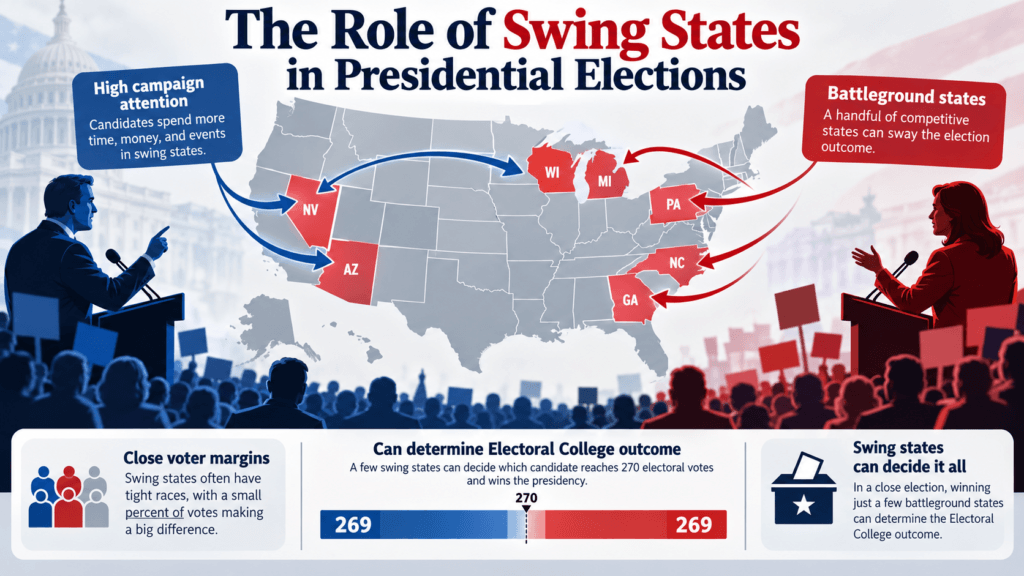
Swing states work differently because the winner is not known in advance. A shift of a few thousand votes in a closely divided state can flip its entire bloc of electoral votes from one candidate to the other. That makes every vote in a swing state carry outsized weight in determining the national outcome, compared to a vote cast in a state whose result is already settled. A deeper look at how this math shapes where candidates actually spend their time and money is covered in how the Electoral College affects campaign strategy.
Which States Have Earned The Swing Label Over Time
The list of swing states has never been fixed. States that were once reliably safe for one party have become competitive, and states that were once battlegrounds have settled into safe territory for the other side.
A few patterns stand out across recent decades:
- States in the industrial Midwest, including Ohio, Michigan, Wisconsin, and Pennsylvania, were central battlegrounds through much of the late twentieth and early twenty-first centuries, tied to manufacturing employment and union membership that made their politics harder to predict.
- Florida built a long reputation as a swing state through the 1990s and 2000s, driven by a diverse population and a closely split electorate, though its results have leaned more consistently toward one party in more recent elections.
- Sun Belt states such as Arizona, Georgia, and North Carolina have moved from reliably Republican to genuinely contested as their populations have grown and diversified, drawing new residents from other parts of the country.
- States like Virginia and Colorado, once considered swing states, have trended more reliably toward one party as their suburban populations have grown.
No state is permanently assigned to either category. The label describes a current condition, not a fixed identity, which is why political analysts revisit the list of competitive states before every election cycle rather than assuming it carries over unchanged.
Why Swing States Shift From One Election To The Next
A state’s swing status changes because the voters within it change, and because the national political coalitions that parties build shift over time.
Population movement is one driver. When people move from one state to another, they often bring their political leanings with them, and large enough migration can shift a state’s overall balance. Growth in urban and suburban areas relative to rural areas has reshaped the competitiveness of several states over the past two decades.
Demographic change within a state matters too. Shifts in age, education level, race, and ethnicity among a state’s population can move its overall partisan lean even without anyone moving at all, as younger voters replace older ones and as existing residents’ views shift.
Economic conditions tied to a particular region can also make a state more or less predictable. A state whose economy depends heavily on an industry facing disruption, for example, may see its voters respond strongly to candidates’ positions on trade, jobs, or regulation in a way that does not hold once that economic pressure eases or shifts.
Finally, the parties themselves change. The coalition of voters that supports a party is not static, and as a party’s positions or candidates evolve, the voters most responsive to them can shift accordingly, pulling states in or out of competitive territory as a result.
What Living In A Swing State Actually Changes For Voters
For a voter, living in a swing state changes the practical experience of a presidential election season in several concrete ways.
Television and digital advertising spending concentrates heavily in these states, meaning residents see a volume of campaign ads during election season that voters in safe states rarely encounter. Candidates and their running mates make repeated in-person visits, holding rallies and town halls in swing state cities and towns that safe-state voters may never see a presidential candidate visit at all.
Local and state news coverage in swing states tends to treat the presidential race as a dominant story for months, since the outcome locally has genuine national consequences. Campaign field offices, canvassers, and phone banks operate at a scale in swing states that simply does not exist in states where the outcome is assumed.
There is also a psychological dimension. Voters in swing states often report feeling that their individual vote carries more weight, and turnout in competitive states is frequently higher than the national average as a result. Whether or not any single vote is likely to be decisive, the sense of being part of a contest that could go either way changes how seriously many voters engage with the election.
Could Reform Ever Make Swing States Obsolete
The concentration of attention on a small number of states is a direct consequence of how electoral votes are awarded, and it has prompted recurring proposals to change the system. Reform ideas range from moving to a national popular vote to changing how individual states allocate their electoral votes, and each would affect the swing state dynamic differently.
A shift to electing the president by national popular vote would eliminate the swing state phenomenon entirely, since every vote nationwide would count equally toward the same total regardless of which state it came from. Other, more incremental proposals, such as splitting electoral votes by congressional district rather than awarding them winner-take-all, would change which areas become competitive without eliminating the underlying dynamic of concentrated attention on specific places.
None of these proposals has been adopted at the national level, and each carries its own set of tradeoffs and political obstacles. The full range of these ideas, along with why none has succeeded so far, is covered in the history of Electoral College reform proposals.
For now, the system that produces swing states remains in place, and the list of which states hold that status will likely keep shifting the way it always has, shaped by where people move, how populations change, and how the parties themselves evolve. For a closer look at how candidates target these states with time and money, read how the Electoral College affects campaign strategy.