
Every four years, the same number gets repeated on election night: 270. It gets treated like a finish line, as if the whole system were built to always produce a winner by that number. It wasn’t. The Constitution anticipated the opposite outcome too, and it wrote out, in detail, what happens when no candidate reaches a majority of electoral votes. That backup plan has its own rules, its own history, and its own two near misses that show exactly how it works.
The magic number: why 270 matters
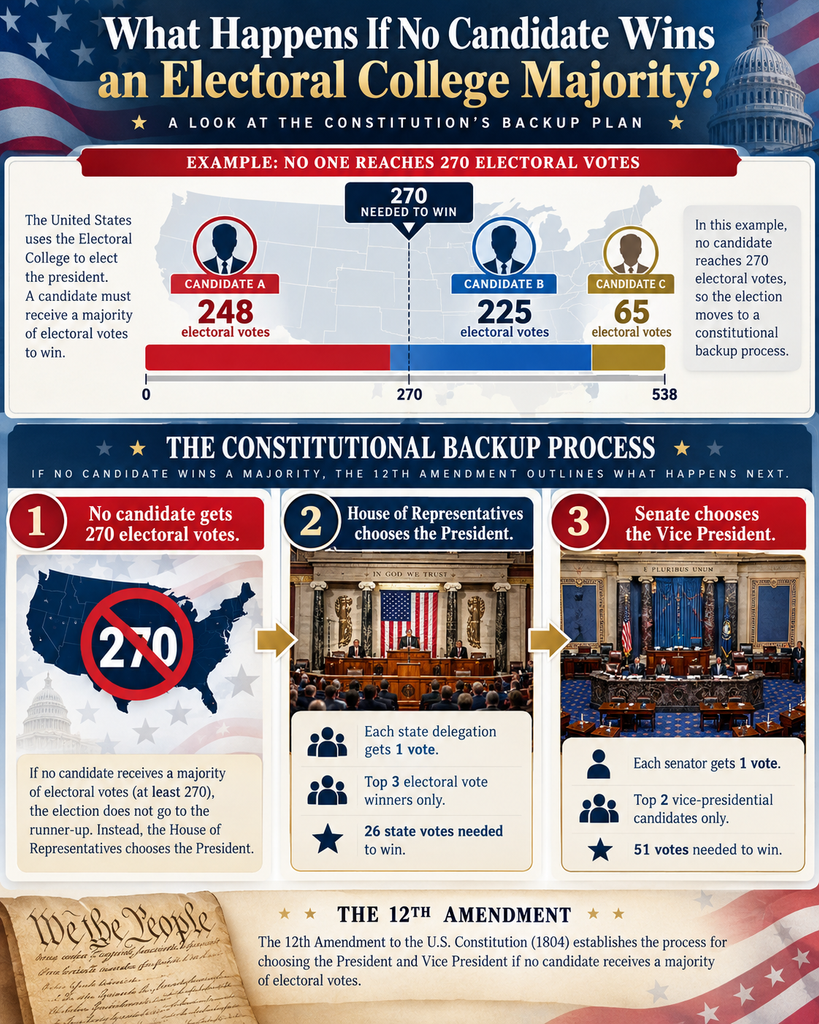
There are 538 electors total, one for each member of the House and Senate, plus three for Washington, D.C. To win the presidency outright, a candidate needs a majority of those votes, not just the most votes. Half of 538 is 269, so 270 is the smallest whole number that clears a majority.
That distinction matters more than it sounds like it should. A candidate could finish with the most electoral votes of anyone in the race and still fall short of the presidency if the total is split three or more ways, or if it divides evenly between two candidates. Either scenario leaves the country without an Electoral College winner, and the Constitution hands the decision to Congress instead.
The 12th Amendment’s backup plan
The original Constitution had a method for this, but it broke badly in the election of 1800, which is covered below. Congress and the states fixed it with the 12th Amendment, ratified in 1804, and that amendment is still the rule today.
The 12th Amendment splits the job in two. If no presidential candidate reaches 270 electoral votes, the House of Representatives chooses the president from among the top three electoral vote getters. If no vice presidential candidate reaches a majority, the Senate chooses the vice president from the top two. These are called contingent elections, and they run on separate tracks with separate rules, which means it’s possible for the House to seat a president from one party while the Senate seats a vice president from another.
How the House picks a president, one state, one vote
This is the part that surprises most people the first time they hear it. The House doesn’t vote the way it normally does, with 435 members each casting one vote. In a contingent election, each state delegation gets exactly one vote, decided by whatever process that state’s House members agree on internally.
That means California’s 52 representatives have to agree on a single vote, and Wyoming’s lone representative casts that state’s entire vote alone. A state with a delegation split evenly in half casts no vote at all unless its members break the tie somehow. Washington, D.C., despite having three electoral votes, gets no vote in this process because it has no voting House member.
A candidate needs the votes of at least 26 states to win, a majority of the 50. The vote happens with the new House, the one elected in that same November election, not the outgoing one, and the Constitution requires at least one member from two-thirds of the states to be present for the vote to count at all.
How the Senate picks a vice president
The Senate’s job is simpler on paper. Each of the 100 senators casts one individual vote, choosing between the top two electoral vote getters for vice president. A candidate needs 51 votes to win. There’s no state-by-state grouping here, no delegation math, just a straight majority vote among senators.
If the Senate deadlocks or somehow fails to pick a vice president before Inauguration Day, that’s where it gets interesting. If the House has already picked a president by then, that president just serves without a vice president until the Senate resolves it. If neither chamber has resolved its vote by Inauguration Day, the Presidential Succession Act determines who serves as acting president, typically the Speaker of the House, until Congress finishes the job.
When this almost happened: the elections of 1800 and 1824
The 1800 election is the reason the 12th Amendment exists. Under the original rules, electors each cast two votes for president with no separate ballot for vice president, and the candidate with the second-most votes became vice president. Thomas Jefferson and his running mate Aaron Burr ended up tied with 73 electoral votes each, because the electors who supported them hadn’t coordinated to throw away a vote for Burr the way the system assumed they would.
That tie sent the election to the House, where it took 36 separate ballots over several days before Jefferson finally won enough state delegations. The deadlock exposed a real flaw in the original design, and Congress moved to fix it with the 12th Amendment before the next election, separating the presidential and vice presidential ballots for good.
The election of 1824 is the only time the fixed system has actually been used. Four candidates split the electoral vote: Andrew Jackson won the most electoral votes and the most popular votes, but not a majority, since John Quincy Adams, William Crawford, and Henry Clay all pulled votes away from him. The contest went to the House, limited to the top three finishers, which meant Clay, who had finished fourth, was out of the running himself but still Speaker of the House and highly influential in it.
Clay threw his support behind Adams, who won the House vote despite Jackson’s lead in both electoral and popular votes. When Adams then named Clay his Secretary of State, Jackson’s supporters called it a “corrupt bargain,” and the controversy helped fuel Jackson’s campaign and eventual win four years later. It remains the clearest real-world demonstration of how a contingent election can produce a president who didn’t lead in either popular or electoral votes going in.
Could a contingent election happen again
It hasn’t happened since 1824, but the structural conditions haven’t gone away. A contingent election becomes possible any time a third-party or independent candidate wins enough electoral votes to keep either major candidate below 270, or in the rarer case of an exact 269 to 269 split between two candidates.
The 269 to 269 scenario gets discussed more now because of how closely some recent elections have been decided in a handful of states. It would only take a shift of a small number of electoral votes in certain states to produce that exact tie, and if it happened, the outcome wouldn’t hinge on the national popular vote or even the usual Electoral College math. It would hinge on which party controls more state delegations in the incoming House, since that’s the body deciding the president under this process. That’s a very different kind of contest than the one most voters think they’re participating in on election night, and it’s part of why the mechanics of swing states and close margins carry so much weight; for more on how those states shape campaign strategy in the first place, see The Role Of Swing States In Presidential Elections.
What a tied Electoral College reveals about how the system was built
The contingent election process shows something the “270 to win” shorthand hides: the framers didn’t design a system that guarantees a clean, direct answer every time. They designed layers, with the popular vote feeding into state-level electors, electors feeding into a national count, and that count, if it fails to produce a majority, feeding into Congress itself. Each layer has its own rules, its own math, and its own way of representing the country, whether by population, by state, or by individual vote.
That layered design was deliberate. It reflects the same compromise between large and small states that shows up throughout the Constitution, giving Wyoming a voice equal to California’s in a contingent House vote even though their populations aren’t remotely comparable. Understanding that design doesn’t require agreeing with it, but it does explain why the process looks the way it does, and why a tie or a near tie doesn’t break the system. It just moves the decision to a different room.
Already comfortable with how a contingent election works? Read Common Myths And Facts About The Electoral College next to clear up the misconceptions that usually come up alongside this scenario.