
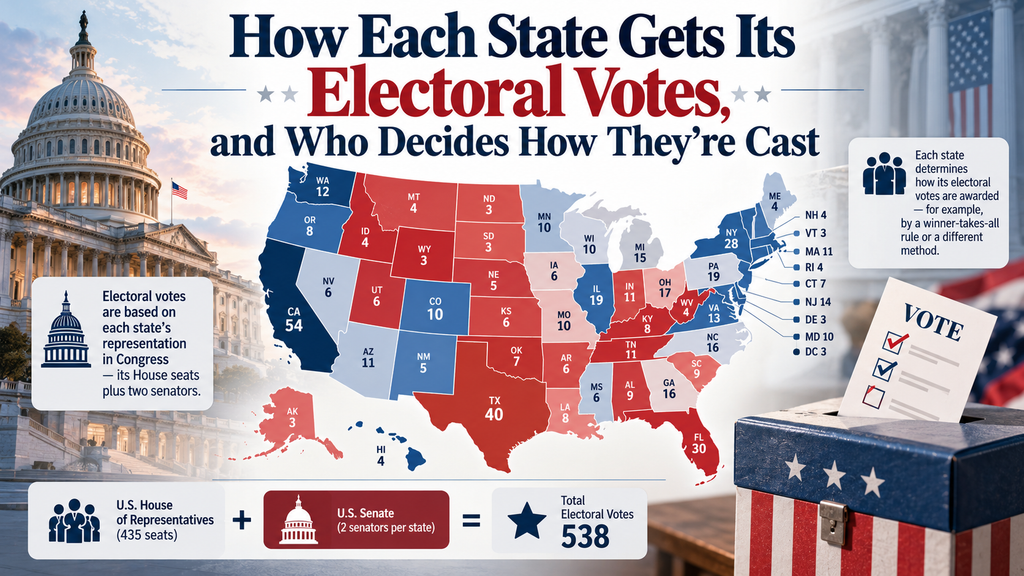
Every four years, news coverage talks about a candidate “winning” a state and picking up its electoral votes. That sentence combines two separate questions. One is how many electoral votes a state has. The other is how the state decides which candidate gets them. This article covers both, because how electoral votes are allocated to states depends on a different rule at each step.
Where the 538 comes from and why 270 wins
The Electoral College has 538 electors in total. That number is not chosen directly. It is the sum of three smaller numbers:
- 435 members of the U.S. House of Representatives
- 100 U.S. senators
- 3 electors for Washington, D.C.
A candidate needs a majority of those 538 to win the presidency. Half of 538 is 269, so the first number above half is 270. A candidate with 270 or more electoral votes wins outright. If no one reaches 270, a separate process in Congress decides the result, which the post on what happens if no candidate wins an electoral college majority covers in detail.
The rest of this article works backward from 538 to show where each state’s share comes from.
Your state’s number: House seats plus two senators
A state’s electoral votes equal its number of House seats plus its two Senate seats. The formula comes directly from the Constitution, which gives each state a number of electors equal to the “whole number of Senators and Representatives” it has in Congress.
The two parts of the formula work differently:
- The Senate part is fixed. Every state has two senators, whether it is the most or the least populated. That adds two electoral votes to every state’s total.
- The House part depends on population. Seats in the House are divided among the states according to how many people live in each one. A state with more residents gets more seats.
This is why the smallest states have three electoral votes. Wyoming, for example, has one House seat plus two senators. California has 52 House seats plus two senators, which gives it 54 electoral votes, the largest total of any state.
The design mixes two ideas about representation. The House seats reward population, and the Senate seats give every state the same baseline. The result is that small states have somewhat more electoral weight per resident than large states, while large states still hold far more electoral votes in total. If you want to see how Congress itself is built on this two-chamber structure, the post on bicameral and unicameral legislatures explains why the House and Senate divide representation in different ways.
Why Washington, D.C. has electors too
Washington, D.C. is not a state and has no voting members in the Senate or the House. Under the original Constitution, that meant it had no electors either, so residents of the capital could not take part in presidential elections.
The 23rd Amendment, ratified in 1961, changed that. It gave D.C. the number of electors it would have if it were a state, with one limit: it can never have more than the least populous state. Since the smallest states have three electoral votes, D.C. has three.
That is where the 3 in the 538 comes from. D.C. has electors for the presidential race, but it still has no voting representation in Congress.
How the census quietly reshuffles the map every ten years
The number of House seats is fixed at 435. Congress set that limit in 1929, and it has not changed since. So when the population shifts, seats cannot simply be added for growing states. Seats have to move from one state to another.
This happens through a process called reapportionment, which follows the census:
- The Census Bureau counts the population of the country every ten years, in years ending in zero.
- The 435 House seats are divided among the 50 states based on those counts.
- States that grew faster than the national average may gain seats, and states that grew more slowly may lose them.
- Each state’s electoral votes change with its House seats, because the Senate part stays at two.
A state that gains a House seat gains an electoral vote. A state that loses one loses an electoral vote. The total stays at 538, so every gain somewhere is matched by a loss somewhere else.
The timing matters. The 2020 census set the current distribution, and it applies to the 2024 and 2028 presidential elections. The next census is in 2030, and the numbers it produces will first be used in the 2032 election. Between censuses, a state’s electoral vote total does not change, even if its population changes a lot.
Reapportionment is quiet because it rarely makes headlines, but over several decades it moves real political weight. It is a slow, steady reason why the electoral map of one era looks different from the map of another.
Winner-take-all: how most states hand out their votes
Once a state has its number, it needs a rule for assigning those votes. The most common rule is winner-take-all. Under it, the candidate who gets the most votes in the state receives all of that state’s electoral votes.
Forty-eight states and Washington, D.C. use this system. In a state with 10 electoral votes, a candidate who wins the state by a large margin gets 10, and a candidate who wins it by a single vote also gets 10. The losing candidate gets zero in either case.
A few things follow from that:
- Margins inside a state do not carry over. A huge win in one state does not add extra electoral votes anywhere else.
- Close races are not split. The candidate who finishes second in a winner-take-all state receives nothing for the votes cast for them.
- The national popular vote and the electoral count can differ. A candidate can win more votes across the country while winning fewer states, or the right combination of states, which is how the two totals sometimes disagree.
This single rule also shapes where campaigns spend their time and money. The post on swing states in presidential elections looks at what that means in practice, so this article stays with the mechanics.
Maine and Nebraska: the two states that split their votes
Two states use a different method, usually called the congressional district method. Maine and Nebraska divide their electoral votes instead of awarding them all to one candidate.
Under this method, a state’s electoral votes are split in two groups:
- Two electoral votes go to the winner of the statewide vote. These correspond to the state’s two Senate seats.
- One electoral vote per congressional district goes to the winner of the vote in that district. These correspond to the state’s House seats.
Maine has four electoral votes. Two go to the statewide winner, and one goes to the winner in each of its two congressional districts. Nebraska has five. Two go to the statewide winner, and one goes to the winner in each of its three districts.
This makes it possible for a state to divide its votes between candidates. Nebraska did so in 2008, when one of its districts voted for a different candidate than the rest of the state. Maine has had the same thing happen in a later election as well. Maine has used the method since 1972 and Nebraska since 1992.
The other 48 states and D.C. could adopt the same system, but each would have to decide to change its own law. Neither method is required by the Constitution, which leads to the last question.
Who decides the rules: the Constitution and your state legislature
The Constitution sets the framework but leaves a lot to the states. Article II says each state appoints its electors “in such Manner as the Legislature thereof may direct.” In other words, the state legislature decides how electors are chosen.
In the early years of the country, some legislatures picked electors themselves, and no popular vote took place. Over time, every state moved to letting voters decide. Today, every state’s electors are chosen based on a statewide vote, but the details still come from state law. That includes:
- Whether the state uses winner-take-all or a district method
- How electors are nominated, which is usually done by the political parties
- When and where electors meet to cast their votes
- What rules apply to electors once they are chosen
Because these are state laws, they can change. A legislature can pass a new law about how it awards electoral votes, as Maine and Nebraska did when they adopted their district methods. That is also why proposals for changing the system often focus on state action, which the post on the history of electoral college reform proposals goes through.
The Constitution itself sets the outer limits: the number of electors, the role of Congress in counting votes, and the constitutional amendments that have adjusted the process over time. For a broader look at why constitutions divide authority this way, see the role of constitutions in governments.
Where to go next
Now that you have the two questions separated, you can follow the rest of the process more easily. Each state’s total comes from its House seats plus two Senate seats, updated after every census. Each state’s method then decides how the total is divided.
Two related topics build directly on this:
- To see how the winner-take-all rule changes where candidates campaign, read about the role of swing states in presidential elections.
- To learn what happens after a state assigns its electors, and whether those electors must follow the state’s result, read can Electoral College electors vote against their state’s results.