
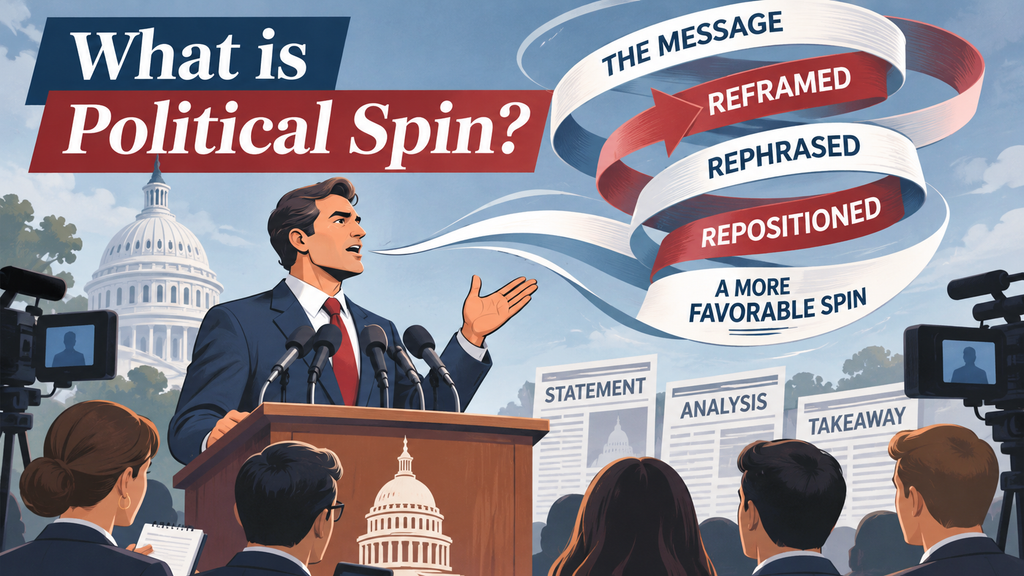
Political spin is the practice of presenting true information in the way that helps the presenter most. A politician, a party or a press office picks which facts to lead with, how to describe them and when to release them, so that the audience reaches a favorable conclusion. Most people who ask what political spin is have already sensed it: a statement that is technically accurate and still leaves them feeling steered.
Spin is common to every party, every government and most organizations that want public support. Learning to see it works best when you look at the technique and ignore whose side is using it. Once you can spot the move, you can spot it from anyone.
Spin in plain English: the same facts, told to win
Spin starts with a simple observation: no one can say everything. Any statement about an event leaves out most of what happened, so the speaker has to choose. Spin is that choice, made with an eye on the result.
Three decisions make up almost all of it:
- Which true facts to emphasize. A budget has winners and losers, and a speech can name only some of them.
- How to frame them. The same tax change can be a “relief for families” or a “giveaway to the wealthy,” depending on which effect is described first.
- When to release them. Good news gets a press conference. Bad news may come out late on a holiday eve, or be bundled with a bigger story.
Nothing in that list requires a false statement. That is why spin works so well and why it is hard to catch: a fact-check can confirm every sentence and the overall impression can still be lopsided.
One news event, two spins: a worked example from opposite sides
Here is an invented example, so no real party or person is involved. Suppose a state releases its monthly jobs report. Assume these facts are all accurate:
- Employers added 8,000 jobs.
- The unemployment rate rose from 4.1 percent to 4.3 percent.
- The rate rose because more people started looking for work, which enlarged the labor force.
- Job gains have continued for several months.
The governor’s party issues this statement: “Our state added 8,000 new jobs last month, and more residents than ever are confident enough to start looking for work. The recovery continues.”
The opposition party responds: “Unemployment climbed to 4.3 percent today. Thousands more people are searching for work and can’t find it.”
Both statements are true. The first leads with job creation and explains the higher rate as a sign of confidence. The second leads with the higher rate and describes the new job seekers as people who are failing. Each side left out the half that hurts it: the governor’s office did not mention that the rate rose, and the opposition did not mention that employers hired.
Neither side lied. Each told a version of the event built to support its argument. If you only ever heard one of them, you would come away with a clear picture that is missing half the data.
The spin toolkit: framing, selective emphasis, timing and euphemism
The jobs example used two techniques at once. Spin generally draws on four.
Framing
A frame is the context that tells you what a fact means. “The state spent $50 million on the program” sounds different from “the state invested $50 million in the program,” and different again from “the program cost taxpayers $50 million.” The number is identical. The verb and the noun carry the judgment.
Framing also covers the comparison point. A figure can be “up 12 percent from last year” or “still below where it was five years ago.” Both can be correct, and the choice of baseline decides whether it sounds like progress or decline.
Selective emphasis
This is the choice of what goes in the headline, what goes in paragraph six and what is left out. Percentages and raw numbers are a common tool here. A small change in a large number sounds modest as a raw figure and dramatic as a percentage, or the other way round, and speakers pick whichever helps.
Timing
Information released at a moment of low attention gets less scrutiny. A practice often called a “Friday news dump” means publishing unwelcome news when fewer people are reading. The reverse also happens: favorable numbers are often scheduled to appear right before an election or a vote.
Euphemism and loaded words
Euphemism softens a hard fact. “Downsizing” or “workforce reduction” describes people losing jobs. “Revenue enhancement” can mean a tax increase. The opposite move uses a charged word to make something sound worse than a neutral description would. If a phrase seems to be doing the arguing for the speaker, it probably is. You can find more of these verbal techniques in how politicians use rhetoric.
Spin, lying and propaganda: where the lines fall
These three get mixed together, but they differ in ways that matter.
Spin shapes true information. Every claim can be verified, and the distortion comes from selection, emphasis and framing.
Lying asserts something false. If a spokesperson says the unemployment rate fell when it rose, that is a lie. It can be checked and proven wrong, which is why most professional communicators avoid it and prefer spin.
Propaganda is a sustained, organized effort to shape what a whole population believes, usually by appealing to emotion and identity more than evidence. It may use truths, half-truths and falsehoods together, and it often aims to make people stop trusting alternative sources. The longer treatment is in the article on propaganda in politics.
The boundaries are not perfectly sharp. Spin drifts toward lying when the omission is so large that the listener ends up believing something false. If a company says “no layoffs this quarter” while planning them for next week, each word may hold up and the overall message is still deceptive. A useful test is whether a reasonable listener, given the full picture later, would feel misled and not simply disappointed.
Scale and intent matter for propaganda. One press release with a hopeful framing is spin. A coordinated, long-running campaign that floods every channel with one message and discredits every other is a different thing.
Who spins: campaigns, officials, press offices and, yes, the media
Anyone with an interest in how an event is understood has a reason to spin it:
- Campaigns shape every statistic and event around a candidate’s message.
- Elected officials and agencies present their own record, and a government press office exists largely to do this.
- Parties and advocacy groups pick the studies, numbers and stories that support their cause.
- Opposing parties do the same in reverse, as the jobs example showed.
- The news media choose which events to cover, what goes in the headline, which sources to quote and how to describe the people involved. Outlets have audiences, and what keeps an audience engaged influences those choices. Most journalists try to be accurate, and accuracy still leaves room for emphasis.
- Ordinary people do it when they share a post that supports their view and skip the one that complicates it.
Seeing the media on the list does not mean everything in the news is false. It means a news story is also built from choices, and it is worth asking what was chosen. How your own news habits affect what you see is covered in the piece on how media influences political participation.
Five questions to ask when a story feels too tidy
A story that is perfectly clear, with obvious heroes and villains, deserves a second look. These questions work on any source.
- Compared to what? Check the baseline. Is the number being measured against last month, last year, a peak, a promise or another place? A different comparison might tell a different story.
- What is missing? Ask what a person on the other side would add. If the governor’s statement leaves out the unemployment rate, that is the first thing to look up.
- Why now? Notice the timing. A big announcement just before a vote or an election, or a quiet one at a slow news moment, is information in itself.
- Which words are doing the work? Find the adjectives, verbs and labels that carry a judgment, then replace them with neutral ones in your head. If the claim gets weaker, the wording was supplying part of it.
- How would the other side tell it? Look for the opposing version, and look for the facts both versions share. That overlap is usually the most reliable core of the story.
Numbers deserve their own care. A figure from a survey, for example, can be reported in a way that suggests more certainty than it has, which the guide to how to understand opinion polls walks through.
Reading spin without becoming a cynic
Once you notice spin, it is tempting to decide that everyone lies and nothing can be trusted. That conclusion is as inaccurate as believing everything. Spin is selective telling of true facts, which means the facts are still there to be found.
A better approach is to treat each spun statement as partial information. The governor’s jobs claim is true, and so is the opposition’s unemployment claim. Together they give a more complete picture than either does alone. Reading this way turns spin from an annoyance into a clue about what each side wants you to focus on and what each would rather you skip.
It also helps to apply the same standard to every source, including the ones you agree with. Spin from your own side is the hardest to see because it sounds like common sense. If you only catch it from people you oppose, you are noticing disagreement, and the technique goes unseen.
Practice on small cases: a press release, a campaign email, a headline. Find the emphasis, the frame, the timing and the loaded words, then write down what the other side would say. After a few rounds the pattern becomes quick to see, and you can take the facts on offer while setting aside the push toward a conclusion.