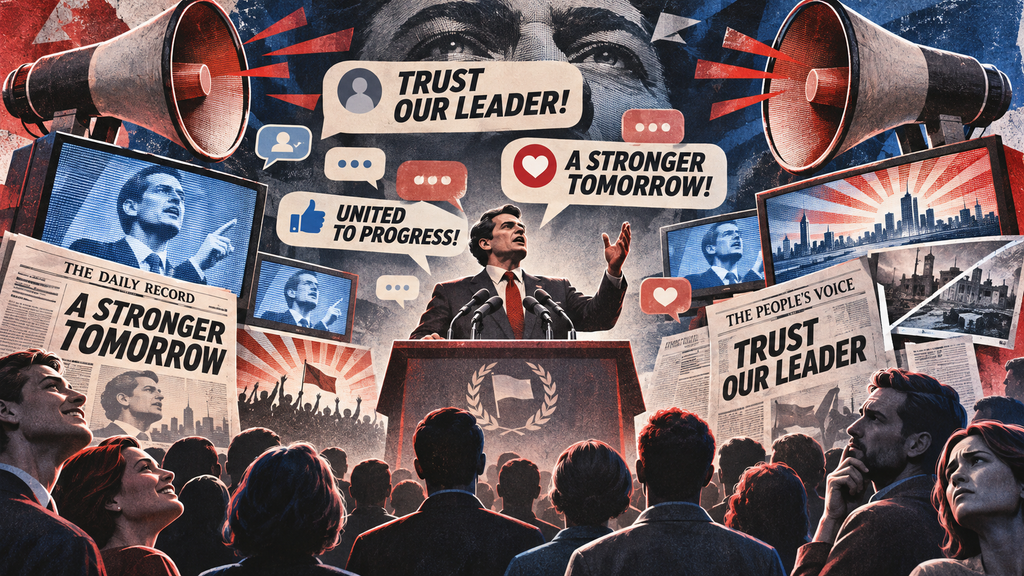
Propaganda in politics is the organized effort to shape what a large group of people believe or do, using messages designed to produce a reaction more than to inform. The word is older than most political parties. It comes from the Latin name of a committee the Catholic Church set up in the early 1600s to spread its faith, and for a long time it described that activity without any insult attached. It became a slur in the twentieth century, when wartime governments and mass media made large-scale message control something people feared.
Today almost nobody calls their own messaging propaganda. The word is used almost exclusively about the other side: “that’s just propaganda” means “that’s what they say, and I don’t believe it.” That habit is the main reason many people never learn to spot the real thing. If propaganda is only what your opponents produce, you will miss it every time it arrives in a form you like.
What propaganda actually means, and why the word gets thrown at the other side
A workable definition is this: propaganda is communication that aims to steer an audience toward a conclusion or action by managing what they see and how they feel, while giving them little chance to weigh the evidence themselves. The key part is the method. A message can be true, partly true or false and still be propaganda, because the test is how it tries to move you.
This also means the word describes a technique, not a political position. Governments, opposition parties, charities, corporations and neighbors on social media can all use it. A message you strongly agree with can be built exactly the way a message you hate is built.
People throw the word at opponents because it is a shortcut. Calling a message propaganda lets you dismiss it without answering it. That is a poor use of a useful idea, since the more valuable question is how a message works, whoever sent it.
Propaganda, persuasion, rhetoric and fake news: how they differ and where they overlap
These four terms get mixed up constantly, and they are not the same thing.
Persuasion is any attempt to change someone’s mind. A candidate explaining why a tax change would help local businesses, with figures you can look up, is persuading. Persuasion is a normal part of democratic life, and most of it is honest. It tends to give you reasons, admit that other views exist and leave you free to disagree.
Rhetoric is the craft of speaking and writing effectively: structure, tone, repetition, memorable phrasing. Every speech uses it, including good ones. Rhetoric becomes a concern only when the style is doing the work that evidence should be doing. The blog covers this in detail in how politicians use rhetoric and how to spot the techniques.
Fake news is false information presented as real reporting. The defining feature is falsehood. The harm it does to public debate is covered in what fake news does to politics and why it hurts every side.
Propaganda sits across these. It usually uses rhetoric, it is a deliberate form of persuasion, and it sometimes uses fake news, though it does not need to. A campaign can run a campaign built entirely on accurate statistics and still be propaganda if it picks only the numbers that help, hides context that would change the picture and wraps the result in imagery meant to produce fear or pride before you have thought it through.
A rough way to separate them:
- Persuasion that respects your judgment gives you reasons and room to disagree.
- Rhetoric is style, which can support either honest or manipulative content.
- Fake news is defined by false content.
- Propaganda is defined by a method of steering the audience, whatever the content.
Common propaganda techniques, with neutral examples from more than one side
The techniques below appear across the political spectrum. The examples are invented illustrations, not quotations from real campaigns, so you can see the pattern without arguing about the politics.
Loaded language. Words chosen for their emotional charge instead of their accuracy. One side might call a policy a “tax relief plan” while the other calls the same policy a “giveaway to the rich.” Both labels carry a verdict inside the name before any argument begins.
Selective facts. Sometimes called card stacking. A message presents the true statistics that support its case and leaves out the equally true ones that complicate it. A claim such as “unemployment fell under our government” and a claim such as “wages fell under their government” can both be accurate and both be misleading when the surrounding facts are removed.
Us versus them. The message divides people into a good group and a threatening group. A speaker on the left might blame “greedy billionaires” for ordinary people’s problems. A speaker on the right might blame “out-of-touch elites.” The structure is identical, only the villain changes.
Fear appeals. Messages that say a terrible outcome is imminent unless you act now. Fear is a fast, strong motivator, which is why it appears in so many ads, fundraising emails and speeches. Real dangers exist, so the question is whether the message gives evidence for the scale of the danger or only the feeling.
Bandwagon. “Everyone is joining us.” This suggests that the safe, normal choice is the one the crowd is making. Crowd size is not evidence that a position is right.
Glittering generalities. Appealing words nobody opposes, such as freedom, fairness, security, strength and family, used in place of specific commitments. Everyone agrees with them in the abstract, and the real disagreement is hidden in how they are applied.
False choice. The message offers two options and implies there are no others: “Either we do this, or the country collapses.” Most real policy questions have several options and trade-offs.
Repetition. A slogan repeated often enough feels true because it feels familiar. Familiarity and accuracy are different things.
Why it works: the emotions and habits it relies on
Propaganda succeeds because it works with ordinary human habits, not against them. Nobody has time to investigate every claim, so everyone relies on shortcuts, and propaganda is designed to fit those shortcuts.
- Emotion arrives first. Anger, fear, pride and disgust come quicker than analysis. A message that triggers one of them can get you to share or agree before you have asked whether it is accurate.
- Belonging matters. People want to be part of a group, and political identity is often part of that. A message that flatters your group, or threatens it, gets attention it would not otherwise earn.
- Agreement feels like evidence. When a claim fits what you already believe, you check it less. This is why messages from your own side are the ones most worth examining.
- Simple beats complicated. A clear story with a hero and a villain is easier to remember than a balanced account with trade-offs. Complex issues such as economic policy rarely have a clear villain, which makes them easy to oversimplify.
- Speed and repetition. Social feeds reward fast reactions. The more often you see a claim, the more credible it seems, whether or not anyone has checked it.
None of this means you are gullible. These are features of how every human mind handles an overload of information.
Who uses it: governments, parties, campaigns, advocacy groups and ordinary supporters
Propaganda is not limited to dictatorships or to one party. A short list of who uses it shows how broad the practice is.
- Governments use it to build support for their policies, to explain wars and to present their record. Official messaging in democracies and non-democracies both involves choices about what to emphasize and what to leave out.
- Parties and campaigns use it because elections reward short, memorable, emotional messages. Attack ads and positive ads alike are designed with this in mind.
- Advocacy groups on every cause use it to raise donations and attention. A fundraising email that shows the worst-case outcome of an issue is trying to move you to give, not to give you a balanced briefing.
- Ordinary supporters use it too. A meme with a cropped quote, a screenshot without context or a confident one-line summary of a complicated bill spreads propaganda techniques without any central planning. Many people who share such content sincerely believe it is accurate.
The last group matters most for a beginner, because it means you may be a channel for propaganda without ever intending to. How the platforms you read affect this is covered in how the news and social media you use shape whether and how you take part in politics.
Five questions to ask about any political message before you share it
These questions do not require expert knowledge, and none of them depends on which side is speaking. They work best when applied to a message you like.
- Who made this, and what do they want me to do? Identify the sender: a campaign, a government office, an advocacy group, an anonymous account. Then identify the action being asked for, whether that is voting, donating, sharing or simply feeling angry.
- What feeling is this trying to produce, and does it give me reasons as well? Notice your own reaction first. If the message produces strong emotion and offers little you could check, treat that as a signal to slow down.
- What is missing? Look for the context a fair account would include: the time period of a statistic, the comparison group, the cost of the proposal, the strongest argument against it.
- Can I confirm the main claim somewhere else? Find the original source of the central fact, such as the bill text, the full speech or the data release, and see whether other credible outlets with different leanings report it the same way. How to read an opinion poll is a good example of how a headline number can differ from what the data supports.
- Would I judge this the same way if the other side had sent it? Imagine the same technique, the same wording and the same evidence coming from a group you disagree with. If you would call it manipulative then, it deserves the same label now.
You will not always get clear answers. Even asking the questions changes how you share, because it creates a pause between reacting and spreading.
How to stay informed without becoming cynical about everything
Once people learn to see propaganda, a common mistake is to decide that everything is propaganda and nothing can be trusted. That conclusion is as unhelpful as believing everything. If no source is reliable, you have no basis for any decision, and that leaves the loudest voices unchallenged.
A more useful approach is to treat sources as more or less reliable and to keep adjusting that view. A few habits help:
- Read across sources. Compare how two or three outlets with different outlooks describe the same event. The facts they agree on are a solid starting point, and the differences show you where framing enters.
- Separate facts from interpretation. “The bill raises the budget by a stated amount” is a claim you can check. “The bill is reckless” is a judgment that needs arguments behind it.
- Prefer primary sources when possible. The text of a law, a full transcript or the original dataset often says less dramatic things than the summary does.
- Notice when you are being rushed. Urgent language, countdown timers and demands to share immediately are common in propaganda because they discourage checking.
- Stay open to being wrong. Changing your mind when evidence changes is a sign of a healthy information diet, not weakness.
Skepticism and trust can coexist. You can believe that most people and institutions are trying to tell you something true while still checking the claims that matter and noticing the methods used to persuade you.
Pick one political message you came across this week, ideally from a side you agree with, and run it through the five questions in this article. Then share what you noticed in the comments.