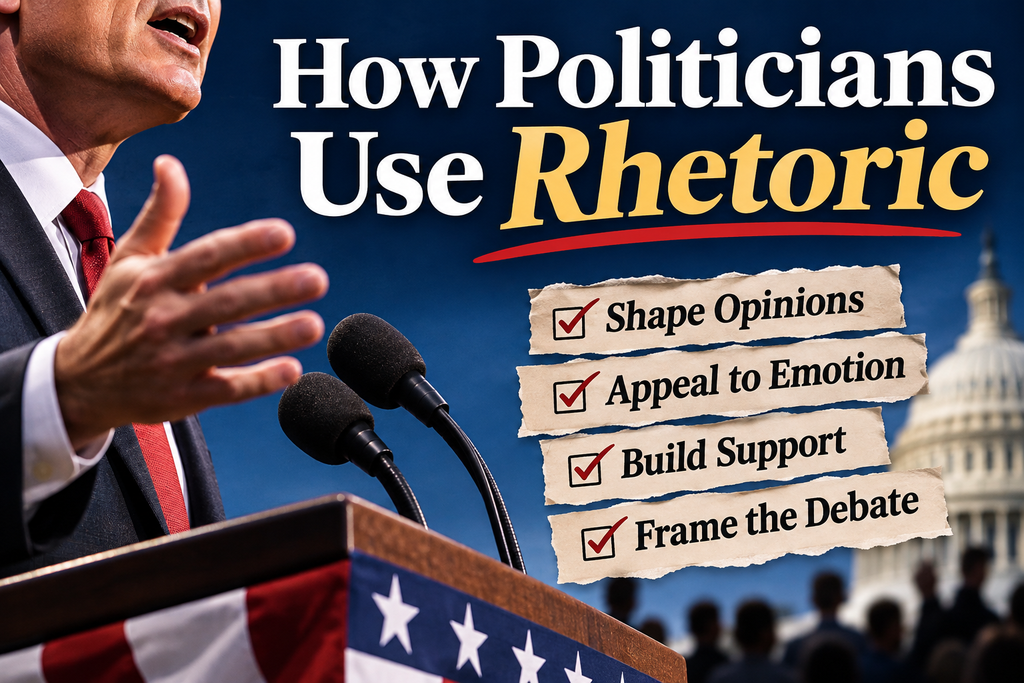
Every politician who has ever won a vote has used rhetoric, and so has every one who lost. How politicians use rhetoric is easier to see once you know what to listen for: a small set of techniques that appear in speeches, debates, and campaign ads in every party and every country. Learning to notice them does not make you cynical. It lets you separate the way something is said from what is actually being claimed, so you can judge each one on its own.
The examples below are invented. The politicians, towns, and bills are made up, so no real person or party is being singled out.
Rhetoric Is Persuasion, Not Just Spin: What the Word Actually Means
Rhetoric is the craft of using language to persuade. The study of it goes back to ancient Greece, and it was once a standard part of a formal education. A speech with strong rhetoric is not automatically dishonest, and a plain, dull speech is not automatically truthful.
In everyday talk, “that’s just rhetoric” usually means “that’s empty words.” That use of the word hides something useful. A candidate can use vivid language to argue for a policy that is well supported by evidence. Another can use the same vivid language to cover a weak case. The technique is identical in both, and only the substance underneath differs.
So the goal of listening critically is to answer two separate questions. How is this speaker trying to persuade me? And, once I have noticed that, is the claim itself any good? Keeping the questions apart is the main skill.
Ethos, Pathos, Logos: Three Old Appeals You Hear in Every Speech
The Greek philosopher Aristotle described three kinds of appeal in his work on rhetoric, and they still sort most political speech well.
Ethos is an appeal to credibility. The speaker shows why you should trust them: experience, character, shared background, or endorsements. An invented example: “I ran a hardware store in Millbrook for twenty-two years, and I met payroll every month. I know what a budget looks like when the money is real.”
Pathos is an appeal to emotion. The speaker wants you to feel something, such as anger, hope, fear, pride, or sympathy. An invented example: “Every parent in this room knows the feeling of lying awake and wondering whether the school bus will even come tomorrow.”
Logos is an appeal to logic. The speaker offers reasons, numbers, comparisons, or cause and effect. An invented example: “The bridge repair costs four million dollars now. If we wait, the same repair costs more every year, and the bridge may have to close in the meantime.”
Most good speeches blend all three. Emotion is not a defect, since people make decisions with feelings as well as facts. The question to ask is whether a feeling is being offered along with a reason, or in place of one.
Framing: How the Same Policy Gets Two Different Names
Framing means choosing the words and the angle that shape how a topic is understood before anyone argues about the details. The same proposal can sound very different depending on the label.
Take an invented proposal in the town of Harlow to allow apartment buildings near the train station. A supporter might call it “adding homes near transit.” An opponent might call it “overriding neighborhood zoning.” Both descriptions can be accurate. Each one puts a different part of the proposal in front of you, and each leaves the other part in the background.
Framing also works through the choice of what the debate is about. If one candidate says the question is “who benefits,” and the other says it is “who pays,” they are not disagreeing on a fact. They are choosing which fact you will weigh first.
You can often spot framing by looking for the names. When two sides give a policy different names, it is a signal that each has chosen a frame. A useful habit is to restate the proposal in the most neutral words you can find, then see whether your reaction changes. If you want to see how real policy areas are laid out before the labels get attached, the what is housing policy piece is one place to start.
Repetition, Rhythm, and the Rule of Three: Why Some Lines Stick
People remember what they hear several times, and they remember patterns. Speechwriters use both facts.
Repetition means returning to the same phrase throughout a speech or campaign. An invented example: a candidate ends every section with “Fair pay for honest work.” By the tenth time, listeners can finish the sentence for her. The phrase becomes shorthand for her whole platform, whether or not any specific policy is attached to it.
The rule of three is the habit of grouping ideas in threes, because a list of three sounds complete. Lincoln’s “government of the people, by the people, for the people” is a famous case. An invented modern version: “We will build it faster, build it cheaper, and build it here.”
Rhythm makes a line sound true. A balanced sentence, such as “We will not be divided by fear, and we will not be defined by anger,” has a symmetry that feels like wisdom. The symmetry is a property of the sentence, though, and it says nothing about whether the claim is correct.
When a line sticks in your head after a speech, ask what it actually commits the speaker to. Often the answer is very little, and noticing that is the point.
Stories and Ordinary People: Why Politicians Open With One Voter
Many speeches and debate answers begin with a person: a nurse in a small town, a veteran who cannot find work, a couple who cannot afford a first home. Storytelling works because a single face is easier to care about than a statistic, and because a story is easier to remember than an argument.
An invented example: “Last month in Dunmore, I met a woman named Carla who drives forty minutes each way to a job that pays barely above the minimum wage. She told me the gas costs more than her groceries.” The detail makes the problem feel real, and it makes the listener sympathetic before any policy has been mentioned.
A story is evidence of one case. It shows that something can happen to someone, and that may be worth knowing. It does not show how common the problem is, what caused it, or whether the proposed solution would fix it. Both parties tell these stories, and the more affecting the story, the more important it is to ask what it proves.
Us and Them: Identity Language and Where Persuasion Turns Into Pressure
Politicians also persuade by defining groups. Words like “we,” “our community,” “hardworking families,” “the establishment,” or “the other side” tell you who belongs and who does not. Shared identity is a powerful motivator, and it is a normal part of politics. A candidate who says “we are a town that looks after its own” is inviting you to see yourself as part of a group with shared values.
The same language can apply pressure. If a speaker implies that disagreeing with a policy means you are not truly one of “us,” the argument has shifted from reasons to belonging. You are being asked to agree in order to stay in the group, and no evidence has been offered.
The difference is often visible in the grammar. “People who share these values will want to support this bill” is an invitation. “Anyone who opposes this bill does not care about this town” is pressure. It also works to describe an opponent as a type of person instead of describing what they actually proposed.
Mirror Examples: The Same Technique Used by Left and Right
No party owns any of these techniques. Here are two invented speakers using the same ones on opposite sides of the same invented issue, a proposed increase in the minimum wage in the state of Calder.
Speaker A, supporting the increase. “A full-time worker in Calder should not need a second job to pay rent. Frank Ellis, a cook I met in Ridgeway, works fifty hours a week and still counts coins at the grocery store. We can do better. We can raise pay, lift families, and strengthen our economy.”
This opens with a story, uses the rule of three, and frames the issue as a matter of dignity for workers.
Speaker B, opposing the increase. “A small business in Calder runs on thin margins. Maria Santos, who owns a bakery in Ridgeway, told me that a sudden jump in wages means fewer hours for her staff or a higher price at the counter. We can do better. We can protect jobs, protect Main Street, and protect the people we are trying to help.”
This opens with a story, uses the rule of three, borrows the same “we can do better” repetition, and frames the issue as the risk to small businesses and the jobs they provide.
The structures match almost line for line. What differs is the frame and the claim, and the claims are where the real disagreement is. Whether a wage increase costs jobs is a question about evidence that neither speech answers. Recognizing the matching structure lets you ask each speaker for that evidence.
A Five-Question Checklist for Listening to Any Politician
You can use these questions on any speech, debate answer, or campaign video, whether or not you agree with the speaker.
- What am I being asked to feel, and is a reason attached? Notice the emotional peak of the speech, then check whether an argument or fact follows it.
- Why should I trust this speaker on this topic? Separate the credibility claim (“I’ve done this for years”) from evidence you can check independently.
- What name is being used, and what would the other side call it? Restate the proposal in the most neutral words you can, and see whether your reaction changes.
- Which line is repeated, and what does it commit the speaker to? A slogan that sticks is worth examining for the specific promise inside it, if there is one.
- Who is “us,” who is “them,” and what is being asked of me? Check whether you are being invited to consider an argument or pressured to join a side.
A related habit helps with story-based arguments. After any personal story, ask whether it is typical, and what it proves.
You do not need to answer all five every time. Even two or three, asked consistently, will change how a speech sounds to you.
Try It on Two Speakers
Pick one speech or debate clip from a politician you like and one from a politician you disagree with. Run the five-question checklist on both, and notice what you find. Many beginners are surprised by how similar the techniques look, and by how much easier it is to spot them in a speaker they already distrust.
If you want the wider picture, what is political campaigning explains the machinery that carries these speeches to voters, and how the news and social media you use shape whether and how you take part covers the channels they travel through.