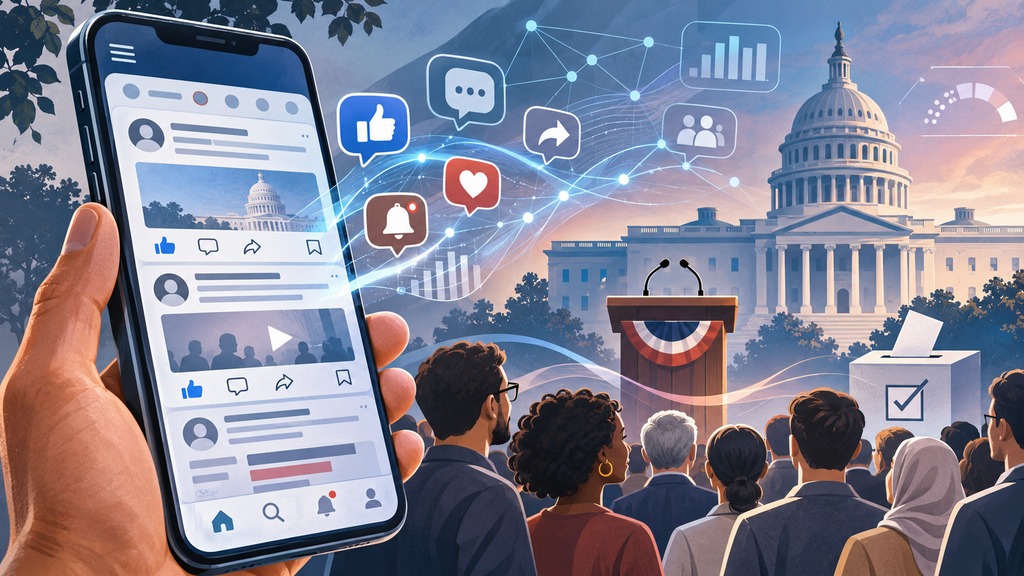
Open your phone and scroll for a few minutes. Somewhere in that scroll, a politician’s clip, a friend’s comment about an election, or a joke about a policy will probably appear, even if you only follow cooking accounts and football teams. Social media and political influence are closely tied, and the connection works whether or not you go looking for it.
This article explains how that influence works in ordinary terms: who gets heard, how feeds decide what you see, and what it does for and against democracy. It ends with five habits you can use whatever your views are.
Why your feed has become a political space, whatever you follow
Politics has always spread through conversation: at work, at dinner tables, in newspapers, on the radio. Social media put that conversation in the same place as everything else you do online. A post about a local zoning dispute sits next to a vacation photo, and the same app that shows you a recipe also shows you a debate about taxes.
That mixing is the main reason political content reaches people who never sought it out. Your friends share things. The accounts you follow for other reasons comment on the news. Platforms also suggest accounts and posts they think you might engage with, which brings in content from outside your own follows.
This matters because most people on social media are there for something else. Few open an app thinking, “I would like to be persuaded today.” Persuasion happens in the gaps, in a headline you read in two seconds or a clip that makes you laugh. Understanding that is the first step toward noticing it.
Who has influence on social media: politicians, parties, creators, and ordinary friends
Several kinds of voices compete for your attention, and they work differently.
Politicians and parties. Elected officials and candidates use social media to speak to voters directly, without a reporter or editor in between. That lets them respond quickly, show a more personal side, and reach people who do not read the news. It also lets them frame an issue exactly as they like, with no one asking a follow-up question. Parties and campaigns run official accounts and often coordinate messaging across many supporters at once.
Creators and commentators. Many people who discuss politics online are not journalists or officials. They may be video makers, podcasters, writers, or anyone who built an audience by being engaging. Their influence comes from trust and familiarity: followers feel they know the person. Some creators are careful and transparent about their sources. Others are not. The format does not tell you which is which.
Organizations and campaigns. Advocacy groups, unions, businesses, and issue campaigns all post with a goal in mind, whether that is raising money, recruiting volunteers, or shifting opinion on a policy.
Ordinary friends and family. This is the most underrated group. People tend to give more weight to a message from someone they know than to one from a stranger or an institution. A relative sharing an article can carry more persuasive force than the article’s author ever could. Each time you reshare something, you become part of the channel through which influence travels.
Having a large audience is not the same as being correct, and a small account can have an outsized effect if its posts get passed around. Reach and accuracy are separate qualities, and the platform measures only one of them directly.
How feeds decide what you see, and why two people can see very different politics
Most major platforms do not show posts in simple time order by default. They rank them. The ranking system predicts which posts you are most likely to react to, using signals such as what you have liked, shared, commented on, watched to the end, or lingered over. Posts that score well get shown to you and to people similar to you.
The details vary by platform and change often, and the companies do not publish full explanations. What can be said safely is the general principle: the feed is built to hold your attention, and it learns from your behavior to do that.
This has a few practical consequences:
- Two people can follow the same accounts and see different feeds. Their past behavior differs, so the ranking differs.
- Your feed reflects your habits, not a neutral sample of public opinion. If you often pause on posts about one issue, you will likely see more of them.
- What looks like “everyone is talking about this” may be a small group talking loudly. A topic can dominate your feed without dominating the country.
- Recommendations can pull you toward content you never chose. Suggested posts and videos come from the system’s guess about what you will engage with.
Because of this, a person who relies on social media for politics can come away with a picture of the world that feels complete but is partly built from their own clicks. Neither of two people comparing feeds has to be careless or dishonest for them to see very different things.
What social media does well for democracy
It would be unfair to discuss only the problems. Social media has real benefits for political life.
Access. Citizens can watch a city council meeting clip, read a representative’s statement, or find out when a bill is up for a vote without traveling or subscribing to anything. Officials can be contacted, and sometimes they answer. For someone with limited time, that lowers the cost of paying attention.
Organizing. Groups can form quickly around a shared concern. A neighborhood association, a student group, or a petition campaign can find members, set a date, and spread the word at almost no cost. Protests, volunteer drives, and fundraisers all use these tools. If you want to see how online interest connects to offline action, the guide on how to get involved in politics covers what to do with an hour a week.
New voices. People who once had no route into public debate can now publish. Someone with firsthand experience of a policy, such as a nurse, a small-business owner, or a renter, can describe it directly. Traditional media often missed these perspectives, and audiences benefit from hearing them.
Faster feedback for those in power. Officials can see quickly how a decision is received. That can make them more responsive, though it can also push them to react to the loudest reaction rather than the most representative one.
These benefits are real regardless of political side. Every party and movement has used the same tools to reach voters and organize supporters.
Where it can quietly mislead
The problems with social media and political influence are mostly not about outright lies. They come from how the system is built and how people behave inside it.
Echo chambers. When your feed learns your preferences and your friends tend to share your views, you may see mostly one side of an issue. The other side appears mainly as quoted examples, often the weakest or most irritating ones. That makes opponents seem less reasonable than they are. Research on how strong this effect is varies, and people do encounter opposing views online, so it is best treated as a tendency to watch for rather than a certainty.
Outrage. Posts that provoke strong emotion, especially anger, tend to get reacted to and shared more, and ranking systems often reward reactions. The result can be that the most heated version of an argument travels furthest, while a careful one stays quiet. Feeling furious after a scroll is worth noticing as a signal, whichever side made you feel that way.
The pull of the shareable post. A post that fits in a screenshot, a short clip, or a punchy line spreads more easily than one that needs context. Complex issues such as budgets, health systems, or trade rules get squeezed into a sentence. Something can be technically accurate and still leave out the part that would change your view.
Missing context. Clips can be cut, quotes can be trimmed, and images can be reused from other events. Often nobody did this on purpose; the context simply fell away as the post was copied. A short video of someone saying a sentence is not the same as the speech around it.
Mistaking visibility for popularity. Likes, shares, and follower counts can be inflated by coordinated groups or automated accounts, and even without that, they measure engagement, not agreement. A heavily shared post tells you little about what most people think. For a similar caution about numbers, see the guide on how to read an opinion poll.
Five habits for using social media as a citizen without being steered by it
These habits work for anyone, on any side. None requires leaving social media.
- Pause before you share. Ask whether you have read past the headline and whether you know where the claim came from. Sharing takes one tap, so a short delay costs almost nothing and prevents most accidental spreading of weak claims.
- Check how a post makes you feel, then check the facts. If a post makes you angry or smug, read it again more slowly. Strong emotion is a reasonable cue to look for the original source, the full quote, or the date.
- Widen your sources on purpose. Follow a few accounts or outlets that disagree with you, chosen for being careful rather than for being easy to mock. You do not have to agree with them. The aim is to understand the best version of the other argument and to see which topics your own feed rarely shows you.
- Go to primary sources for things that matter. If a post describes a bill, a court ruling, a speech, or a report, find the document or the full recording. Official sites usually publish them. Reading the original for a few minutes often changes how a post looks.
- Move important conversations out of the comments. Arguments in comment sections rarely change minds, and the format rewards the quick retort. A direct message, a phone call, or a conversation in person tends to go better. For action that counts, such as voting, contacting an official, or attending a meeting, the real work happens off the feed. The guide on why voting matters explains why that step carries weight that likes and reposts do not.
You can also adjust the feed itself. Most platforms let you mute accounts, unfollow, hide topics, and review or reset recommendations. Using those controls to reduce what drains you or to add variety is a legitimate choice, and it changes what the ranking system learns about you.
How to read political posts alongside the blog’s guides on spin, propaganda, and fake news
Social media is where many of the techniques covered elsewhere on this site show up in compressed form. A short post can contain spin, an emotional appeal, a selective statistic, or a false claim, sometimes all at once. Having a few terms for these makes them easier to spot.
When a politician or party frames a story to look as favorable as possible, the guide on what political spin is shows how to recognize it. When a message seems designed less to inform than to move you toward a conclusion by any available means, the guide on political propaganda explains how to tell it apart from ordinary persuasion. And when a claim is simply false and spreading anyway, what fake news does to politics describes the damage it does to every side.
A simple routine for any political post:
- Who is posting, and what do they want from me: a vote, a donation, a share, or just attention?
- What is the claim, stated plainly without the tone around it?
- What would I need to see to check it?
- What might be missing: a date, a full quote, a comparison, the other side’s reply?
You will not be able to run through this for every post, and you do not need to. Use it for the posts that make you want to react, change your mind, or pass them on. Those are the posts where influence is working hardest, and where a moment of attention returns the most.