
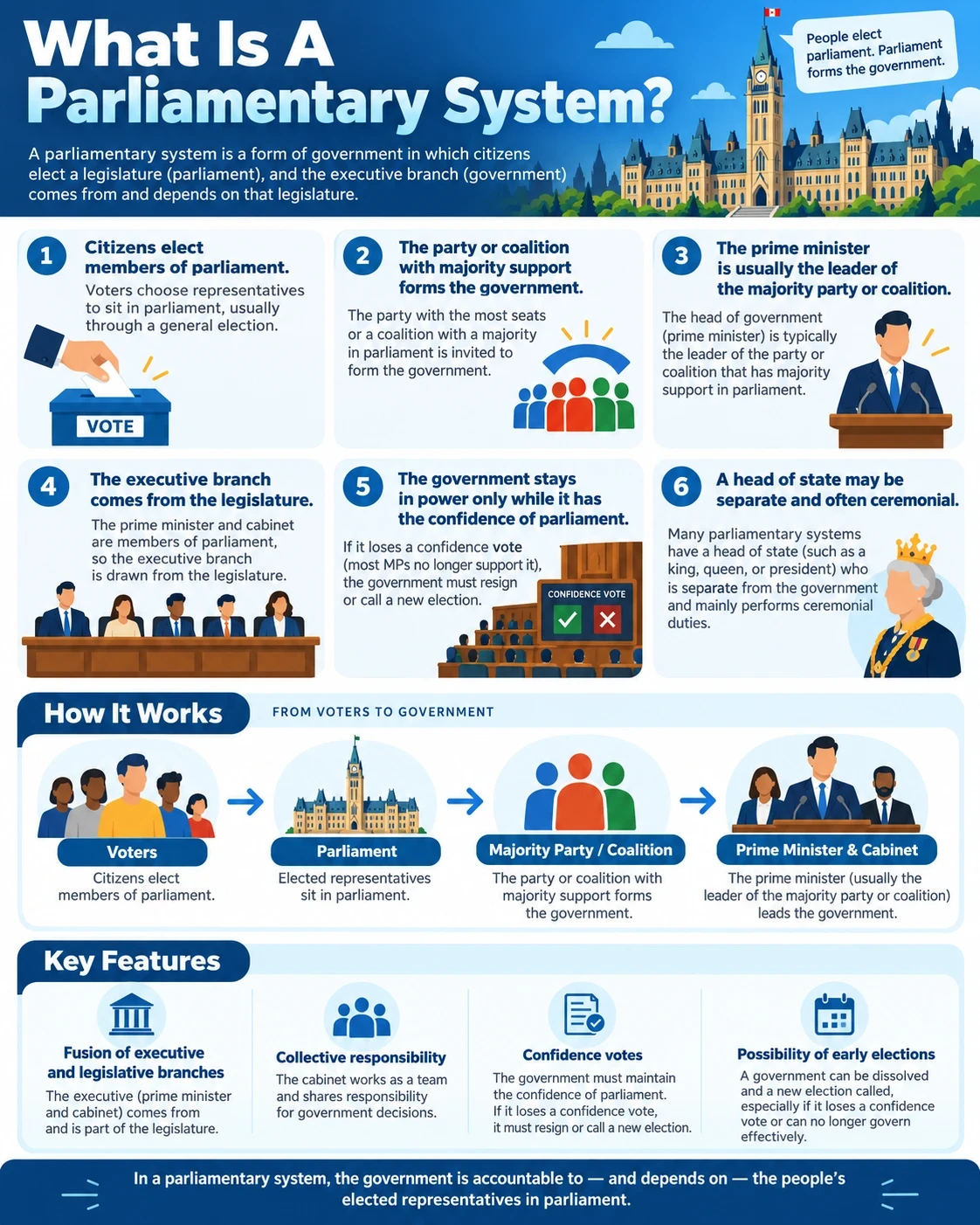
 Imagine a system where the people you elect actually have to answer to you constantly, that’s what a parliamentary system is at its heart. In this setup, the executive branch of government, which consists usually of a prime minister and cabinet, gets its power directly from the legislative branch or parliament. Think of it as a government that needs to keep earning the public and parliament’s trust all the time.
In a parliamentary system, the head of state and the head of government are two separate persons. The head of state could be a monarch or a president, depending on the country, playing mostly ceremonial roles. The real day-to-day power lies with the head of government, often the prime minister. They’re like the captain of the team who calls the shots but must keep the rest of the players onside.
The backbone of this whole setup is something called ‘responsible government.’ This principle means the government has to keep the confidence of the parliament, and if not, they might have to call it quits and possibly trigger an election. It’s like having to prove yourself repeatedly to keep your job.
A lot of times, when people say ‘parliament,’ they imagine just the building where lawmakers meet. But in this system, ‘parliament’ is where the magic happens – the debates, the decision-making, the accountability checks. It’s way more than a physical place, it’s the pulse of the whole governmental system.
Who Holds Power? How a Parliamentary Government Is Formed
Getting a handle on who calls the shots in a parliamentary system? It’s pretty fascinating. After people cast their votes in an election, it’s all about which party snags those seats in parliament. The party with the majority seats usually leads the government, but things get interesting when no party has clear dominance.
That’s when you’ll hear about minority governments or coalition governments. A minority government is when the governing party doesn’t have more than half the seats, so they rely on support from other parties to pass legislation. Coalition governments are like power partnerships formed by two or more political parties agreeing to work together to command a majority.
The leader of the party that can boast majority support in parliament typically steps into the role of prime minister. But don’t be surprised if it looks a bit different in each country. Formalities vary, but the idea stays the same – they’re the head of government if they secure that parliamentary backing.
Next, we’ve got the cabinet ministers, picked by the prime minister. These folks are like the crew tasked with steering different areas of policy, from education to finance, and they need to work tight-knit with the prime minister. Known as collective cabinet responsibility, they’ll either sink or swim together if things go pear-shaped.
Navigating through the formation of a parliament can feel a bit like playing a strategic game, with parties negotiating, leaders emerging, and cabinets forming to guide the ship. It gives you a sense of how power dynamics in a parliament reset and align following each election.
How Parliament Keeps the Government Accountable
Accountability is the name of the game in a parliamentary system, and it comes with some nifty mechanisms. Confidence votes are one of the ways parliament can keep tabs on the government. If the government can’t pass a vote on key issues, like the budget, they might need to step down. It’s like a constant reminder to play straight and keep parliament on side.
Question periods and parliamentary debates are basically the government’s hot seat moments. Here, members of parliament pepper the prime minister and cabinet ministers with questions. Squirming under pressure? That’s how this accountability powerhouse ensures everyone stays transparent and accountable.
Parliamentary committees work like investigative teams, diving into the specifics of policies and decisions. They review bills, scrutinize expenditure, and make recommendations. Think of committees as parliament’s brain trust, offering deep dives and insightful critiques that keep the government in check.
Sometimes, the government might lose confidence due to missteps or a big policy flop. If this happens, they might resign, try to spin up a new collaboration, or even head to the polls for an election. It’s a built-in safeguard, preventing anyone from getting too comfy in power without earning it.
The rules of the game sound solid, right? Well, party discipline can throw a wrench into things sometimes. Strong party loyalty might limit individual members from speaking out or making independent decisions, potentially muzzling true oversight. It’s a delicate balance between fostering unity and ensuring genuine scrutiny within parliament.
Parliamentary vs. Presidential Systems: Key Differences That Matter
In the world of different governmental setups, parliamentary and presidential systems stand pretty much like night and day. The big difference? How they handle power. In a parliamentary system, the executive and legislative branches are intertwined, while in a presidential system, they each do their own thing and are independent of each other.
So, who picks the top dogs? In parliamentary systems, the leader is usually the head of the party with the most support in parliament. It’s a team effort. In presidential systems, the president is directly elected by the people, making it more of a personal victory. This differences lead to distinct paths on how leaders serve and can be removed. In parliamentary setups, if parliament turns against them, leaders might have to pack up. Presidents, on the other hand, serve fixed terms, and getting rid of them isn’t a walk in the park.
Roles make another interesting comparison point. In many parliamentary systems, the head of state (think queen or president) is separate from the head of government (prime minister). In presidential systems, this role is combined into one mega position – the president.
Each system has its own set of perks and hurdles. Parliamentary systems can get a new government up and running fast, but a presidential system can be more stable during a political shake-up. However, a presidential system risks political stalemates. It’s like choosing between agility and stability. Neither is necessarily better; it just boils down to what suits the country’s needs and culture.
Real-World Parliamentary Systems: Different Models, Shared Principles
Look around the globe and you’ll see parliamentary systems sprouting up in various flavors, even though they share some core principles. Take the UK, for instance. It’s the poster child for parliamentary systems with its constitutional monarchy, where the queen’s role remains mostly ceremonial, and the real power’s with parliament and the prime minister.
Canada rolls with a similar vibe but tails worldly tweaks in handling certain federal aspects. Meanwhile, countries such as Germany and Sweden have parliamentary republics where symbolic presidency steps in for the monarch. In both cases, parliaments are at the heart of government, ensuring that executive power stays tightly tethered to legislative control.
Down in Australia and New Zealand, they’re practicing parliamentary systems with a twist. Even though they follow the British model, local customs and political landscapes mold unique dynamics. In India, despite its size and diversity, a parliamentary system handles the complexity, balancing power across its vast states.
Then, you’ve got Japan and its stable parliamentary framework balancing the emperor’s ceremonial presence. Here, a widely respected prime minister leads, illustrating how parliamentary structures adapt to cultural contexts.
Each of these countries adapts parliamentary principles to its unique political culture, electoral rules, and constitutional tweaks. Whether it’s unicameral or bicameral setups, like the House of Commons and House of Lords in the UK, upper chambers often offer a quieter voice of reason or regional focus.
No two systems are copy-paste jobs. But the underlying ideas of cooperation, accountability, and responsible government hold all these models together. They form a tapestry of governance practices that reflect local values and historical nuances.
So, whether you’re watching a prime minister hustling votes or a parliament debate heated policies, these systems provide a fascinating look into the dance of democracy adapted in many forms across different nations.
Why Parliamentary Systems Matter: Benefits, Challenges, and Informed Civic Participation
Parliamentary systems bring a fresh mix of accountability and flexibility to the table. One of their standout perks is how they tie the executive branch directly to the legislature, ensuring the government stays answerable to the people. Leadership transitions can be smooth since a change in government isn’t shackled to rigid election schedules. It helps in keeping policies responsive and adjusted to current needs.
Of course, like all things, it’s not without its quirks. Parliamentary systems face challenges like unstable coalitions that may lead to frequent elections. Think of it as a balancing act, where getting consensus sometimes means compromising efficiency. The flipside? This setup can lead to concentrated executive power which might not allow voters to directly choose their prime minister, another point to ponder.
No one system can claim the crown of being the best universally. What’s crucial is how well the institutions and safeguards work to keep democracy vibrant and healthy. The blend of tradition, constitutional forces, and political culture determines how effective a parliamentary system can be.
For the curious minds out there, understanding your parliamentary system isn’t just about following the rules of the game. It involves knowing who your representatives are, being aware of the current governing landscape, and keeping a close watch on those confidence votes. Dig a little deeper by consulting official parliamentary sources and staying informed about legislative processes.
Feeling empowered to engage and critique your government plays a vital role in preserving democracy’s pulse. Remember, a well-informed citizenry that actively participates can address the governance challenges effectively. Taking a proactive stance means having the tools and insights to influence how this system evolves for the better over time.