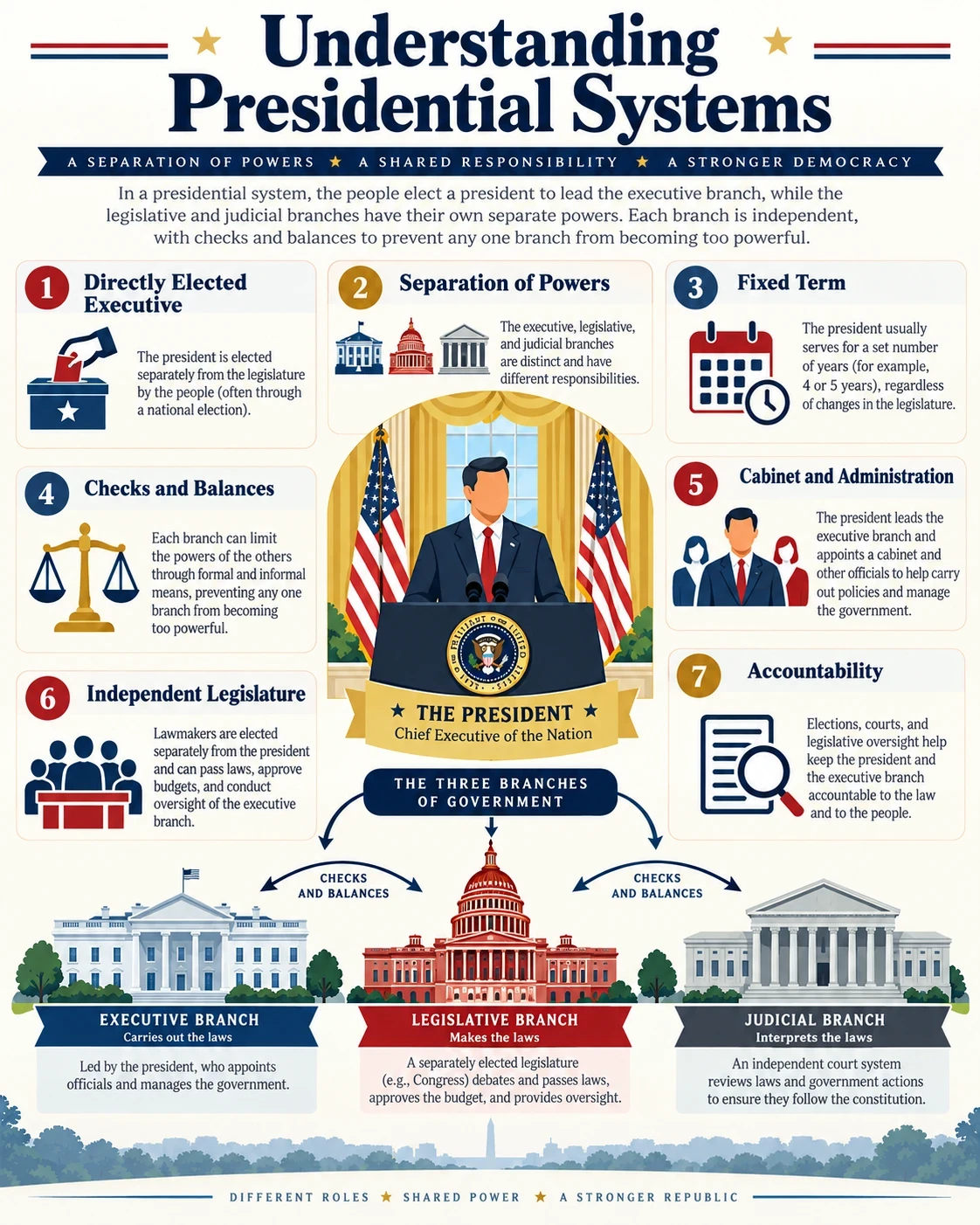
 A presidential system is a type of government where the president is the head honcho, steering the executive branch of government separately from the legislative one. It’s like how the captain of a ship doesn’t also sew the sails. This design creates a defined line between two major government arms that together shape the nation’s path.
At the core of a presidential system sits the president, an elected figure who often wears two hats: head of state and head of government. Think of them as the face of the country and the one running the show too. But, unlike other systems where these roles might split, in a presidential setup, it’s the same person.
Presidents don’t work solo. They collaborate with a team called the cabinet, made up of heads of various government departments. Plus, a sea of voters, political parties, and a legion of public servants all have roles in how power gets flexed and laws get made.
One of the key perks in a presidential system is the way the executive and legislative branches get their distinct marching orders. Both are separately elected, meaning they answer to the people. This independence is like having two security codes: only when they both match up do the government’s new directives roll out.
It’s crucial to know that saying ‘presidential system’ doesn’t mean it’s a one-size-fits-all suit. Different countries add their unique badges and patches, leading to varied practices and power dynamics. So, while the job title stays the same, job descriptions can differ wildly based on constitutional design.
How Presidents Are Chosen—and What a Mandate Really Means
Presidents come to power through various election methods, each with its own flair and impact on legitimacy. In some systems, voters head straight to the polls to pick their leader. This direct popular election screams democracy, giving people a front-row seat in choosing their nation’s figurehead.
Other setups might use an electoral college or a group of representatives to make the final call, like getting a second opinion before picking a movie to watch. This indirect method can shift focus from a national popularity contest to a strategic game of chess, where every move counts—but not always in a straightforward way.
Presidencies are defined by terms—they’re not forever, thankfully! Fixed terms and set term limits mean there’s a scheduled refresh so no one gets too comfy in the captain’s chair. Succession plans and rules on removal through impeachment are the safety nets in case of any political turbulence or scandal.
Winning an election gives a leader the top job, but it doesn’t magically create smooth sailing ahead. Governing effectively requires broad support, often beyond just those who cast a vote for them. A president with undeniable charisma and vision is key, but it also matters how well they can collaborate and inspire across the aisle once in office.
By scoping out how presidents rise to power, you get a good look at the unique dance of democracy in action. It’s never just about winning over the crowd once, but about keeping them rallied for the whole performance. Different countries play this tune in their way, and that’s what makes observing political systems fascinating.
Separation of Powers: How Institutions Check a President
In a presidential system, the separation of powers isn’t just a catchy phrase—it’s the backbone of democratic governance. By dividing authority among the executive, legislative, and judicial branches, each arm of the government operates with a level of independence while still being intertwined. The checks and balances in place ensure no single entity rules everything, preventing the concentration of too much power in one place.
The legislature doesn’t just sit back and watch the president’s every move. They have real influence through lawmaking, budget control, and even wielding tools like impeachment if things go south. Keeping an eye on presidential nominations or confirming appointments to key positions ensures that no one is pulling a power grab unnoticed.
On the flip side, presidents aren’t without their own set of tools. Veto power, making key appointments, and getting involved in foreign relations are just a few ways presidents flex their muscles. However, it’s crucial that they operate within the confines of the law, as overstepping boundaries can lead to serious consequences.
Judicial review plays a huge role in this landscape, offering a legal check on the other branches. An independent judiciary is essential to interpret constitutions and ensure everyone sticks to the rules of the game. Courts can strike down unconstitutional moves, acting like referees keeping things fair and orderly.
Ultimately, written powers are just that—words on paper—without transparency and enforceable rules. Strong civic norms and credible institutions mean the difference between just having a democratic framework and actually living it out. Institutions need to function openly and with integrity to make democracy more than just a buzzword.
Governing in Practice: Parties, Gridlock, Bargaining, and Public Accountability
Governance in a presidential system is anything but a straight line. When the president’s party controls the legislature, getting things done might look easy. But more often than not, the legislative landscape is a mix, with opposition parties holding enough power to stall or shape the outcome of any proposed policy.
Divided government is when one party controls the presidency while another holds sway in the legislature. This scenario can stir up everything from compromises to outright gridlock. How well presidents work with legislative leaders often dictates whether policy pitches sink or swim.
Cabinets, advisors, and bureaucratic networks act as an engine room for policy discussion and implementation. But influence isn’t limited to those inside the halls of power. Governors, regional leaders, the media, and civil society groups all play key roles in keeping the process transparent and accountable.
Executive orders or decrees can bypass slower legislative processes to get things moving, but it’s a risky route if they’re overused or overextended beyond legal limits. Understanding how, when, and why these are used tells a lot about the health of the democratic process.
Public accountability isn’t just a moral checkbox—it’s what holds power in check. Credible elections, active media, publicly accessible records, solid ethics rules, and effective oversight bodies combine to create a tapestry of accountability that helps keep leaders in check and responsive to the citizenry.
Strengths, Risks, and Democratic Safeguards in Presidential Government
Presidential systems offer some standout advantages that make them appealing. A clear chain of command can provide accountability that’s easy to trace back to the ballot box, which isn’t just neat but necessary for letting citizens call the shots. During a crisis, having a stable, non-fragmented executive can mean quick and decisive action.
Despite these perks, there’s a darker flipside: the risks of personalizing power around one leader. Whether it’s bending rules or bypassing opposition, executive overreach can throw a wrench in democratic works. Legislative paralysis is real when decisions get stuck at the multiple checkpoints needed for approval. And winner-take-all dynamics can fuel deep political rifts and polarization among citizens.
Emergencies call for extraordinary powers, but they also demand tight confines. Presidential systems must guard against extending such authorities indefinitely. That’s where legal limits, legislative review, judicial scrutiny, and time restrictions come into play. By placing checks here, a country can avert power consolidations that sneak in during tumultuous times.
Term limits and smooth power shifts through elections are like a refresh button for democracy. They’re key to stopping leaders from overstaying their welcome, nipping autocratic tendencies in the bud. Watching peaceful transitions isn’t just satisfying; it’s essential for sustaining a vibrant democratic atmosphere.
There’s no neat ranking system for presidential systems since outcomes lean heavily on institutions’ resilience, the political culture in place, and enforcement integrity. That’s why safeguarding democracy in these setups needs more than good intentions—it’s about creating systems that uphold the democratic pillars through thick and thin.
Presidential Systems Around the World: How to Evaluate Real-World Examples
Understanding presidential systems is a lot like getting into a mystery novel—every country has its own plot twists and characters. To really get what’s happening, it helps to have a framework for comparison. Think about election rules, the party landscape, how courts hold their ground, federal structures in place, and the constitutional safety nets put up to reel in power when needed.
Presidential systems can play out differently depending on where you look. While some countries follow these setups to the letter, others infuse their own political flavor into the system. This is where contrasting them with parliamentary or semi-presidential systems can shine a light on what makes each unique without trying to fit them into a neat hierarchy box.
Delving into the nitty-gritty means turning to reliable sources like constitutions, official election bodies, detailed court decisions, and solid research published by folks who know their stuff. Even nonpartisan groups dedicated to government transparency can help paint a complete picture. It’s all about understanding the nuances instead of just the headlines.
Some questions to keep at the ready: How can a president be removed? Who holds the strings when it comes to spending? How are emergencies handled? Are elections just races or actual contests with credible outcomes? These aspects matter because they show how power’s divided, shared, and kept in check.
Peeling back the layers on presidential systems isn’t about finding one perfect model—it’s about seeing the bigger picture that goes beyond individual leaders. It’s the systems, the laws, and ultimately the people who shape democracy, keeping it lively and responsive to change.