
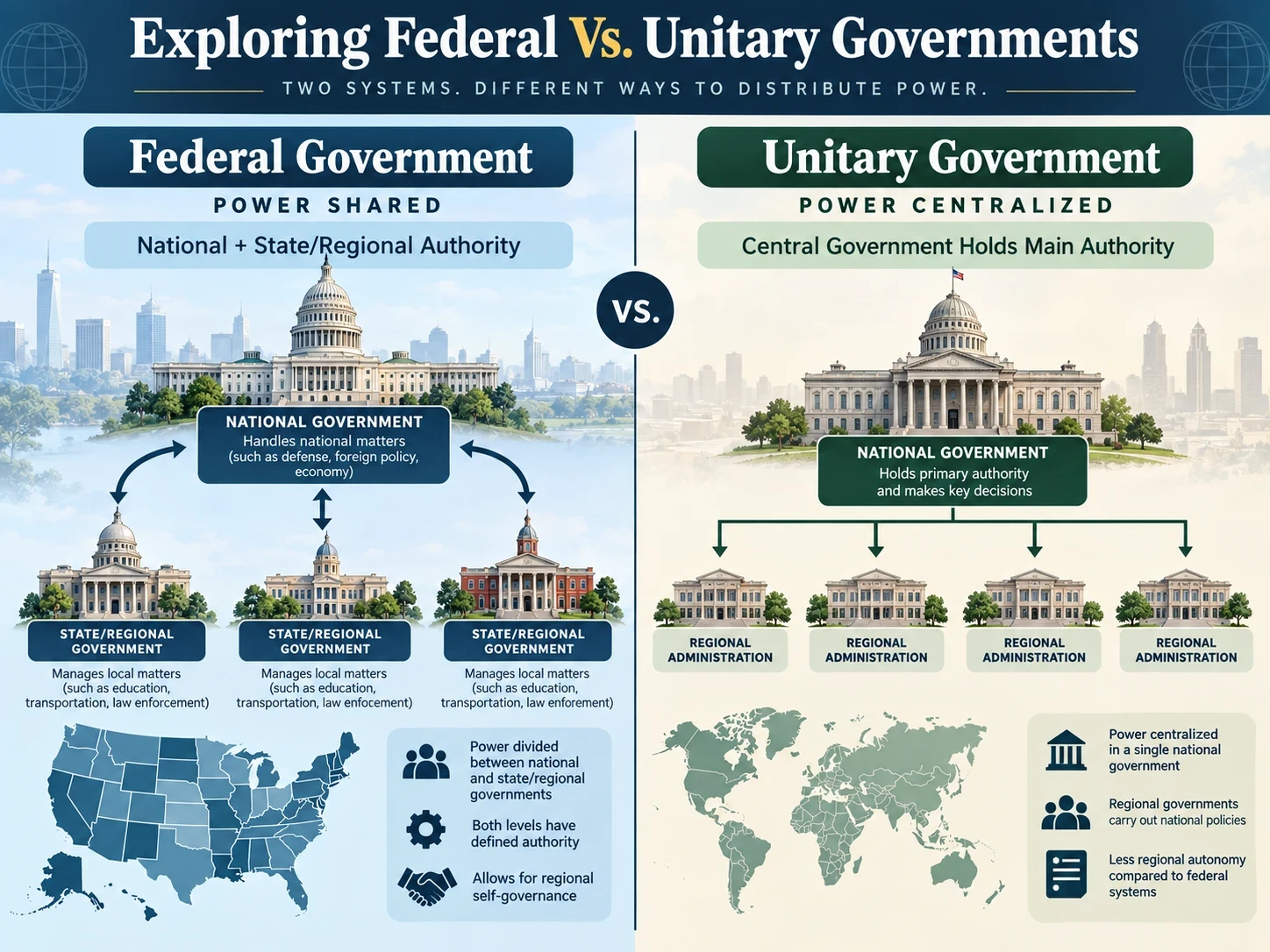
 Figuring out the basic difference between federal and unitary governments boils down to a pretty simple question: Who’s really in charge? It comes down to whether the power’s spread out across various levels of government or just hanging out in the national party’s hands. This isn’t just some political theory mumbo jumbo; it actually affects stuff like schools, policing, health care, taxes, and how local services run from place to place.
Federal systems are all about sharing. Picture a big family dinner where everyone gets a say in what’s for dessert. Here, power is split between a national government and smaller regional governments, like states or provinces. So, they’ve got their own thing going on when it comes to laws and services. It sounds cool, but it can also mean you might face different rules and taxes depending on where you are. Just imagine how that plays out when you move or travel.
On the flip side, unitary systems are a bit more straightforward. Think of them like a franchise—one central headquarters calling the shots while the local branches handle day-to-day stuff but can’t change the big rules. In this setup, the national government holds the legal power, even if it lets local guys run their towns and cities. It’s more about getting everyone on the same page, nationwide.
In reality, most countries don’t stick to one model strictly. It’s kinda like a playlist where you mix up genres; they borrow bits from each system to fit their needs. It’s all about balancing the scales between national unity and regional self-expression, finding that sweet spot that works for their particular social and political landscape.
How Federal Governments Work: Shared Authority Across National and Regional Levels
In a federal system, power isn’t hogged by the central government. Instead, it’s more like a family where everyone gets a say at times. The national government and regional governments, like states or provinces, each have their own specific powers. Think of it like a puzzle, where each piece has its defined role but together creates a complete picture.
The constitution generally divides powers into different types: reserved, delegated, concurrent, and implied powers. Reserved powers are strictly for the states, like setting up local governments. Delegated powers, meanwhile, are the feds’ territory, like declaring war or printing money. You’ll find some shared tasks, too, like taxes, under concurrent powers.
But what happens when they clash? Enter the courts. They step in to settle disputes and ensure no one’s stepping out of bounds. It’s like having a referee in a game to keep things fair.
Around the world, each federation puts its spin on federalism. The United States, Germany, Canada, India, Australia, and Switzerland all rock federal systems, but with their own quirks and twists. Just because they’re federal doesn’t mean they’re twins!
Living in a federal system means your everyday experience can vary depending on your location. Different laws, tax rules, or public services might be on the menu, depending on the region. It gives residents a taste of regional flair but can sometimes make things complex, like navigating a choose-your-own-adventure book, only the decisions are very real.
How Unitary Governments Work: National Authority With Local Administration
In a unitary system, ultimate authority is parked at the national level. Here, the central government holds the reins, effectively calling the big shots. Yet, don’t assume local governments are sitting idly by. They’re responsible for implementing decisions made at the top.
This system’s like a tree. Picture the central government as the trunk and local authorities as its branches. Each branch handles its own set of leaves (responsibilities), but any big changes or directions still stem from above. So, while local branches can sway with the wind, they can’t decide to start sprouting apples instead of acorns without a green light from the trunk.
Decentralization and devolution pop up as common terms here. They mean shifting specific powers down to local governments as per national law. This isn’t quite the full regional sovereignty you see in federal systems—more like letting your younger sibling drive the car, but you’re still in the passenger seat ready to take over.
Countries like France, Japan, New Zealand, and the United Kingdom have unitary systems. They may delegate responsibilities, allowing regions to tailor solutions to local needs. However, the UK’s devolved system is unique, where Scotland, Wales, and Northern Ireland have greater say within a unitary framework.
Unitary systems aim for policy consistency. If you’re living in one, you’re likely to spot the same public programs, rights, and services wherever you go. National standards can make for smoother, more uniform experiences across the board, taking out the patchwork feel that federal residents often navigate.
Federal vs. Unitary Systems Compared: Strengths, Trade-Offs, and Practical Effects
When it comes to comparing federal and unitary systems, it’s like weighing the pros and cons of a sports car versus an SUV. Both have their strengths, but what works for one person might not suit another.
Federal systems prioritize regional autonomy and can handle large, diverse populations well. Because power is shared, regional governments can tailor policies like education or healthcare to fit their people better. But this local flavor can make decision-making slower and policies less uniform across regions, leading to a bit of a patchwork.
Unitary systems shine in consistency and speedy national responses. Like one-size-fits-all policies, they ensure everyone gets the same treatment no matter where they live. While this can streamline administration with fewer layers to deal with, it may not always address local needs or prevent regional disparities.
Regardless of the system, accountability and protecting citizens’ rights sit at the heart of good governance. Simply picking federal or unitary doesn’t offer a magic fix; the real quality comes from how it’s implemented through trusted institutions, sound political culture, and strong legal frameworks.
No system is inherently superior. Matching a system to a country depends on myriad factors, including history, demographics, and geography. It’s like choosing a mode of transport based not just on speed, but on terrain and journey length. The best choice is the one that balances national goals with local needs, ensuring the wheels keep turning smoothly without losing their grip on the road.
Why Countries Choose One Model Over Another: History, Identity, and Political Reality
Deciding between federal and unitary systems isn’t just about efficiency; it’s about identity, history, and sometimes a bit of compromise. Countries often let their unique stories steer the direction of their governance.
Geography plays a huge role. A nation with vast lands or diverse cultures might opt for a federal system to accommodate different regional identities. This helps regions feel represented and respected, maintaining national unity while allowing local flavors to thrive.
Linguistic and ethnic diversity adds another layer. A country with multiple languages or ethnic groups might need a federal structure to ensure everyone’s voice is heard, preventing majorities from overshadowing minority cultures.
Colonial history and previous political divisions can influence a country’s choice, too. Sometimes nations stick with a familiar structure or adapt it to better suit their modern context. Take a look at countries emerging from colonial rule; some centralize power to unify, while others distribute it to avoid past mistakes.
Constitutional design isn’t set in stone. Systems evolve over time as countries tweak them through amendments, court decisions, or political reforms. It’s like upgrading your tech not because it’s broken, but to keep up with changing needs and expectations.
Ultimately, choosing between federal and unitary is a practical decision, not just an academic one. It’s about optimizing for a country’s circumstances, values, and goals, ensuring governance reflects the identity and needs of its citizens.
Reading Government Systems More Clearly: Questions Citizens Can Ask
Understanding government structures is like decoding a mystery, where the clues lead to clarity about who’s in control and how decisions impact daily life. Asking the right questions can help you uncover the real workings behind the scenes.
Start by identifying who holds the reins over specific policies. Is it the national government, a regional body, or perhaps both? Clarifying this can give you insight into who to hold accountable or lobby for change when needed.
Funding is another critical piece of the puzzle. Knowing who funds certain services can reveal which government body has the most influence, or why certain areas may be prioritized over others.
Law changes are a biggie too. Determining which level can alter laws might explain why some policies seem stuck in political limbo while others fast-track through the system.
When disputes arise, check which court handles them. Is this settled on a regional level or does it escalate to national courts? This can reflect the balance of power and independence within a government structure.
Tapping into reliable sources like constitutions, governmental websites, and nonpartisan research can sharpen your understanding of these systems. Scrutinize not just the legal framework but how it plays out day-to-day. Do local governments have real independence, or are they heavily tethered to the national agenda?
Remember, federal and unitary systems are all about distributing power differently, and recognizing this can better equip you to engage with governmental processes, demand rights and services, or even simply navigate the political landscape with greater ease.