 Every four years, Americans go to the polls to choose a president. We watch the vote totals come in, states are called for one candidate or another, and eventually a winner is projected.
But technically, voters do not directly elect the president of the United States.
Instead, they choose a group of people known as electors, who later cast the official Electoral College votes for president and vice president.
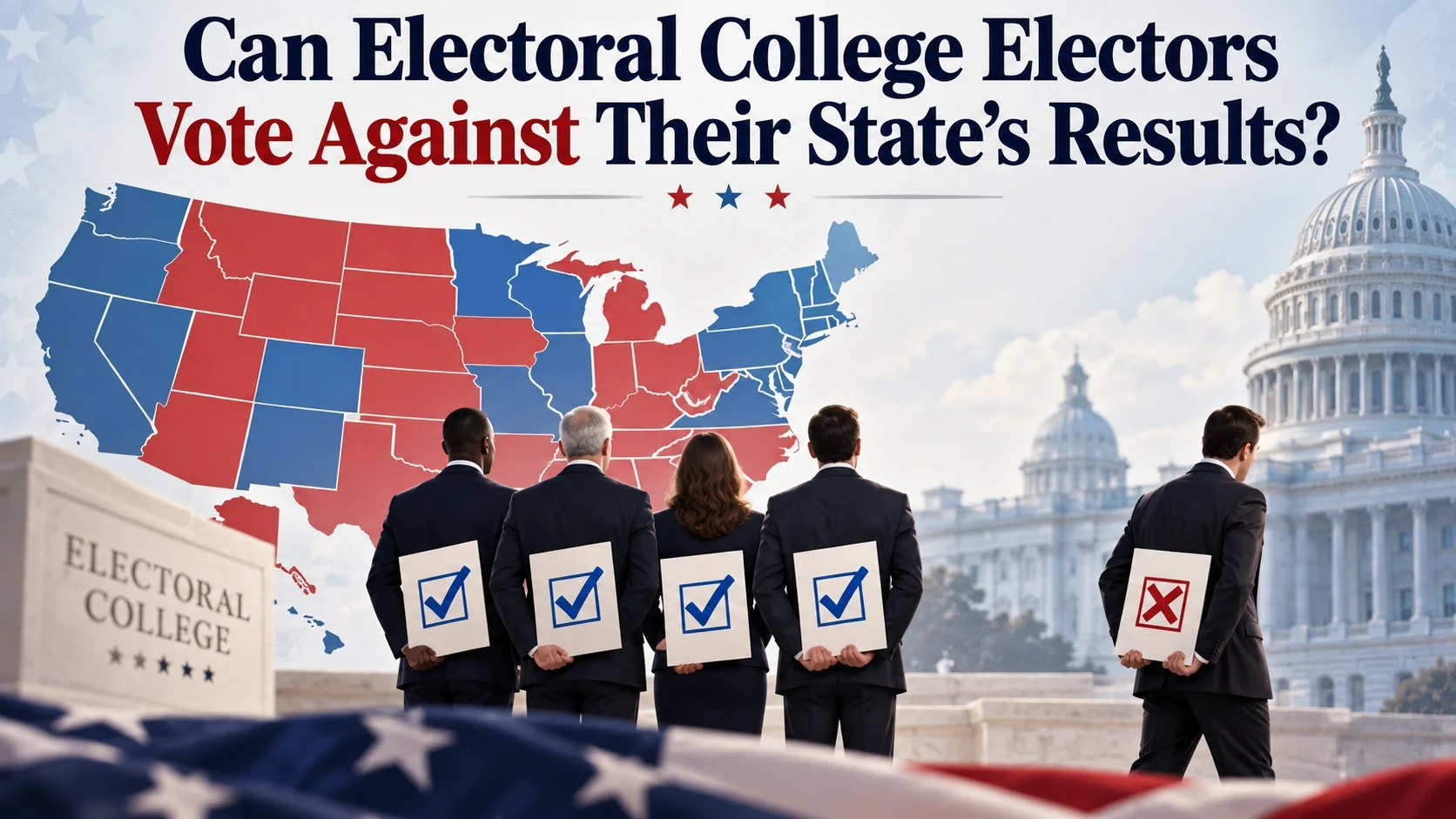
That raises an interesting question: What happens if one of those electors decides not to vote for the candidate who won their state?
Can an elector simply change their mind?
The short answer is: sometimes an elector may attempt to vote differently, but states can legally require electors to follow the state’s election result and can impose consequences or replace an elector who refuses.
The rules vary by state, and the Supreme Court has weighed in on the issue.
Here is how the system works.
What Exactly Is an Electoral College Elector?
The Electoral College consists of 538 electors, and a candidate generally needs a majority—currently 270 electoral votes—to win the presidency. Each state receives a number of electors equal to its total number of U.S. senators and representatives, while the District of Columbia receives three electoral votes.
When Americans vote for president in November, they are actually helping select a slate of electors associated with the presidential candidate they support.
Political parties generally choose these potential electors before Election Day.
For example, suppose Candidate A and Candidate B are competing in a state with 10 electoral votes.
Candidate A’s party has a slate of 10 potential electors, while Candidate B’s party has another slate of 10.
If Candidate A wins the state’s popular vote, Candidate A’s slate normally becomes the state’s official electors.
In nearly every state, the candidate who wins the statewide popular vote receives all of that state’s electoral votes.
The exceptions are Maine and Nebraska, which use a different system that allows their electoral votes to be divided based partly on congressional district results.
The electors then meet in their respective states in December and cast the actual votes for president and vice president.
Those votes are later sent to Congress and officially counted.
So Could an Elector Vote for Someone Else?
This is where things get interesting.
An elector who votes for someone other than the candidate they were expected or pledged to support is commonly called a “faithless elector.”
The U.S. Constitution itself does not contain a provision specifically requiring electors to vote for the candidate who won the popular vote in their state.
There is also no general federal law requiring every elector to follow their state’s popular-vote result.
At first glance, that might make it sound as though electors are completely free to vote however they want.
But that is not quite how the modern Electoral College works.
Individual states have significant authority over their electors.
Some states require electors to pledge that they will vote for their party’s presidential and vice-presidential nominees. State laws may also impose consequences on an elector who breaks that pledge.
Depending on the state’s law, a faithless elector could potentially face a fine, have the attempted vote rejected, or be removed and replaced by another elector.
And importantly, the Supreme Court has upheld the ability of states to enforce these requirements.
The Supreme Court Settled a Major Part of the Question
One of the most important cases involving faithless electors was Chiafalo v. Washington, decided by the U.S. Supreme Court in 2020.
The case involved electors from Washington state who had pledged to support the candidate who won their state’s presidential vote but instead cast their electoral votes for someone else.
Washington imposed fines on the electors.
The electors challenged those penalties, arguing that once appointed, presidential electors had constitutional authority to vote according to their own judgment.
The Supreme Court disagreed.
In a unanimous decision, the Court concluded that states may enforce laws requiring electors to vote as pledged. A Congressional Research Service summary of the ruling notes that the Court upheld Washington’s law imposing penalties on electors who voted contrary to their pledge.
The decision established an important principle:
The Constitution does not require presidential electors to have complete freedom to vote however they choose.
States can require electors to follow the candidate they were appointed to support.
That significantly reduces the possibility that individual electors could independently overturn the results produced by voters.
What Happens If an Elector Refuses?
The answer depends largely on the state.
State election laws are not identical.
In some states, an elector’s pledge may be backed by penalties.
In others, an elector who attempts to cast a different vote may be removed from the position and replaced.
One model that states can use is the Uniform Faithful Presidential Electors Act.
Under that approach, an elector pledges to vote for the appropriate presidential and vice-presidential candidates. If the elector tries to violate that pledge, the action is treated effectively as a resignation, and another elector can be appointed to fill the vacancy.
Other states may use different enforcement methods.
The important point is that an elector cannot simply assume that being selected to the Electoral College gives them an unrestricted constitutional right to disregard the election results.
State law matters.
Have Faithless Electors Actually Existed?
Yes.
Faithless electors are not purely theoretical.
There have been instances throughout American history when electors voted for someone other than the candidate they were expected to support.
However, they have been relatively rare.
According to the National Archives, more than 99 percent of electors throughout American history have voted as pledged.
One of the most notable recent examples occurred following the 2016 presidential election.
Several electors attempted or succeeded in voting for candidates other than the presidential or vice-presidential candidates they had originally been expected to support.
Some were replaced, while others faced penalties under state law.
The National Archives records seven faithless electoral votes in the 2016 election. In the 2020 election, by contrast, all electors voted for the candidates to whom they were pledged.
Despite occasional faithless votes throughout U.S. history, they have never changed the final outcome of a presidential or vice-presidential election.
Could Faithless Electors Ever Change an Election?
In theory, the Electoral College system creates a scenario in which individual electoral votes could become important during an extremely close contest.
Imagine a hypothetical presidential election in which Candidate A appears to have exactly 270 pledged electoral votes and Candidate B has 268.
If an elector pledged to Candidate A successfully voted for someone else and that vote were legally valid, Candidate A could potentially fall below the required majority.
That would create a complicated situation.
But several safeguards make such a scenario much less straightforward than it may appear.
First, many electors are chosen specifically because they are active or trusted members of the political party whose candidate they are expected to support.
Second, states may legally bind electors to their pledges.
Third, some states can replace an elector who refuses to cast the expected vote.
And finally, the overwhelming historical pattern is that electors vote as expected.
So while faithless electors can make for dramatic headlines, they have not functioned as an independent group capable of routinely reversing presidential election results.
What If Nobody Gets 270 Electoral Votes?
Faithless electors also raise another question: what happens if no candidate receives a majority of the Electoral College?
Under the Constitution’s 12th Amendment, the presidential election would move to the House of Representatives.
The House would choose the president from among the three presidential candidates receiving the highest numbers of electoral votes.
However, representatives would not simply vote individually.
Instead, each state delegation receives one vote.
That means a state with a very large population has the same single state vote in this process as a state with a much smaller population.
The Senate would separately select the vice president from the top two vice-presidential electoral-vote recipients. The National Archives explains this process as the procedure used when no presidential candidate receives an Electoral College majority.
This situation is known as a contingent election.
It is extremely unusual in modern American politics, but it remains part of the constitutional system.
Do Electors Vote at One Big Electoral College Meeting?
No.
Despite the name, the Electoral College does not gather together in one building somewhere in Washington.
In fact, the National Archives emphasizes that the Electoral College is a process, not a place.
Electors meet separately in their own states.
At those meetings, they cast separate ballots for president and vice president.
The results are documented and transmitted as part of the official election process.
Congress later meets in a joint session to count the electoral votes.
This is why the presidential election does not technically end on Election Night in November.
Election Day determines which electors are appointed. Those electors cast their votes in December, and Congress counts the electoral votes in January.
Why Have Electors at All?
The Electoral College was created by the Constitution in 1787.
The system reflected several considerations and compromises during the Constitutional Convention, including debates over whether the president should be selected by Congress or through some form of popular election.
The system that emerged gave states a formal role in presidential selection through electors.
But the role of those electors has changed dramatically over time.
Early constitutional discussions sometimes envisioned electors exercising a greater degree of personal judgment.
Modern electors generally function very differently.
Today, presidential candidates run nationwide campaigns, voters know which candidates they are supporting, and electors are normally expected to carry out the choice produced by the election system in their state.
The Supreme Court’s 2020 ruling reinforced the authority of states to structure the elector’s role that way.
Could States Change the Way Their Electoral Votes Are Awarded?
Yes, within constitutional limits.
The Constitution gives states substantial authority over how electors are appointed.
Currently, almost every state uses a winner-take-all approach.
Maine and Nebraska use their congressional-district method instead.
The National Archives notes that states determine how electors are allocated, subject to constitutional and federal requirements, and that state rules must be established in accordance with applicable law before the presidential election.
That distinction is important.
There are really two separate questions:
How does a state decide which electors are appointed?
And:
Once appointed, must those electors vote according to the state’s rules?
States have considerable power in both areas, although that authority operates within the Constitution and federal election law.
So, Can Electors Vote Against Their State’s Results?
The most accurate answer is:
An elector may attempt to vote differently from the candidate they were pledged to support, but whether that vote is accepted—and what happens to the elector—depends on state law.
Some states legally require electors to vote as pledged.
They may impose penalties, invalidate the attempted vote, remove the elector, or replace that person with another elector.
And following the Supreme Court’s 2020 decision in Chiafalo v. Washington, there is no longer much doubt about whether states generally have the constitutional authority to enforce elector pledges.
Faithless electors have appeared occasionally throughout American history, but they remain unusual.
More than 99 percent of electors have voted as expected, and faithless electoral votes have never changed the outcome of a presidential election.
For voters, the practical takeaway is fairly simple.
When you cast a presidential ballot, you are technically voting as part of the process that selects electors. But those electors are not normally independent decision-makers who can casually disregard the election and choose a completely different president.
Modern state laws, political-party rules, longstanding practice, and Supreme Court precedent all make the elector’s role much more structured than the word “elector” might initially suggest.
And that is one of the interesting features of the American presidential system: the election Americans watch in November is only one stage of a constitutional process that continues through December and finally reaches Congress in January.