
 Few parts of the American political system generate as much recurring debate as the Electoral College.
Every four years, Americans vote for president, but technically they are choosing electors who later cast the official votes for president and vice president. For most of American history, people have debated whether this system should remain as it is, be modified, or be replaced altogether.
That debate is hardly new.
In fact, proposals to change the Electoral College have appeared throughout American history. The National Archives says that more than 700 proposals to reform or eliminate the Electoral College have been introduced in Congress over roughly two centuries—more proposed constitutional amendments than on any other subject.
Some proposals would abolish the Electoral College entirely. Others would keep electoral votes while changing how they are awarded.
To understand the debate today, it helps to look at how these reform movements developed.
The Electoral College Began as a Compromise
The Electoral College grew out of the Constitutional Convention of 1787.
Delegates considered several ways to select the president. Among the possibilities were election by Congress, selection by state governments, and direct election by the people. The eventual Electoral College system represented a compromise among competing ideas about federalism, representation, and presidential independence.
The Constitution gave each state a number of presidential electors equal to its total representation in the House and Senate.
It also gave state legislatures authority over how their electors would be appointed.
One detail worth remembering is that the Constitution does not actually use the phrase “Electoral College.” It refers instead to electors.
The original system did not last very long without modification.
The Election of 1800 Produces the First Major Reform
Under the original Constitution, electors did not cast separate votes for president and vice president.
That arrangement created a major problem during the election of 1800.
Thomas Jefferson and his running mate Aaron Burr each received 73 electoral votes. Because of the tie, the presidential election moved to the House of Representatives, where lawmakers required 36 ballots before Jefferson was finally elected president.
The experience demonstrated a weakness in the original system.
Congress responded with the 12th Amendment.
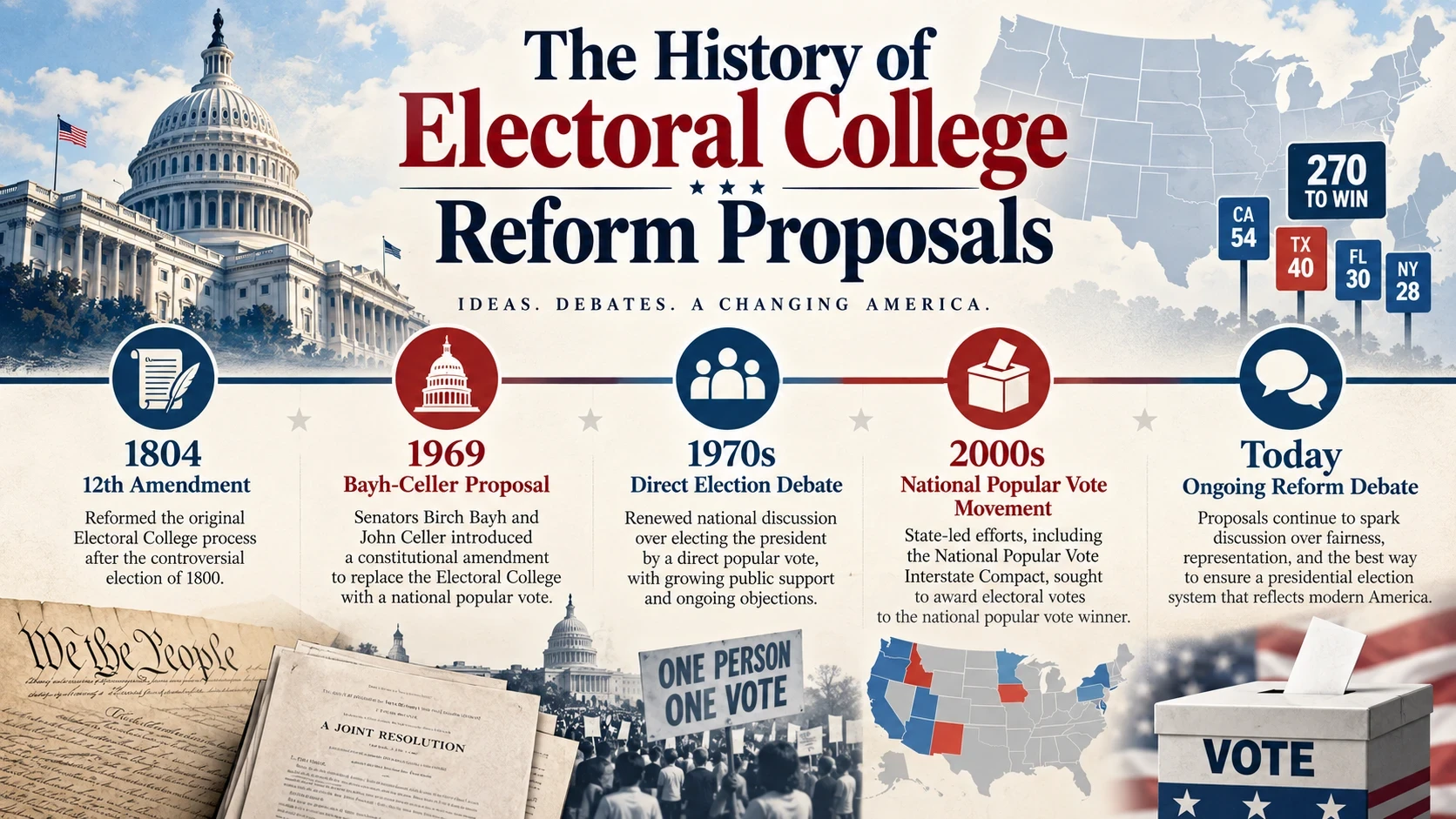
Ratified in 1804, the amendment required electors to cast separate ballots for president and vice president. It also modified the procedures used when no presidential candidate receives an electoral majority.
The 12th Amendment remains the most important direct constitutional reform of the Electoral College.
But it certainly did not end demands for additional changes.
Reform Ideas Appear During the 1800s
Questions about presidential elections continued throughout the 19th century.
One of the most important long-term changes actually occurred without amending the Constitution.
States increasingly began allowing voters to choose presidential electors through popular elections. Eventually, almost every state adopted a winner-take-all system in which the candidate receiving the most votes statewide receives all of that state’s electoral votes.
The Constitution itself does not require winner-take-all allocation.
That distinction becomes important when discussing modern reform proposals.
Meanwhile, members of Congress continued introducing constitutional amendments aimed at changing presidential elections.
Some ideas were conventional. Others were remarkably creative.
The National Archives has documented an 1846 proposal that would have involved drawing a ball from a bowl as part of the presidential selection process. While that idea obviously did not become law, it illustrates just how long Americans have experimented with alternatives to the existing system.
Controversial presidential elections also tended to renew interest in reform.
The elections of 1876 and 1888, for example, intensified debate about the relationship between the nationwide popular vote and the Electoral College result.
That pattern would repeat itself in later generations.
Four Major Reform Ideas Emerge
Over time, most serious reform proposals fell into several broad categories.
The Congressional Research Service has identified four of the most frequently discussed approaches: direct popular election, the district plan, the proportional plan, and an automatic electoral-vote plan.
Each would change presidential elections differently.
Direct Popular Election
The most sweeping proposal would replace the Electoral College with a national popular vote.
Instead of competing for electoral votes state by state, presidential candidates would compete for individual votes nationwide.
Different versions of this idea have included different rules.
Some proposals simply award the presidency to the candidate receiving the most votes nationwide. Others have required a minimum percentage of the national vote, followed by a runoff if no candidate reaches that level.
Supporters generally argue that the candidate receiving the most votes nationally should become president.
Opponents often argue that eliminating the Electoral College could reduce the importance of states as political units within presidential elections and would represent a major alteration of the federal system.
Those competing arguments have remained remarkably consistent across generations.
The District Plan
The district plan keeps the Electoral College but changes the way electoral votes are distributed.
Under this approach, a state generally awards one electoral vote to the winner of each congressional district. The state’s two remaining electoral votes go to the statewide winner.
This is not merely theoretical.
Maine and Nebraska currently use versions of the district system, while most other states use winner-take-all rules.
Supporters argue that the district approach can reflect political differences within a state instead of treating the entire state as one voting bloc.
Critics note that presidential results could then be affected by the boundaries of congressional districts. Because congressional maps can change through redistricting, disputes over those maps could become even more important during presidential elections.
The Proportional Plan
Another proposal would distribute electoral votes roughly according to each candidate’s percentage of the popular vote within a state.
Imagine, for example, that a candidate received about 60 percent of a state’s vote while another received about 40 percent. Instead of the leading candidate receiving every electoral vote, the two candidates might receive approximately 60 and 40 percent of them.
Different versions use different mathematical formulas because electoral votes cannot always be divided neatly.
Supporters believe proportional allocation would represent minority viewpoints within individual states more accurately.
Critics argue that it could make it more difficult for any candidate to receive the required Electoral College majority, possibly increasing the likelihood that an election could be decided through the contingent-election process in Congress.
Colorado voters considered a proportional electoral-vote proposal in 2004 but rejected it.
The Automatic Plan
The automatic plan is the least dramatic of the four traditional reforms.
It would preserve electoral votes and generally preserve winner-take-all allocation while eliminating the actual human electors.
In other words, when voters selected a presidential candidate, that candidate would automatically receive the appropriate electoral votes.
The idea was partly intended to address concerns about so-called “faithless electors”—electors who vote for someone other than the candidate they were expected to support.
The 1968 Election Sparks a Major Reform Effort
Perhaps the closest Congress came to fundamentally changing the Electoral College occurred after the 1968 presidential election.
Republican Richard Nixon won 301 electoral votes, while Democrat Hubert Humphrey received 191. Independent candidate George Wallace won 46.
Nixon received about 43 percent of the national popular vote.
During the campaign, there had been concern that Wallace might win enough electoral votes to prevent either major-party candidate from receiving an Electoral College majority. That possibility brought renewed attention to the system.
In 1969, Representative Emanuel Celler introduced a proposal to replace the Electoral College with direct popular election.
Under the proposal, a candidate receiving at least 40 percent of the nationwide vote could win the presidency. If nobody reached that threshold, the top two candidates would participate in a runoff.
The proposal received striking bipartisan support.
On September 18, 1969, the House approved the amendment by a vote of 338-70.
That remains one of the most significant Electoral College reform votes in American history.
But changing the Constitution requires approval from two-thirds of both houses of Congress before an amendment can be sent to the states.
The Senate never approved the measure.
Efforts to end debate on a related proposal failed twice in September 1970, and the reform effort eventually stalled.
Reform Continues During the 1970s
The idea did not disappear.
Senator Birch Bayh of Indiana became one of the leading congressional supporters of direct presidential election.
Another direct-election amendment was considered during the late 1970s. A 1979 proposal again sought direct popular election of the president and vice president, but it also failed to move through the entire constitutional amendment process. Senate records show a cloture effort involving the measure that year.
Afterward, large-scale Electoral College reform became less prominent in Congress for a period.
Then came the election of 2000.
The 2000 and 2016 Elections Renew the Debate
George W. Bush won the Electoral College in 2000 while Al Gore received more votes nationwide.
Sixteen years later, Donald Trump won the Electoral College while Hillary Clinton received more votes nationally.
Those elections once again placed Electoral College reform near the center of public debate.
Members of Congress introduced new constitutional amendments calling for direct election. For example, a 2005 proposal sought to abolish the Electoral College and elect the president and vice president through a nationwide popular vote.
None received the two-thirds support in both chambers required to send an amendment to the states.
A Different Approach: The National Popular Vote Interstate Compact
During the 2000s, another reform strategy appeared.
Instead of amending the Constitution, states could use their existing constitutional authority to decide how their electors are appointed.
That idea became the basis of the National Popular Vote Interstate Compact.
Under the compact, participating states agree that once states representing at least 270 electoral votes have joined, their electoral votes would be awarded to the presidential candidate receiving the most popular votes nationwide.
The Electoral College would technically continue to exist, but participating states would use it to produce a national-popular-vote result.
As of 2026, the compact has been enacted by 19 jurisdictions representing 222 electoral votes. Virginia became the latest state to join in April 2026. The agreement does not take effect unless participating jurisdictions collectively represent at least 270 electoral votes.
Supporters describe the compact as a way to create a nationwide popular-vote system without amending the Constitution.
Critics raise questions about federalism, election administration, interstate-compact law, and how the arrangement would operate during a very close or disputed national election.
If the compact eventually reaches 270 electoral votes, its implementation could also generate significant legal questions.
Why Electoral College Reform Is So Difficult
There is a simple reason reform proposals keep appearing but rarely become law: changing presidential election rules affects political power.
A constitutional amendment must clear an extremely high hurdle.
Two-thirds of both the House and Senate must approve an amendment, followed by ratification from three-fourths of the states.
That requires an unusually broad national consensus.
State-level changes are easier because states possess considerable authority over how their electors are awarded.
However, changing the system in only a few states can produce different strategic effects than changing it nationwide.
That is one reason Electoral College reform involves not only questions about democracy but also federalism, state power, political parties, campaign strategy, and constitutional law.
The Debate Is Older Than Most People Realize
It is easy to view arguments about the Electoral College as another feature of today’s polarized political environment.
History tells a different story.
Americans were debating presidential election rules almost immediately after the Constitution was adopted.
The election of 1800 produced the 12th Amendment. Throughout the 1800s, lawmakers proposed additional alternatives. The 1960s and 1970s produced one of the strongest congressional efforts to replace the system. Elections in 2000 and 2016 brought the subject back into national discussion, while the National Popular Vote Interstate Compact introduced a new state-based approach during the 21st century.
More than two centuries after the Constitution was written, the basic questions remain familiar.
Should presidential elections emphasize states or individual voters?
Should electoral votes be winner-take-all, divided by district, or distributed proportionally?
Should the president simply be the candidate who receives the most votes nationwide?
Americans have been debating those questions for generations.
That long history may be the most interesting part of the Electoral College reform debate. Whatever someone thinks about the current system, arguments about how the United States should choose its president are not a recent development.
They have been part of the American constitutional conversation almost from the beginning.