 Every four years, Americans see presidential candidates traveling across the country, holding rallies, giving interviews, buying television ads, and trying to convince voters to support them.
But if you watch closely, you may notice something interesting.
Candidates don’t spend the same amount of time in every state.
One week, a candidate may make several stops in Pennsylvania. A few days later, the campaign might be in Michigan, Wisconsin, Georgia, Arizona, or another closely contested state. Meanwhile, millions of voters living elsewhere may rarely see either presidential candidate in person.
Why?
A big part of the answer is the Electoral College.
The way Americans elect a president has a major influence on where campaigns spend their money, where candidates travel, which voters they concentrate on, and even which issues receive the most attention.
Understanding the Electoral College can therefore help us understand not only how presidential elections are decided, but also why presidential campaigns behave the way they do.
First, How Does the Electoral College Work?
When Americans vote for president, the presidency is not awarded simply to whichever candidate receives the most votes nationwide.
Instead, the winner is determined through the Electoral College.
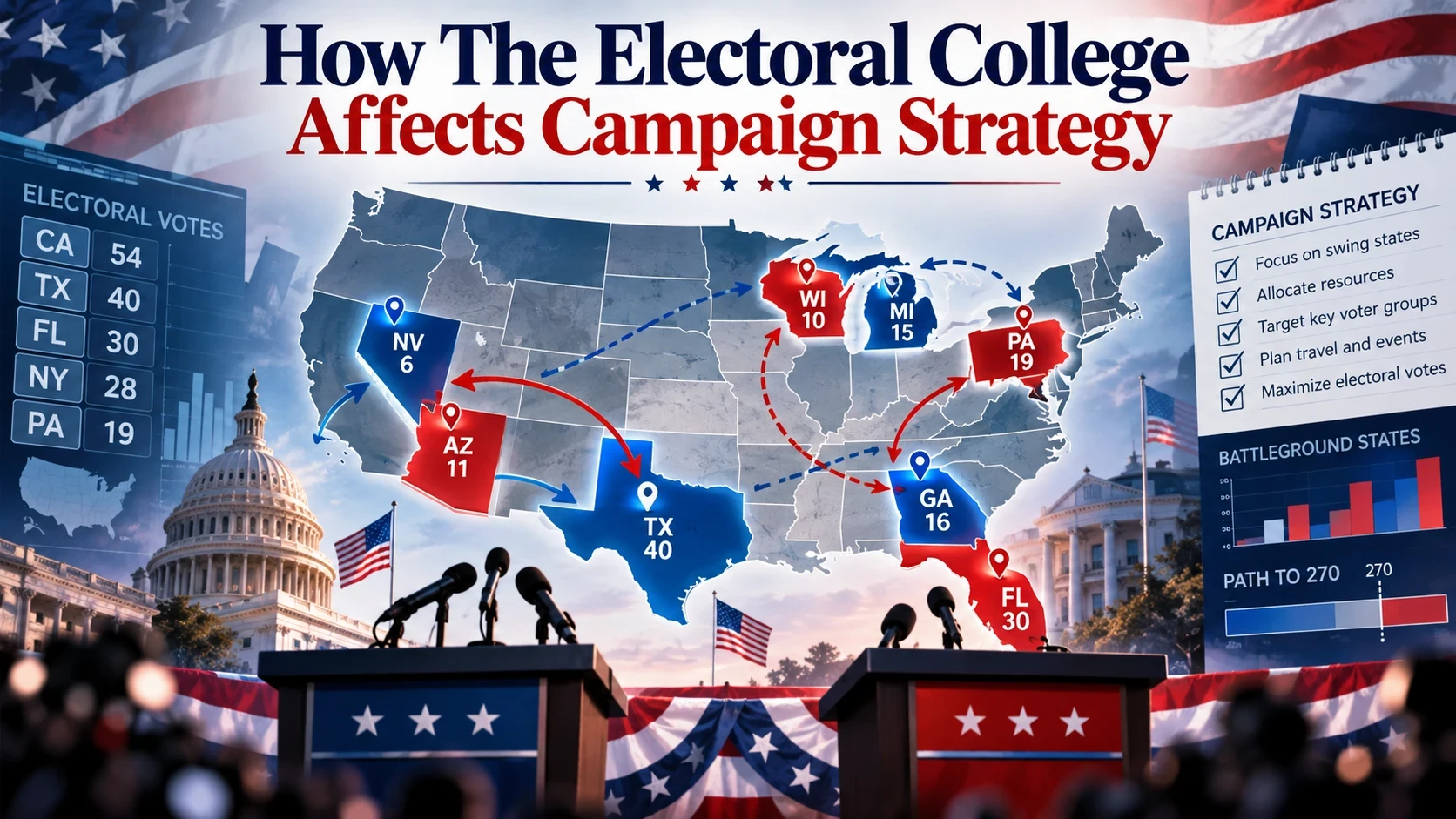
There are currently 538 electoral votes, and a presidential candidate needs a majority—at least 270 electoral votes—to win. Each state’s number of electoral votes is based on its representation in Congress, while Washington, D.C., receives three electoral votes.
This creates a very different campaign than we would probably see under a national popular-vote system.
A presidential campaign isn’t simply asking:
“How can we receive the most votes nationwide?”
It also has to ask:
“What combination of states can get us to 270 electoral votes?”
That second question is enormously important.
Campaign strategists can look at the electoral map almost like a puzzle. They know they need to put together enough states to reach 270, and there can be several possible paths to get there.
That affects nearly every major strategic decision a campaign makes.
Winner-Take-All Changes the Calculation
Another important part of the system is that most states use a winner-take-all approach.
In 48 states and Washington, D.C., the candidate who wins the statewide popular vote receives all of that jurisdiction’s electoral votes. Maine and Nebraska use a different method, awarding two electoral votes to the statewide winner and one electoral vote to the winner of each congressional district.
Think about what winner-take-all means for a campaign.
Imagine a state with 15 electoral votes.
Candidate A receives 50.5 percent of the vote.
Candidate B receives 49.5 percent.
Even though the candidates finished extremely close, Candidate A generally receives all 15 electoral votes.
Now imagine Candidate A wins another state by 20 percentage points.
The candidate still receives the same number of electoral votes assigned to that state. There is no extra Electoral College reward for winning the state by a bigger margin.
This encourages campaigns to focus on winning states rather than maximizing their margin everywhere.
And that’s where battleground states become so important.
Why Swing States Get So Much Attention
Some states reliably favor one party in presidential elections, while others are much more competitive.
Those competitive states are often called swing states or battleground states.
From a campaign’s point of view, spending enormous amounts of time and money trying to turn a comfortable defeat into a slightly smaller defeat may not change the Electoral College result.
Likewise, increasing an already comfortable victory may add popular votes without adding any additional electoral votes.
A closely divided state is different.
If a relatively small number of voters could change which candidate wins the state, campaigning there could potentially shift all of its winner-take-all electoral votes.
That makes competitive states especially valuable.
It helps explain why presidential candidates may visit certain states again and again while barely appearing in others.
It isn’t necessarily because voters in the other states don’t matter. It is because campaigns have limited resources, and the Electoral College encourages them to put those resources where they believe they have the greatest chance of affecting the final electoral vote count.
Campaign Travel Is Strategic
Presidential candidates only have so much time.
During the final months of a campaign, every day matters. Candidates must decide where to hold rallies, where to meet voters, where to give speeches, and where to send their running mates and other campaign representatives.
The Electoral College heavily influences those choices.
Suppose internal polling suggests a campaign is comfortably ahead in one state, far behind in another, and virtually tied in a third.
Where would you send the candidate?
In many cases, the close state becomes the logical destination.
That’s why campaign schedules can sometimes seem repetitive.
Candidates may return to the same areas several times because winning a closely contested state could make the difference in reaching 270 electoral votes.
Advertising Money Follows the Electoral Map
The same principle applies to campaign advertising.
Presidential campaigns and outside political groups can spend huge sums trying to reach voters through television, radio, digital advertising, mail, and other forms of communication.
But money isn’t unlimited.
A campaign must decide where another dollar is most useful.
Consider two hypothetical states.
In State A, polling shows a candidate ahead by 18 percentage points.
In State B, the race appears almost evenly divided.
Buying another television advertisement in State A might have little effect on the Electoral College outcome if that state already appears secure.
That same money spent in State B could potentially persuade or mobilize enough voters to influence who receives that state’s electoral votes.
As a result, people living in competitive states may be flooded with political advertising while people elsewhere see considerably less presidential campaign activity.
It can feel strange, but it makes sense when viewed through Electoral College strategy.
Campaigns Build a “Path to 270”
You’ll often hear political analysts talk about a candidate’s path to 270.
This simply means the combination of states that could provide enough electoral votes to win the presidency.
There isn’t necessarily only one path.
For example, one campaign might believe it can reach 270 by winning several states in the Midwest. Another possible route might rely more heavily on competitive states in the South or West.
Campaigns constantly evaluate these possibilities.
If polling changes in one state, they may redirect money and staff toward another. A state once considered essential might become less important if a different combination of states provides an alternative route to 270.
This is one reason presidential campaign strategy can change quickly.
The map is constantly being reassessed.
Not All Electoral Votes Are Equal in Strategy
States also have very different numbers of electoral votes.
Under the allocation being used for the 2024 and 2028 elections, for example, California has 54 electoral votes, Texas has 40, Florida has 30, and New York has 28. At the other end of the scale, several states and Washington, D.C., have only three.
That doesn’t automatically mean candidates spend most of their time in the biggest states.
Competitiveness matters too.
A smaller state where the election is extremely close may attract far more campaign attention than a much larger state where the outcome appears relatively predictable.
Campaign strategists therefore have to consider at least two things at once:
How many electoral votes does the state have, and how realistically can we win them?
A large, competitive state can be particularly attractive because moving a relatively small percentage of voters could produce a significant Electoral College payoff.
Maine and Nebraska Are Different
Maine and Nebraska provide an interesting exception to the usual strategy.
Instead of automatically giving every electoral vote to the statewide winner, both states award two votes to the statewide winner and one vote based on the winner of each congressional district.
That means their electoral votes can be divided between presidential candidates.
And this isn’t merely theoretical.
In the 2024 presidential election, both Maine and Nebraska split their electoral votes. Maine awarded three electoral votes to the Harris-Walz ticket and one to the Trump-Vance ticket, while Nebraska awarded four to Trump-Vance and one to Harris-Walz.
Because individual congressional districts can matter in these states, campaigns may sometimes target a particular district rather than treating the entire state as a single winner-take-all contest.
It’s a small exception, but it shows how the rules themselves can shape campaign behavior.
The Electoral College Can Differ From the Popular Vote
Another important feature of the Electoral College is that the national popular-vote winner is not guaranteed to become president.
That has happened several times in American history, including the elections of 2000 and 2016.
This possibility further reinforces why campaigns think state by state.
Winning another 200,000 votes in a state a candidate was already going to win comfortably could increase the candidate’s national popular-vote total without adding any electoral votes.
Winning 20,000 additional votes in a very close state, however, might change who receives that state’s entire block of electoral votes.
From a purely strategic standpoint, those votes can therefore have very different consequences.
Campaign Issues Can Be Affected Too
The Electoral College doesn’t just influence where candidates travel.
It can also influence what candidates talk about.
If several competitive states contain large numbers of voters concerned about a particular industry, economic issue, or local concern, candidates have an incentive to address those topics.
That doesn’t mean national issues disappear.
Presidential candidates still need broad coalitions of voters across many states.
But battleground-state politics can affect which issues receive extra attention, especially during the closing weeks of a campaign.
When you hear a presidential candidate discussing an issue that seems particularly relevant to the state they’re visiting, there’s often a strategic reason behind it.
What Does This Mean for Voters?
One criticism of the Electoral College is that it encourages presidential candidates to concentrate heavily on a relatively small group of competitive states.
Supporters of the system point to different considerations, including the Electoral College’s state-based structure and the role states play in choosing the president.
That larger debate over whether the Electoral College should be kept, changed, or replaced has been going on for a long time.
But regardless of where someone stands on that debate, one thing is clear:
The Electoral College has a major effect on how presidential campaigns are run.
Once you understand that, campaign behavior becomes much easier to follow.
Why is a candidate visiting the same state for the fourth time?
Why are voters in one state seeing political commercials constantly while voters elsewhere see relatively few?
Why do television networks spend election night talking about different combinations of states?
Why are campaigns obsessed with finding a “path to 270”?
The Electoral College helps answer all of those questions.
Final Thoughts
Presidential campaigns may look like nationwide contests, but strategically they are really a collection of state contests that eventually produce one national result.
Candidates must win enough electoral votes to reach 270, so their campaigns are designed around that goal.
That means identifying competitive states, deciding where campaign appearances could make a difference, concentrating advertising dollars where they may have the most impact, mobilizing supporters in crucial areas, and constantly calculating different routes to an Electoral College majority.
You don’t have to support or oppose the Electoral College to recognize its influence.
The next time you watch a presidential campaign unfold, pay attention to where the candidates are going.
Look at where they’re advertising.
Notice which states political analysts keep discussing.
Then look at the electoral map.
Chances are, the Electoral College will explain a lot of what you’re seeing.