Most people meet a political debate as a clip: a sharp line, a awkward pause, a headline declaring a winner. The event itself is a constructed thing. Its length, its order of speakers, its questions and even its microphones were decided in advance, and those decisions shape what the candidates can do on stage.
Once you know how political debates work, you can watch one without needing a side to cheer for. This guide covers who builds a debate, the common formats, the moderator’s job, what candidates are trying to accomplish, and a checklist you can use on any debate in any country.
Who organizes a debate, and who decides the rules
A debate is not a law or a constitutional requirement. In most places no rule forces candidates to appear on a stage together. Debates happen because organizers invite candidates and candidates agree to attend.
Organizers vary. They can be a broadcaster, a nonprofit commission, a newspaper, a university, a civic group such as a league of voters, or a political party running its own primary debates. Each has its own goals: reaching a large audience, informing local voters, or fitting a party’s nomination calendar.
The rules are usually negotiated. Campaigns and organizers settle questions like these before anyone walks on stage:
- How many debates there will be, and when and where they take place
- The format: podium, town hall, panel, or something else
- How long each answer and rebuttal may last
- Whether candidates may bring notes, and whether they may move around the stage
- Whether a candidate’s microphone is switched off while the other is speaking
- Which candidates are invited at all
The last item matters more than it looks. Organizers often set an entry threshold, such as a minimum level of support in polls, and that decides who the audience ever sees. A candidate left out of the debate loses a major chance to be heard, and a candidate who is polling well may have reasons to prefer fewer debates. Each side bargains for rules it expects to help. Candidates who are well known often favor fewer events, while lesser-known candidates often want more.
Debates can also fall through completely. Candidates sometimes decline, and the arrangements change from one election to the next. Treat the existence of a debate as the result of a negotiation, because it is.
The common formats, from town halls to head-to-head podiums
The format changes what a candidate can do, so it is worth recognizing within the first few minutes.
Podium debate
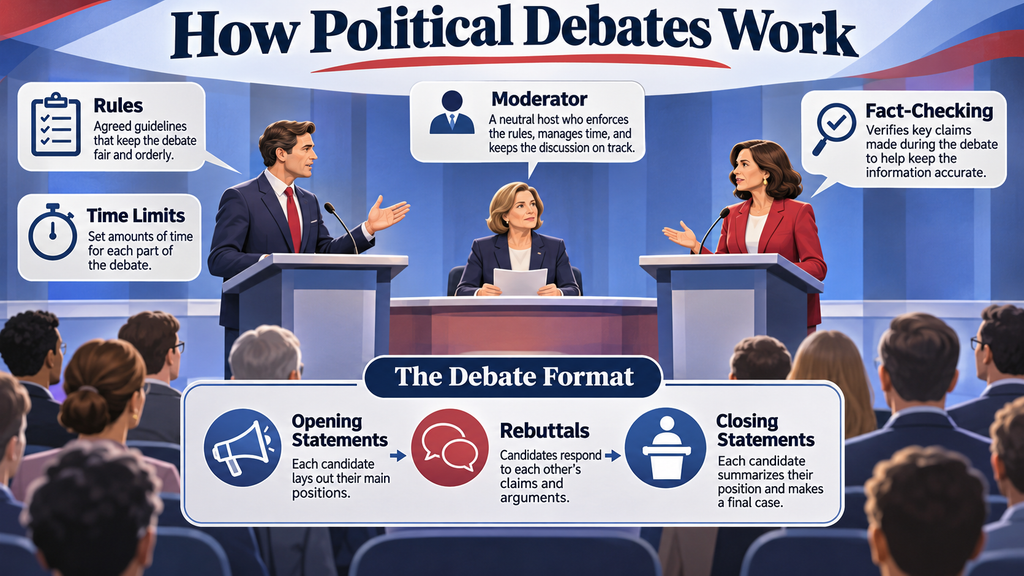
Two candidates (or more) stand at lecterns and a moderator asks questions. Each candidate usually gets a set time to answer, then a short window for the opponent to respond. This format rewards quick, compact answers and direct contrast with the other person. It is the version most people picture.
Town hall
Here the audience asks the questions, sometimes selected in advance by the organizers and sometimes drawn from undecided voters in the room. Candidates often move around the stage. The format tends to be warmer and more personal, because a candidate answers a person’s question face to face. It rewards ease with strangers, and it is harder to deflect a question when its author is standing a few feet away.
Panel debate
A group of journalists or experts, rather than one moderator, questions the candidates. Panels can pursue topics in more depth, though with several questioners the time per candidate shrinks.
Multi-candidate primary debates
When a party has many candidates seeking its nomination, the stage can be crowded. Each person gets only a few minutes of total speaking time across the evening, so candidates compete to be remembered for one memorable moment. Their main rivals are often not the other party but the people standing next to them.
Forums and issue-specific debates
Some events focus on a single subject, such as local housing, schools, or a regional budget. These matter most in local elections, where the stage may hold candidates for a city council or school board and the questions are about decisions that directly affect the room.
If you want to see what the topics themselves involve, our explainers on economic policy and health policy cover the ground debate questions often draw from.
What the moderator does, and why that job is harder than it looks
The moderator has three jobs at once: choosing and asking questions, keeping time, and keeping the candidates to the rules they agreed to. Doing all three while a live audience watches is difficult.
Question selection is where much of the influence sits. A moderator who asks about the economy for twenty minutes and about foreign affairs for five has shaped the evening’s agenda, whatever their intentions. Wording matters too. A question can carry assumptions, and a candidate may spend the first part of an answer accepting or rejecting them.
Timekeeping is the second job. Candidates tend to run past their time, especially when they are mid-argument. The moderator must decide when to interrupt, and interrupting one candidate more than the other looks like bias even when it is not.
Then comes the matter of facts. If a candidate says something that is wrong or misleading, should the moderator correct it in real time? Some argue that live fact-checking is part of the job and that letting a false claim stand misleads viewers. Others argue that the moderator’s role is to manage the exchange, that the opponent can challenge the claim, and that a moderator who fact-checks becomes a participant. Organizers settle this in advance, which is why you will see different behavior in different debates. Neither approach is neutral in effect, since both change how much a candidate can get away with.
Whatever you think the right answer is, notice which approach a given moderator takes. It tells you whom the format places the burden of checking claims on: the moderator, the opponent, or you.
What candidates are really trying to do in ninety minutes
A debate is a rare event where candidates speak without a filter for a long stretch, but they are rarely trying to win an argument in the way a school debater does. Each is working toward several practical goals.
Reach voters who are not already decided. Committed supporters have mostly made up their minds. The people a candidate hopes to move are the undecided and the weakly committed, so answers are often aimed at them rather than at the opponent.
Reassure their own side. Supporters want to see their candidate seem competent and confident. A flat performance can reduce enthusiasm even among people who were never going to switch.
Create a clip. Because many more people see the highlights than the full event, candidates prepare short lines designed to be repeated. A prepared zinger is not spontaneous, even when it sounds that way.
Avoid a mistake. For a candidate who is ahead, the goal may simply be to get through the evening without a damaging moment. That candidate may answer cautiously and repeat familiar points.
Define the opponent. A candidate may use the stage to frame the other person’s record or character before the audience has formed an opinion.
Steer toward home ground. Almost any question can be answered by moving to a topic the candidate prefers. Pivoting is routine, and the phrase “what the voters really care about” often signals one.
Preparation is heavy. Campaigns commonly rehearse with stand-ins and drill answers to likely questions, so a good deal of what sounds improvised has been practiced. That does not make it dishonest, but it is a reason to treat polish as skill rather than as evidence of truth.
Why “who won” is a harder question than the morning-after headlines suggest
Headlines usually name a winner within hours. But a debate has no scoreboard, and “winning” can mean quite different things:
- Performance: who seemed more confident, prepared, and composed
- Arguments: whose claims were more accurate and better supported
- Persuasion: whose performance actually changed minds
- Expectations: who did better than people expected, which can count for more than being best
These often disagree. A candidate can deliver the most polished evening and make several inaccurate claims. A candidate can stumble over wording and still be the one whose policy points hold up. Viewers also see what they expect to see: people tend to judge their own side’s candidate as stronger, which is a reason to be cautious about your own instant verdict.
Instant polls taken right after a debate measure the opinions of whoever responded, and those respondents may not represent voters generally. Our guide on how to read an opinion poll explains what to check before trusting a number.
Effects on actual voting are often small and take days to show up. The story that forms about a debate, repeated in clips and commentary, can matter as much as the event. That is why two people can watch the same ninety minutes and then read very different accounts of what happened.
A neutral viewing checklist you can use on any debate
Keep this beside you while you watch. It works whichever candidates are on stage.
Before it starts
- Who organized it, and who set the rules?
- Which format is it, and how much time does each candidate get?
- Who was invited, and who was left out?
While you watch
- Did the candidate answer the question asked, or move to a different topic?
- Which claims could be checked, such as numbers, dates, or statements about a record? Write them down to verify later.
- When a candidate attacks, is it about policy, record, or character?
- What did each candidate leave unsaid when it would have been easy to say?
- Did the moderator treat both candidates evenly on time and follow-up?
- Which lines sound rehearsed, and what are they designed to make you feel?
Afterward
- Wait a day before deciding who did best. Your first reaction is shaped by mood and loyalty.
- Check the claims you wrote down against primary sources, such as official statistics or the candidate’s actual voting record.
- Read or watch coverage from outlets with different leanings, and compare what each one emphasized.
- Ask yourself what you learned about the candidates’ plans, separate from how they came across.
For a closer look at how outlets frame what happened, see our piece on the role of media in politics.
Where to go next: speeches, rhetoric, and spin
A debate is one kind of political speech, and the same tools apply. If you want a method for taking apart what a candidate says, the five-question approach to analyzing a political speech works on debate answers too. When a candidate seems to be turning a weak point into a strong one, our explainer on what political spin is will help you name what is happening.
Pick the next debate on the calendar, watch it with the viewing checklist beside you, and then read our guide to how politicians use rhetoric to spot the techniques you heard.