
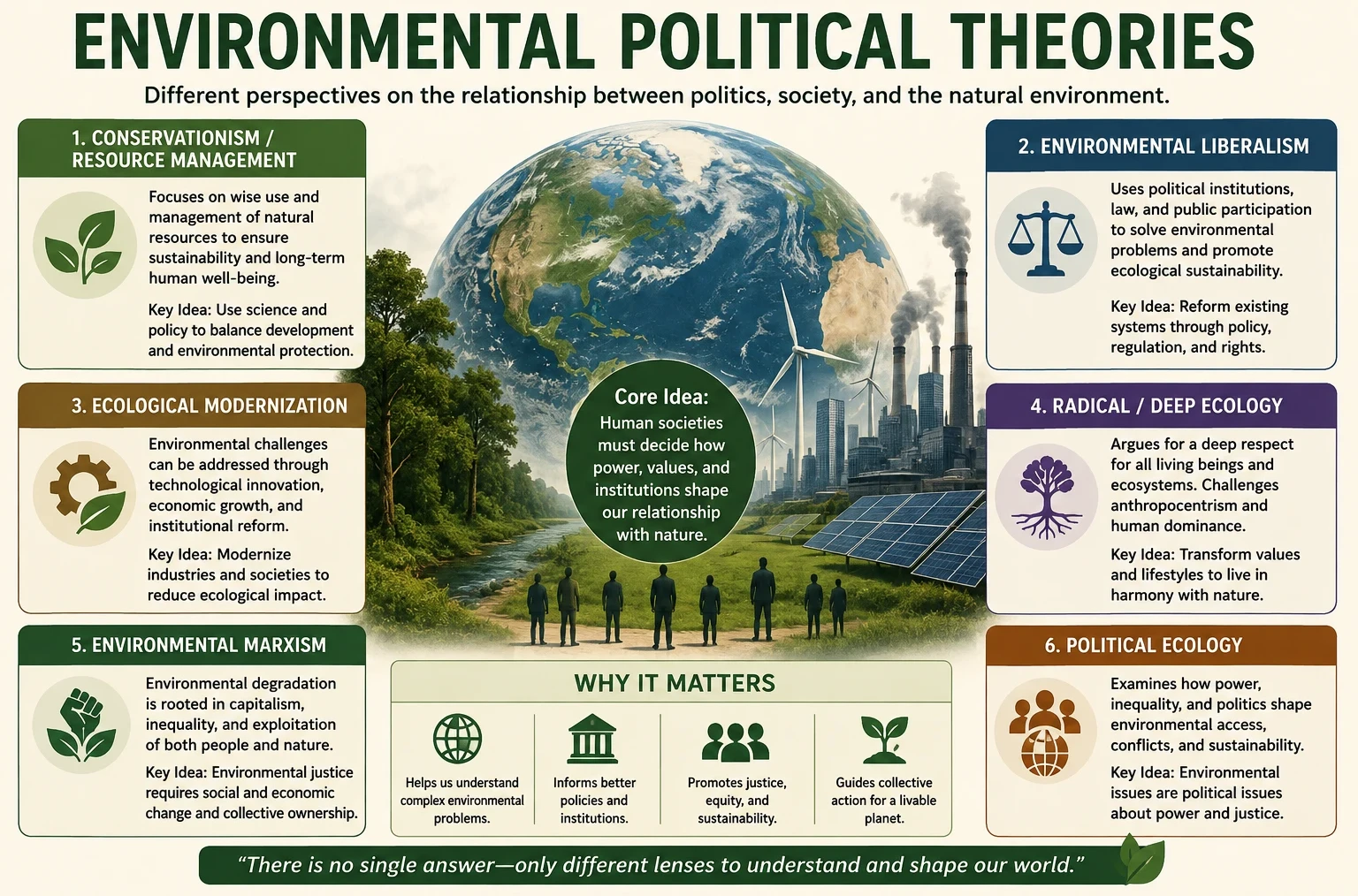
 Environmental political theories explore how political processes shape environmental policies and practices. They examine power dynamics, ideological perspectives, and societal values in crafting policy responses to ecological challenges. This niche field in political science focuses on understanding the relationship between humans and nature through the lens of governance.
Tracing back through history, environmental political theories have evolved parallel to industrial, social, and political changes. The early roots can be found in classical environmentalism, where initial thoughts on human-nature relationships began to take shape against the backdrop of industrial growth and urban expansion.
In today’s fast-paced world, the importance of environmental political theories can’t be overstated. As climate change becomes more than just a buzzword, there’s a growing need to understand the political underpinnings that drive efforts to mitigate environmental issues. These theories equip policymakers, activists, and everyday individuals with the frameworks they need to advocate for sustainable solutions.
The Roots: Classical Environmentalism
Classical environmentalism sets the stage for understanding how we’ve come to approach environmental issues today. This perspective emerged as societies started to notice the adverse effects of unchecked industrialization. With factories popping up and cities expanding, early environmentalists felt the urge to push back, advocating for a more balanced relationship with nature.
Key pioneers in this space, like Rachel Carson—who rocked the world with her book ‘Silent Spring’—highlighted the risks of pesticides and industrial pollution. These people weren’t just raising alarms; they helped lay the groundwork for environmental awareness and policy action through grassroots activism and scientific advocacy.
Classical environmentalism’s impact is still seen in modern policies. Concepts like national park conservation, pollution control, and wildlife protection trace back to those early days. While we might debate the methods or effectiveness, there’s no denying the foundational role classical environmentalism played in shaping today’s environmental policies and dialogues.
Ecological Modernization and Sustainability Politics
Ecological modernization brings a fresh perspective to environmental political theories by emphasizing the synergy of economic growth and environmental protection. It argues that technological advancement and economic development aren’t foes of the environment but can be allies. This approach takes a more optimistic view, seeing industry as part of the solution rather than the problem.
Unlike classical environmentalism that leaned heavily on regulation and control, ecological modernization advocates for innovation. Industries are encouraged to adopt new technologies that reduce emissions and waste, enhancing both competitiveness and sustainability. It’s about reimagining production and consumption processes to align with ecological goals.
Sustainability politics, growing from these theoretical roots, strives to balance economic growth with environmental stewardship. It frames the discussion not just around conservation but around redesigning systems to sustain long-term ecological health. Both policy-makers and businesses are starting to consider not only the environmental costs but also the benefits of sustainable practices.
Technology takes center stage here, seen as a dual-purpose tool for both growth and green initiatives. Smart grids, renewable energy sources, and sustainable urban planning are all products of this modern thinking. They demonstrate how innovation doesn’t have to compromise on economic goals, encouraging a collaborative effort across sectors to build a greener future.
Green Politics and the Rise of Environmental Parties
Green politics takes the idea of environmental concern and ramps it up to a political movement that operates on a global scale. These movements don’t just push for policy changes; they strive to bring environmental issues to the forefront of national and international agendas.
The rise of green parties can be seen across many countries, forming critical components of political systems, especially in Europe. These parties champion issues like renewable energy, climate justice, and biodiversity conservation, often setting the bar in terms of environmental standards and commitments.
The influence of green parties has been particularly pronounced in shaping international environmental protocols and treaties. From the Kyoto Protocol to the Paris Agreement, these parties play key roles, pushing for stronger commitments and more ambitious targets.
Key policies from green politics have led to innovations like carbon trading schemes, increased investment in public transportation, and stronger regulations on pollutants. They promote an integrative approach to politics, where social justice and environmental stewardship coalesce. Their ability to gain traction speaks to the growing public awareness and demand for accountability in dealing with environmental challenges.
What sets green politics apart is its foundational role in rallying the public around systemic changes and leading the charge for governments to act decisively on ecological issues. As the effects of climate change become more evident, their influence only seems to be growing.
Radical Environmentalism: From Anarchism to Eco-Socialism
Radical environmentalism isn’t about minor tweaks. It’s a full-throttle approach to environmental activism, often pushing for deep systemic changes in how societies interact with the planet. In this view, the conventional political and economic systems are seen as inherently exploitative and in need of fundamental transformation.
Anarchism within environmentalism questions the hierarchical structures that drive ecological degradation. It suggests that decentralized, community-based governance might be the answer to achieving true sustainability and equity. This perspective often emphasizes direct action and grassroots organizing as essential tools for change.
Eco-socialism takes a different angle but with similar intensity, melding socialist principles with ecological concerns. The idea here is that capitalism’s intrinsic push for profit directly drives environmental harm. Advocates argue for a societal model where the means of production serve environmental and social good, rather than just economic gain.
Critics often accuse radical environmentalism of being too extreme or impractical. However, the passion that fuels these movements also attracts a dedicated following, inspiring significant movements like Earth First! and Extinction Rebellion. These groups argue that without bold changes, the environmental crisis is destined to deepen.
From protests to blockades, radical environmentalism challenges the status quo, sparking debates on the best approaches to achieve ecological health. While not everyone agrees with their methods, the urgency they highlight raises vital questions about global priorities and the sacrifices needed for a sustainable future.
Future Trajectory of Environmental Political Theories
Emerging trends in environmental political theories suggest an evolving landscape where traditional ideas meet new challenges. As climate science advances, theories are increasingly driven by the undeniable evidence of global warming and resource depletion. This pressure is prompting both governments and industries to rethink their roles.
We’re seeing a fusion of ideas shaping future policies. Traditional theories like classical environmentalism provide grounding, while newer concepts like ecological modernization push for innovative solutions. Less-adopted approaches, such as radical environmentalism, continue to influence discourse, reminding society of the need for genuine change if we’re to curb environmental decline.
Debating how to integrate these diverse theories into cohesive policy strategies is crucial. Some trends indicate increased reliance on technology and new economic models, like the circular economy, which seeks to minimize waste. Others emphasize maintaining biodiversity as a cornerstone of environmental health.
Potential pathways forward may involve balancing economic robustness with ecological responsibility. Suggestions include advancing renewable energy use, adopting nature-based solutions for urban design, and fostering international cooperation for comprehensive environmental policies.
Looking ahead, the role of younger generations cannot be overlooked. They bring fresh perspectives, challenging the status quo and driving shifts in consumption patterns and political activism. Engaging broadly, from local community efforts to international policy-making, their impact will undoubtedly shape the next phase of environmental political theories.