 If you have ever wondered why the president cannot simply make any law he or she wants, why Congress can investigate the executive branch, or why courts sometimes block actions taken by the government, the answer often comes back to one important idea: the separation of powers.
The separation of powers is one of the basic principles behind the United States government. In simple terms, it means that government power is divided among different branches instead of being placed in the hands of one person or one institution.
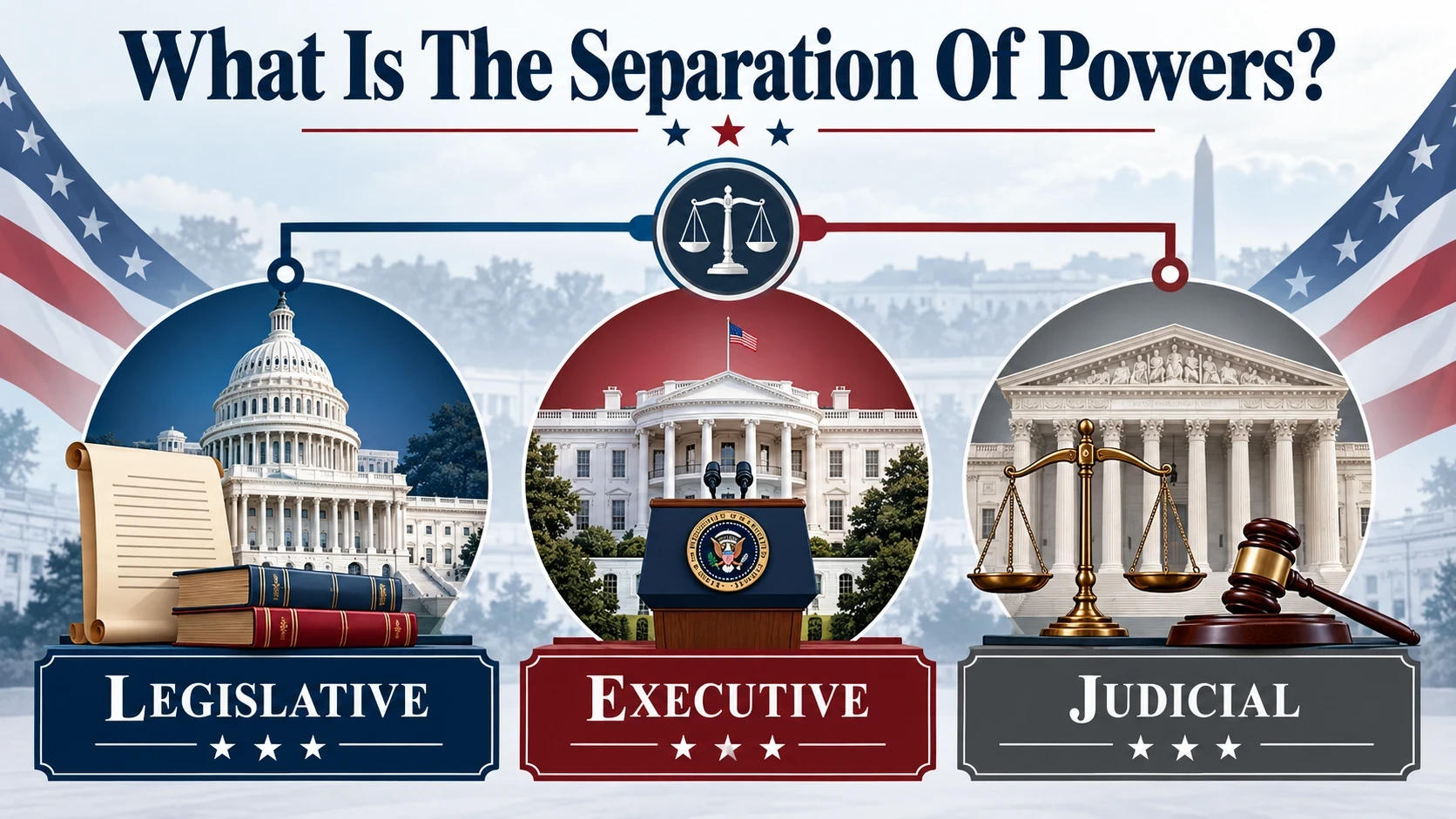
The U.S. Constitution divides the federal government into three branches: the legislative branch, the executive branch, and the judicial branch. Articles I, II, and III of the Constitution establish these three branches and assign different governmental responsibilities to each of them.
But the system is more interesting than simply dividing responsibilities.
The branches are also given ways to limit or influence one another. This is known as the system of checks and balances.
Let’s take a closer look at how it all works.
What Does Separation of Powers Mean?
Imagine for a moment that one person had the authority to write the laws, enforce those laws, and decide whether someone had violated them.
That would place an enormous amount of power in one set of hands.
The separation of powers is designed to prevent that kind of concentration.
Under the U.S. constitutional system, the three major functions of the federal government are divided among separate branches. Congress exercises legislative power, the president exercises executive power, and the federal courts exercise judicial power.
The basic idea is that no single branch should control the entire government.
Separation of powers was an important concern for the people who designed the Constitution. The Framers were influenced by political ideas warning about the dangers of concentrating legislative, executive, and judicial authority in the same hands. The Constitution therefore created separate institutions with different responsibilities.
However, the branches are not completely isolated from one another.
They interact constantly.
That is where checks and balances come in.
The Legislative Branch: Congress
The legislative branch is Congress, which consists of the House of Representatives and the Senate.
Article I of the Constitution gives legislative powers to Congress.
One of Congress’s most important responsibilities is creating federal laws.
A bill normally has to pass both the House and Senate before being sent to the president. Congress also has many other constitutional responsibilities, including raising revenue, regulating interstate and foreign commerce, providing funding for the government, declaring war, and conducting oversight.
Congress also plays an important role in checking the other branches.
For example, the Senate has a role in confirming many presidential appointments, including federal judges and Cabinet officials. The Senate also considers treaties negotiated by the president.
Congress controls federal spending through its power over appropriations. That means the executive branch cannot simply spend unlimited amounts of money without congressional authorization.
Congress also has the power of impeachment. The House can impeach certain federal officials, while the Senate conducts impeachment trials.
These powers give Congress important ways to respond when disagreements arise between the branches.
The Executive Branch: The President
Article II of the Constitution places executive power in the president.
The executive branch is responsible for carrying out and enforcing federal laws.
The president is the most visible part of the executive branch, but the branch is much larger. It includes executive departments, agencies, and thousands of government employees who administer federal programs and enforce federal laws.
The president also serves as commander in chief of the armed forces, appoints certain federal officials, negotiates treaties subject to Senate approval, and performs other responsibilities established by the Constitution and federal law.
The president also has an important check on Congress: the veto.
When Congress passes a bill, the president can sign it into law or veto it.
But even a presidential veto is not necessarily the final word.
Congress can override a veto if two-thirds of both the House and Senate vote to do so.
That is a good example of checks and balances in action. The president can prevent legislation from becoming law, but Congress has a constitutional method of overcoming that decision if enough members agree.
The Judicial Branch: The Federal Courts
The third branch is the judicial branch.
Article III establishes the judicial power of the United States in the Supreme Court and allows Congress to establish lower federal courts.
Federal courts hear cases involving the Constitution, federal laws, treaties, disputes between states, and other matters within federal jurisdiction.
One of the judiciary’s most important roles is interpreting the law.
The Supreme Court’s 1803 decision in Marbury v. Madison established the principle of judicial review, under which courts can determine that government actions or laws conflict with the Constitution.
This gives the judicial branch an important check on both Congress and the executive branch.
For example, Congress might pass a law that someone argues violates the Constitution. If that issue reaches the courts through a proper case, judges can consider whether the law is constitutional.
Courts can also review actions taken by the executive branch when those actions are challenged through the legal system.
At the same time, the judiciary has checks placed upon it as well.
Federal judges are nominated by the president and generally require Senate confirmation. Congress also has authority over the structure and jurisdiction of much of the lower federal court system, subject to constitutional limits.
Once again, no branch operates completely on its own.
Separation of Powers and Checks and Balances Are Related — But Different
People often use the terms separation of powers and checks and balances as though they mean exactly the same thing.
They are closely related, but there is a difference.
Separation of powers refers to dividing government responsibilities among different branches.
Checks and balances refers to the tools those branches have to limit or influence one another.
Think of it this way.
Separation of powers creates three different players.
Checks and balances create the rules that prevent any one of those players from controlling the entire game.
The Constitution was designed so the branches would sometimes have to cooperate and sometimes have to compete.
That can make government slower and more complicated, but the difficulty is partly intentional. The constitutional system does not simply divide power; it also creates overlapping responsibilities that allow the branches to check one another.
A Simple Example of Checks and Balances
Imagine that Congress passes a new federal law.
First, the House and Senate must agree on the legislation.
The bill then goes to the president.
The president can sign it, allowing it to become law, or veto it.
If the president vetoes the bill, Congress can attempt to override the veto with the required two-thirds vote in each chamber.
Suppose the legislation becomes law but someone later argues that it violates the Constitution.
A lawsuit could eventually reach the federal courts. The judiciary could then consider whether the law is constitutional.
So one piece of legislation can involve all three branches:
Congress creates the law.
The executive branch enforces the law.
The judicial branch interprets the law when a legal dispute arises.
That simple example demonstrates why separation of powers and checks and balances are so closely connected.
The Branches Are Separate, But Not Completely Independent
One common misunderstanding is that the three branches are supposed to operate completely independently.
They are not.
The Constitution deliberately creates areas where the branches overlap.
The president nominates federal judges, but the Senate generally decides whether to confirm them.
Congress passes legislation, but the president can veto it.
The president carries out federal law, but federal courts can review executive actions when those actions are challenged.
Congress controls appropriations, which can affect what executive agencies are able to do.
The Constitution therefore creates both separation and interaction.
The Constitution Annotated, published by Congress, notes that although core governmental functions were allocated to separate branches, the constitutional design also anticipates some overlap among them.
Separation of Powers Is Not the Same as Federalism
There is another political concept that is sometimes confused with separation of powers: federalism.
The two ideas deal with different kinds of power.
Separation of powers divides authority within the federal government among the legislative, executive, and judicial branches.
Federalism divides authority between the federal government and the states.
Both systems distribute political power, but they do so in different ways.
Understanding this distinction makes many political debates easier to follow.
When people argue about whether the president or Congress has authority over something, that often involves separation of powers.
When people argue about whether an issue should be controlled by the federal government or state governments, that often involves federalism.
Sometimes, of course, a political or legal dispute can involve both.
Why Does Separation of Powers Matter?
Separation of powers might sound like an abstract idea from a government textbook, but it affects real political decisions every day.
Presidents and Congress regularly disagree over executive authority, government spending, appointments, military actions, regulations, investigations, and many other issues.
Courts are frequently asked to determine whether actions taken by either Congress or the executive branch are consistent with federal law and the Constitution.
The system helps prevent any single branch from exercising all federal governmental power.
It also creates accountability.
A president may have significant authority, but there are actions that require congressional involvement.
Congress has enormous legislative authority, but legislation can face a presidential veto or constitutional challenges in court.
Federal courts can interpret laws and the Constitution, but judges do not normally write legislation or administer executive agencies.
Each branch has important powers, but each also operates within a larger constitutional system.
Why Does the Government Sometimes Seem So Slow?
The separation of powers can also help explain why major political changes sometimes take a long time.
A president might propose a policy but need Congress to pass legislation or provide funding.
Congress might pass a law only to have it vetoed.
A law or executive action might then face a court challenge.
Different political parties may also control different branches or parts of Congress, making agreement more difficult.
That can be frustrating for people who want the government to act quickly.
But the structure was not designed primarily for maximum speed. It was designed to divide authority and require multiple institutions to participate in many important government decisions.
Supporters of this structure often view those obstacles as safeguards against excessive concentration of power. Critics in particular situations may argue that the same structure can contribute to gridlock or make government less responsive.
Both concerns have been part of American political debate for generations.
A Useful Concept for Following Political News
Understanding separation of powers can make political news much easier to understand.
Whenever you hear about a dispute involving Congress, the president, or the Supreme Court, try asking a few simple questions:
Which branch is taking action?
What constitutional or legal authority does that branch claim?
Does another branch have the power to challenge or limit that action?
Is the disagreement really about the policy itself, or is it about who has the authority to make the decision?
Those questions can help reveal what is happening beneath the political arguments.
Many major controversies are not simply disagreements between Democrats and Republicans. They can also involve long-running questions about the constitutional powers of Congress, the presidency, and the courts.
Final Thoughts
The separation of powers is one of the foundations of the American constitutional system.
Instead of placing legislative, executive, and judicial authority in one institution, the Constitution distributes those powers among three branches of government.
Congress makes federal laws.
The executive branch carries them out.
The courts interpret those laws and resolve constitutional disputes that come before them.
At the same time, each branch has ways to check the power of the others.
The result is a system in which political power is divided, shared, challenged, and sometimes negotiated.
It can be complicated. It can also be slow.
But understanding separation of powers gives you a much clearer picture of why the U.S. government works the way it does.
And the next time you hear that Congress is challenging the president, the president has vetoed legislation, or the Supreme Court is reviewing a government action, you will be able to recognize a constitutional principle at work: no single branch was designed to exercise all the powers of the federal government.