 If you are just beginning to learn about politics, you will probably hear the phrase “checks and balances” quite often. It comes up when people talk about presidents, Congress, courts, executive power, Supreme Court decisions, and many other political issues.
But what exactly does it mean?
At its simplest, checks and balances is a system designed to prevent too much government power from becoming concentrated in one place.
Instead of allowing one person or one part of government to make all the important decisions, governmental authority is divided among different institutions. Those institutions are then given certain powers that allow them to limit, challenge, or review the actions of the others.
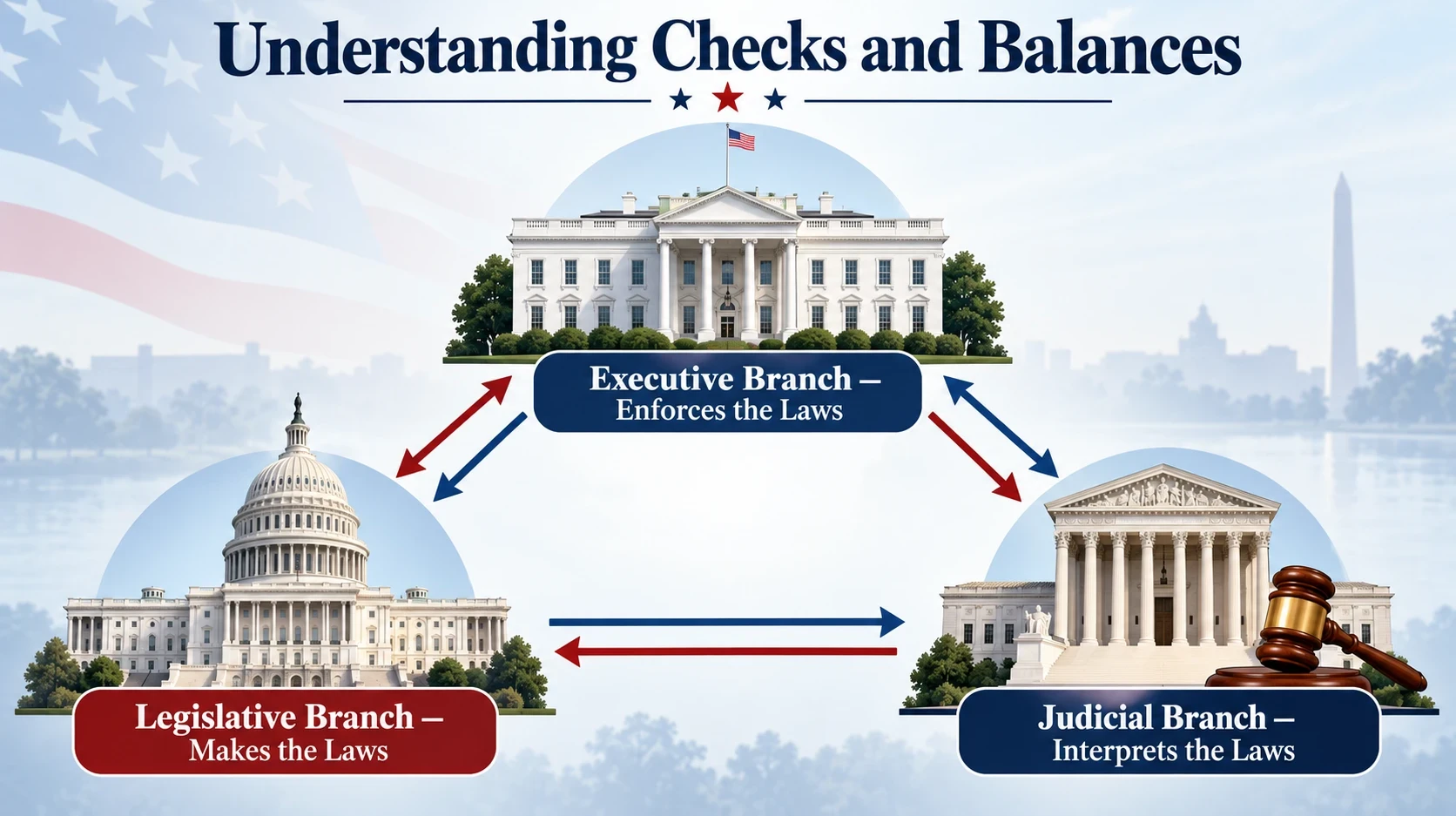
In the United States, checks and balances are closely connected to the three branches of the federal government: the legislative branch, executive branch, and judicial branch. The first three articles of the U.S. Constitution establish these branches and divide federal power among them.
Let’s take a closer look at how this works and why it matters.
Separation Of Powers And Checks And Balances
Before going further, it helps to understand the difference between two terms that are often used together: separation of powers and checks and balances.
Separation of powers means that government responsibilities are divided among different branches.
In the United States:
- The legislative branch, or Congress, makes federal laws.
- The executive branch, headed by the president, carries out and enforces federal laws.
- The judicial branch, including the federal courts, interprets and applies laws in legal cases.
The Constitution does not completely isolate these branches from one another, however. Their responsibilities sometimes overlap, and each branch has ways of limiting certain actions taken by the others. That interaction is what creates the system of checks and balances.
One simple way to think about it is this:
Separation of powers divides power. Checks and balances help keep that divided power under control.
The Legislative Branch
The legislative branch consists of the House of Representatives and the Senate, which together make up Congress.
Congress has the constitutional authority to perform many important functions, including passing federal legislation, approving federal spending, collecting taxes, and exercising other powers listed in the Constitution.
But Congress does not operate completely independently.
For example, imagine that Congress passes a bill.
That does not automatically mean the bill will become law. In most cases, the legislation is presented to the president, who can sign it or veto it.
That gives the executive branch a check on the legislative branch.
However, the story does not necessarily end with a presidential veto.
Congress can override a veto if the required two-thirds majority votes for an override in both the House and Senate.
So we have a check followed by another check.
Congress passes legislation.
The president can veto it.
Congress may then override that veto if enough members agree.
This illustrates an important part of checks and balances: government decisions may require participation from more than one institution.
The Executive Branch
The executive branch is headed by the president and includes federal departments, agencies, and other parts of the government responsible for implementing federal law.
The president has several important constitutional powers, but some presidential actions require involvement from Congress.
One clear example involves appointments.
The president nominates people for certain major federal positions, including Supreme Court justices and other federal judges. However, these nominations are subject to Senate confirmation. The Senate can vote to confirm or reject a nominee.
This means the president does not have complete control over filling these positions.
The same basic idea appears in the treaty process. The president plays a central role in negotiating treaties, but the Constitution gives the Senate an advice-and-consent role regarding their ratification.
Again, power is shared rather than placed entirely in one set of hands.
The Judicial Branch
The judicial branch includes the Supreme Court and lower federal courts.
Courts decide legal cases and interpret laws. The federal judiciary also plays an important role in determining whether governmental actions are consistent with the Constitution.
This brings us to an especially important concept called judicial review.
Judicial review allows courts to hold laws or government actions unconstitutional in cases properly before them. The Supreme Court’s 1803 decision in Marbury v. Madison is traditionally associated with establishing judicial review in American constitutional law.
For example, Congress might pass a law and the president might sign it.
Even though both the legislative and executive branches participated in creating that law, a court could later conclude in a legal case that the law violates the Constitution.
That gives the judicial branch an important check on actions by the other branches.
But the courts are also affected by the other branches.
Federal judges are nominated by the president, and certain judicial nominations require Senate confirmation.
Once again, no branch operates entirely by itself.
Impeachment Is Another Check
Another major example of checks and balances is impeachment.
The Constitution gives Congress responsibilities in the impeachment and removal process involving presidents, vice presidents, and other federal civil officers.
The House of Representatives has the power of impeachment. The Senate conducts impeachment trials, and conviction in the Senate requires the constitutionally specified supermajority.
It is important to understand that impeachment and removal are not the same thing.
Impeachment refers to the House formally bringing charges. A Senate trial comes afterward, and a conviction can result in removal from office.
This divides responsibility even within the legislative branch rather than allowing one chamber of Congress to handle the entire process alone.
Think Of It Like Several Locks On A Door
Here is a simple analogy.
Imagine that an organization keeps something extremely important in a room. Instead of giving one person the only key, several people are involved in gaining access.
One person might have a key.
Another might have the security code.
A third might have to approve the request.
The idea is that no single person can simply do whatever they want.
Checks and balances work somewhat like that.
Of course, government is far more complicated than a locked room. But the basic idea is similar: important governmental powers are distributed so that different institutions have opportunities to participate, object, approve, reject, or review certain decisions.
Why Create A System Like This?
The system reflects concerns about concentrated government power.
The writers of the U.S. Constitution were familiar with political theories arguing that liberty could be threatened when legislative, executive, and judicial authority became concentrated in the same hands. The constitutional structure therefore divided federal authority among separate branches while also giving those branches ways to resist encroachments by one another.
The result was not a system in which the branches never interact.
Actually, it was nearly the opposite.
The branches frequently have to interact.
A president may need Senate approval for a nominee.
Congress may need enough votes to overcome a presidential veto.
Courts may be asked to decide whether government actions are constitutional.
Congress passes legislation, while executive agencies are involved in carrying it out.
The system therefore creates both independence and interdependence among the branches.
Checks And Balances Can Create Conflict
There is another side to this system that is important to understand.
Checks and balances can make governing more difficult.
Imagine that Congress wants one policy while the president wants another. Congress might pass legislation only to have the president veto it.
Or the president might nominate someone to a federal position and the Senate might reject the nomination.
Courts may also issue decisions that limit actions taken by Congress or the executive branch.
From one perspective, these disagreements can look like political dysfunction. From another, disagreement is an expected consequence of distributing authority among competing institutions.
The U.S. Senate’s historical account of checks and balances describes the system as one that can produce both conflict and compromise among the branches.
That distinction is useful when following political news.
Government moving slowly does not automatically mean the system has stopped working. Sometimes delay occurs precisely because multiple institutions must participate in a decision.
At other times, prolonged conflict can make it difficult for the government to act.
Both possibilities are part of the political debate surrounding checks and balances.
Checks And Balances Do Not Mean Equal Powers
Another common misunderstanding is that every branch must have exactly the same powers.
They do not.
Each branch performs different constitutional functions.
Congress legislates.
The executive branch carries out laws.
The courts resolve legal disputes and interpret the law.
Checks and balances are not about making every branch identical. They are about creating a structure in which governmental power is divided and constrained rather than completely concentrated in one institution.
That distinction matters.
Checks And Balances Are Not The Same As Federalism
Beginners sometimes confuse checks and balances with another important concept: federalism.
They are related to the distribution of governmental power, but they describe different things.
Checks and balances primarily concern the relationships among branches of government.
Federalism concerns the division of governmental authority between the national government and state governments.
The Constitution incorporates both ideas.
Understanding this difference will make many political discussions much easier to follow.
Why Checks And Balances Matter When Following Politics
Once you understand checks and balances, political news starts making more sense.
You will have more context when you hear stories about:
- Congress passing legislation.
- A president vetoing a bill.
- Congress attempting to override a veto.
- A Senate confirmation hearing.
- A Supreme Court ruling involving a federal law.
- Congressional investigations.
- Impeachment proceedings.
- Disputes over presidential or congressional authority.
Instead of viewing each event as an isolated political fight, you can ask a more useful question:
Which branch of government is exercising its power, and what checks do the other branches have?
That question can help you understand what is happening without immediately getting caught up in partisan arguments about the people involved.
The Bigger Picture
Checks and balances are one of the basic concepts behind the structure of the U.S. federal government.
The legislative, executive, and judicial branches each have their own responsibilities, but they are also connected. Congress can check presidential power. The president can check Congress through powers such as the veto. Courts can review whether governmental actions comply with the Constitution. At the same time, presidents nominate federal judges and the Senate participates in confirming them.
The system does not eliminate political disagreements.
In many cases, it creates a framework in which those disagreements take place.
And that may be the most important point to remember.
Checks and balances are not designed to make every branch agree. They are designed to distribute governmental power and provide mechanisms through which different parts of government can limit, review, and respond to one another.
Once you understand that basic idea, you have a useful foundation for understanding everything from presidential power and Supreme Court decisions to congressional debates and some of the biggest political stories in the news.
And that is exactly why checks and balances are worth understanding when you are learning how politics works.