
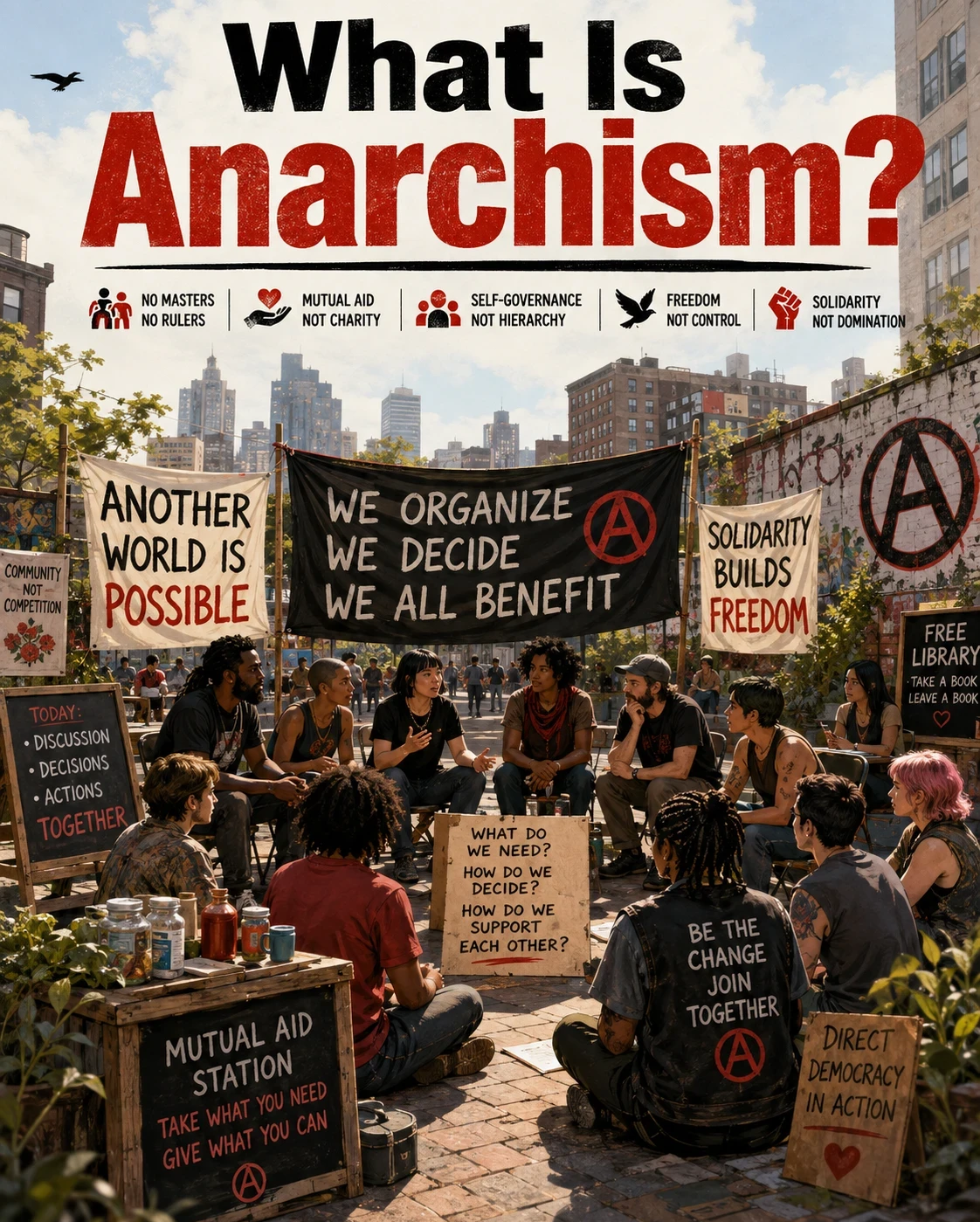
 Anarchism often gets a bad rap, but peel back the layers and it’s much more than the stereotype suggests. At its heart, anarchism is about people. It’s this wild belief that society can organize itself without a top-down authority barking orders. Imagine a community where everyone gets a say and decisions are made together. That’s the core principle—non-hierarchical and decentralized organization.
Anarchism didn’t just pop up overnight. Its roots stretch back to ancient philosophy, with thinkers as far back as Lao Tzu mumbling about life without rulers. Fast forward through history and you hit the 18th and 19th centuries, where folks like Pierre-Joseph Proudhon and Emma Goldman really riffed on the idea, framing anarchism as a legit political movement.
Sure, anarchism might sound like chaos, but it’s actually about order—without the iron fist. The myth that it’s about tossing literal bombs around? Total Hollywood nonsense. Anarchism is more about questioning power structures and authority, favoring cooperation and mutual aid over coercion. So, next time someone talks about anarchism, you might think twice before picturing lawless pandemonium.
Diverse Strands of Anarchism
Anarchism is like this big, vibrant tapestry, full of different threads representing various ideas and movements. Each strand has its own unique flavor, yet they’re all woven together by the shared belief in self-organization and freedom from oppressive structures.
Take anarcha-feminism, for example. It’s where the fight against patriarchy meets the fight against hierarchical rule. Anarcha-feminists argue that gender equality can’t be truly achieved without dismantling all forms of domination, whether it’s based on gender, class, or race. It’s a holistic approach that views liberation as interconnected.
Then you’ve got eco-anarchism, where environmental concerns are front and center. Eco-anarchists highlight how centralized power often leads to environmental degradation. They push for sustainable practices and see nature as something to be nurtured, not exploited.
Anarcho-syndicalism takes us to the workplace. Here, labor is organized from the ground up by workers themselves. It’s about seizing control from capitalist bosses and running industries cooperatively. This aspect of anarchism argues that real democracy starts in the workplace, where people spend much of their lives.
There’s also anarcho-communism, advocating for a society where resources are shared among communities based on need rather than wealth. It’s not about sharing everything equally, but sharing according to needs, making sure everyone’s got what they require to thrive.
Each of these threads might seem different at a glance, but they all share the anarchist dream of a society built on voluntary cooperation rather than coercion. Understanding these diverse strands opens up the bigger picture of anarchism’s goals and influences.
Anarchism in Practice: Past and Present
The idea of anarchism can seem pretty out-there until you see it in action through history and everyday life. One of the standout moments was during the Spanish Civil War in the 1930s. In places like Catalonia, entire regions were run based on anarchist principles. Workers took over factories, farms were managed by communities, and resources were shared equitably. It was a real-world example of anarchism working at a massive scale, even if it was short-lived due to the complexities and eventual defeat.
Fast forward to today, and you can still spot anarchism buzzing around in modern movements, sometimes quietly shaping things behind the scenes. Think about grassroots organizations and collectives popping up in cities worldwide, fighting for causes from climate action to social justice. These groups often shun rigid hierarchies, preferring collaborative organizing where everyone’s voice matters.
Plenty of anarchists you might not have heard of are out there influencing these practices. People like Peter Kropotkin, who emphasized mutual aid as a societal cornerstone, or Errico Malatesta, who argued passionately for direct action and revolution. These thinkers have provided a kind of guiding compass for modern anarchists, offering strategies and philosophies that still resonate.
So, despite what you might see in media or hear in passing conversation, anarchism isn’t just an abstract idea. It’s something people have tried, tested, and continue to tweak and adopt in ways that impact daily lives.
How Anarchism Aims to Organize Society
When it comes to organizing society without traditional structures, anarchism gets pretty creative. At its core, it’s about keeping things localized and grounded, with decisions made by those most affected by them. Imagine breaking free from bureaucratic red tape and having actual control over community decisions.
Anarchists often champion decentralization, proposing small-scale governance as opposed to power being concentrated in a distant capital. Indigenous communities across the globe have embraced these decentralized systems for millennia, emphasizing consensus and communal living over individual power.
Consensus decision-making plays a big part in anarchism’s toolkit. Instead of majority rule where the loudest voice wins, consensus seeks genuine agreement, ensuring everyone’s concerns are heard and addressed. It sounds messy, but this process is designed to build stronger commitments and create solutions that work for the collective.
Anarchism doesn’t just reject existing societal norms; it envisions new systems driven by community needs. Take housing, for instance. Rather than individuals struggling under unaffordable markets, housing could be organized through housing cooperatives, where resources and responsibilities are shared fairly among those who live there.
These approaches might sound radical, but the underlying principle is simple: putting control back into people’s hands. By focusing on community-driven systems, anarchism seeks to build societies that are more equitable, responsive, and humane. It’s about imagining and crafting new possibilities where people can genuinely thrive together.
The Challenges and Criticisms of Anarchism
Let’s be real, anarchism isn’t without its critics. Plenty of folks raise their eyebrows at the thought of a society without a structured government. A common criticism is that anarchism is too idealistic, assuming people will naturally get along without enforceable rules. Critics argue that without a central authority, chaos or tyranny could likely fill the void, leading to instability.
The idea of implementing anarchism on a large scale seems daunting for many. How do you ensure fairness and cooperation without falling into disarray? This question often pops up in critical discussions about anarchism’s feasibility. Can large urban areas truly self-govern in a way that meets the needs of everyone? Skeptics point out that human nature itself might be the biggest obstacle.
Even within the anarchist community, debates rage on what the best paths to achieving these ideals might be. Some emphasize completely dismantling all forms of government at once, while others advocate for more gradual changes. This lack of a unified roadmap often gets pointed out as a weakness, adding fuel to the fire for critics looking for practical solutions to complex issues.
That doesn’t mean anarchism doesn’t offer responses to these critiques. Advocates argue that while challenges exist, they aren’t insurmountable. Focus on education, community building, and redefining what it means to care for one another are seen as essential steps in addressing criticisms head-on. The belief is that by tackling societal issues holistically, anarchism can transform those criticisms into constructive growth.
So while critics line up with questions about pragmatism and order, those rooted in anarchism see opportunities to answer these challenges with creativity and innovation. The dialogue may be contentious, but it also helps refine and question what’s possible in building societies that truly serve everyone.
The Future of Anarchism: Opportunities and Threats
Looking ahead, anarchism faces both exciting possibilities and looming challenges. Technology has started reshaping the landscape, offering new avenues for decentralization and self-governance. Blockchain, for instance, promises ways to track consensus and resource management without centralized control. These digital tools could revolutionize how communities self-organize, sparking interest in anarchist ideas far beyond traditional circles.
The rise of social movements worldwide also breathes new life into anarchist principles. Movements seeking racial justice, climate action, or wealth redistribution often find common ground in the ideas of equity and direct action. Such alignment presents anarchism as a potent philosophical backbone for diverse struggles against systemic inequalities.
However, threats to these ideals are just as real. The resurgence of authoritarianism across the globe challenges the foundations of democratic participation that anarchism champions. These power dynamics pose significant barriers to implementing non-hierarchical systems. Plus, the very technology heralded as an anarchic tool can also serve as a surveillance apparatus for those holding the reins.
Despite these hurdles, debates surrounding anarchism encourage innovation and alternative thinking in political discourse. Anarchists continuously seize opportunities to challenge the status quo, whether through social experimentation or direct action. By reframing global crises as a chance for recalibration, the anarchist vision serves as a compass when exploring avenues for more equitable futures.
So while anarchism dances on the line between visionary and impractical, its continued relevance hints at a broader desire for more just systems. With diligence, exploration, and community effort, the path ahead remains rich with potential, inviting both skepticism and hope in equal measure.
This article helped me see that anarchism is not simply chaos or a lack of rules. The focus on voluntary cooperation, mutual aid, and local decision-making is very different from the common image of lawlessness.
The hardest question for me is how this could work in a large city. Consensus sounds fair when a group is small, but it may become slow when thousands of people disagree. There would also need to be a clear way to protect people who have less power within the community.
I think housing cooperatives are a useful example because they show how shared control can work on a smaller scale. Could local cooperatives be connected through elected councils without creating the same top-down authority that anarchism rejects? That seems like an important test of whether these ideas can grow beyond small groups.
Thanks for the comment, Bob. I agree that Anarchism seems like it would work better in a small group setting. Perhaps there would need to be many small groups for this type of society. Another issue would be what if another group that is bigger and stronger would want to take over another group?
All forms of political rule have their good points and their bad points. Overall, I believe that this type of governing could only work in small groups.