
 Legislatures are the heart and soul of any democratic system, acting as the bridge between citizens and the government. They represent the public, create laws, approve budgets, and keep an eye on the executive’s actions to ensure transparency and accountability. It’s all about making sure the people’s voice is heard loud and clear.
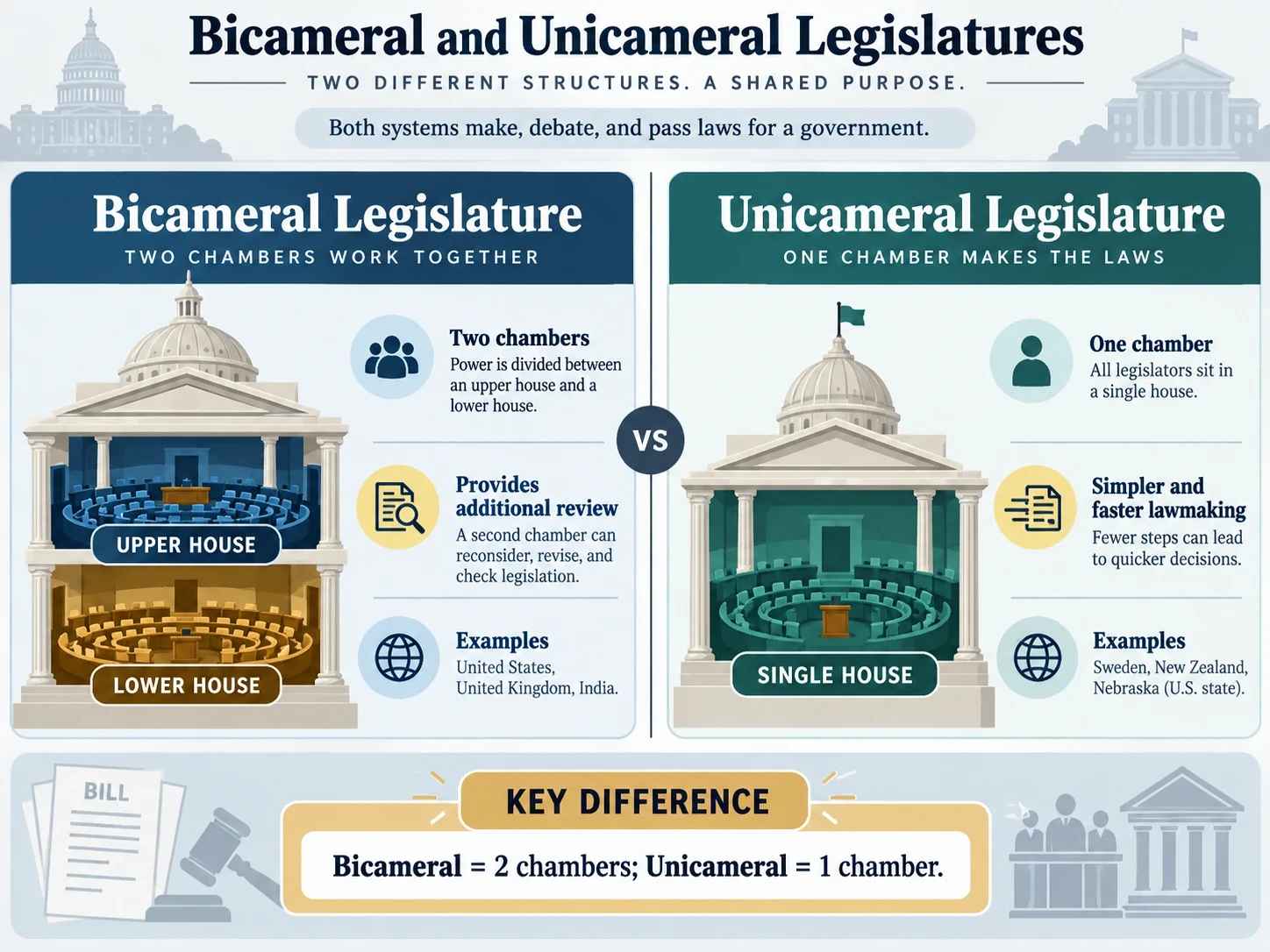
Unicameral systems are pretty straightforward, consisting of just one chamber. All members meet and debate in one legislative room, which can simplify how laws are made and changed. It’s a one-stop shop where decisions are made more swiftly, usually without the extra steps a second chamber would involve.
On the flip side, bicameral systems have two chambers. You’ll often see these called the lower house and the upper house. Think of them as two groups, each with their own tasks, working together (ideally) to move legislation forward. The lower house typically focuses on direct representation, while the upper house might represent regional interests or act as a reviewing body to add more scrutiny to the process.
Don’t assume every country runs its upper chamber the same way, though. The powers they hold, how members are chosen, and even what they’re called can vary widely across the globe. Some nations elect upper house members, others appoint them, while some might have unique setups like hereditary seats.
The real question is how a second legislative chamber either enhances or complicates representation and scrutiny. It’s about whether the added layer justifies the complexity, and that comes down to individual country needs, traditions, and goals.
Why Countries Choose One Chamber or Two
The reasons behind a country choosing to run its legislature with one chamber or two can get pretty interesting. Population size plays a role—bigger countries with diverse people and interests might go for two chambers to better represent everyone. Smaller nations or those with a more centralized systems often lean towards a single chamber for efficiency and clarity.
Geography and federalism also have a hand in shaping legislative structures. Federal states, with their divisions into states, provinces, or regions, often use an upper chamber so each region gets its voice heard. This setup adds a layer that can help balance out power and representation when there’s a lot on the line regionally.
History and constitutional design are equally important factors. Some countries choose their setup based on tradition or how their political systems have evolved over time. For example, former colonial states might inherit bicameral systems from their colonial rulers. There are also those that lean toward unicameral setups after political reform or to move past a historical crisis.
No one type of legislature is automatically more democratic than the other. You can’t just look at the number of chambers to see democracy in action. Far more important is how elections are run and how independent the institutions are, plus whether the public can hold their lawmakers to account effectively.
When looking at why different countries have chosen different systems, it’s critical to explore how these factors come together in unique ways. From the way each chamber represents its people to how effectively it checks and balances, understanding background, tradition, and goals gives insights into why a particular system fits each country just right.
How Bicameral Legislatures Work: Representation, Review, and Restraint
Bicameral systems are kind of like a tag team in the world of legislatures, with two chambers bringing their own flair to the table. The lower house usually gets the spotlight due to its direct connection to the people, often through elections. The upper house, though, sometimes gets chosen by election, appointment, or even indirectly through other bodies. There are some unique cases where seats are passed down through families, but that’s pretty rare.
Each chamber has its job to do when it comes to legislation. A bill typically needs approval from both sides of the house, and if there’s friction, they might hash things out through amendments or committees. Sometimes it involves working things out in sessions that include members from both chambers. It’s a system built to add more layers of review.
Having a second chamber can bring some real benefits. It can provide an extra layer of scrutiny to catch flaws in legislation and make sure regional interests are heard. It also works to keep temporary majorities from pushing through laws on a whim, acting as a bit of a check and balance.
However, the system isn’t without its challenges. There could be duplication of efforts where both chambers end up doing the same work. This might lead to delays, making legislative processes longer than they might need to be. Critics also point out that not having direct elections for some upper houses can lead to questions about democratic legitimacy.
Want some real-world examples? You can check out the U.S. Congress, where the Senate has equal representation from each state, or look at the UK’s Parliament with its House of Lords. Germany and Australia have their own unique setups, showing that while the framework might be similar, each country puts its unique twist on the bicameral idea.
How Unicameral Legislatures Work: Speed, Clarity, and Direct Accountability
Unicameral legislatures keep things simple as it all happens in one place. When it comes to introducing, debating, amending, and passing bills, a single chamber is where the action is. Laws can move from idea to reality without the need for checking in with another group, and that can make things speedier when time is of the essence.
One of the big pluses of a unicameral setup is fewer procedural hurdles, which can translate to lower administrative costs. There’s a straight line from decision to law, making it easier for people to know exactly who’s responsible for legislative choices. If things need to get done fast, like in urgent situations, having just one chamber in the decision-making chain is an asset.
Of course, this setup can also come with its own set of risks. Without a second chamber adding another layer of review, laws might not get as much internal scrutiny before becoming official. With power concentrated in one place, it’s essential to have other checks in place to avoid potential issues like overly dominant majorities.
But don’t worry, unicameral systems aren’t left hanging without safety nets. Many have strong committees that dig deep into legislative details or employ judicial reviews to ensure laws hold up to higher standards. Public consultations and constitutional limits are often used to provide an extra layer of accountability. Plus, things like proportional representation can balance out the power.
Countries like New Zealand, Sweden, and Denmark lead the way with their unicameral parliaments, each putting their spin on the concept while catering to their unique political and cultural backgrounds. Even Nebraska stands out with its nonpartisan state Legislature, showing there’s more than one way to do single-chamber governance well.
Bicameral vs. Unicameral: Comparing Democratic Trade-Offs
Choosing between a bicameral or unicameral legislature isn’t a one-size-fits-all situation. It’s about balancing several democratic trade-offs: representation, scrutiny, speed, cost, and accountability. Each system has its own flair and fumbles, and which works best can depend a lot on unique national needs.
Representation is a big-ticket item. In bicameral systems, you often see an effort to balance between geographical or regional interests and the general population’s voice. But in unicameral setups, it’s all about direct representation, which can be clearer but might miss out on regional nuances.
When it comes to legislative scrutiny, that extra chamber in a bicameral system adds an extra layer of checking, potentially catching issues earlier. But it can also slow things down. Unicameral systems might move faster, helping with quick decisions, but at the risk of missing detailed reviews that a second chamber might catch.
Speed and cost are where unicameral shines a bit brighter. Fewer steps mean quicker decisions and lower costs, which is appealing for those looking to keep governance simple. Bicameral systems might seem expensive or intricate but can justify this through more comprehensive law-making and power-balancing efforts.
Transparency and accountability offer a nuanced picture. Having one chamber takes away guessing games for citizens about who to hold accountable, which can be straightforward in unicameral systems. Bicameral legislatures can sometimes create a rich debate but can also muddy who’s responsible for what if different political affiliations control each house.
It’s important to think about which voices might be amplified or muffled in each model, whether it’s political minorities, different geographical regions, or specific communities. How lawmakers are chosen and how rules are enforced can influence whichever system you are exploring. Instead of looking for a perfect system, it’s key to find what aligns with a country’s democratic values and responds to the needs and challenges of its people.
Legislative Reform: Questions Citizens Should Ask Before Changing the System
Thinking about reforming legislative systems often comes from a need for change, whether it’s fixing inefficiencies in how laws get made or boosting representation for certain groups. It’s not just about tossing out the old and bringing in the new, but about solving specific issues that keep cropping up. Maybe the upper house isn’t pulling its weight, or representation falls short for certain regions.
So, what should you be asking if you’re on team reform? Start by identifying the problem at hand. Are there stumbling blocks in how bills become law? Do citizens feel underrepresented? Knowing the issue guides the direction reform should take.
Consider the selection process for any chamber involved. Who’s picking the lawmakers? Does it remain democratic and inclusive, or is it too exclusive? From here, think about the powers each chamber should hold. Should they get equal say, or does one focus on specific challenges, like regional interests?
Settling disagreements between chambers is another crucial factor. A plan for override procedures, joint sessions, or a higher authority to call the shots might be needed to have legislation move smoothly and avoid policy gridlocks.
Remember to factor in aspects like the cost of making changes and how practical implementation would be. Engage the public: consult widely to get feedback and buy-in. It’s important not to overlook constitutionality and the legal framework that would sustain reform.
In places with referendums, they might be essential to get public consent before diving into full-scale change. Transition planning ensures the changeover respects current lawmakers’ roles while gearing up for the new setup.
Ultimately, an effective legislative setup is marked by its ability to elect fairly, conduct transparent work, receive informed public input, and enforce checks on power consistently, regardless of whether it runs with one or two chambers.