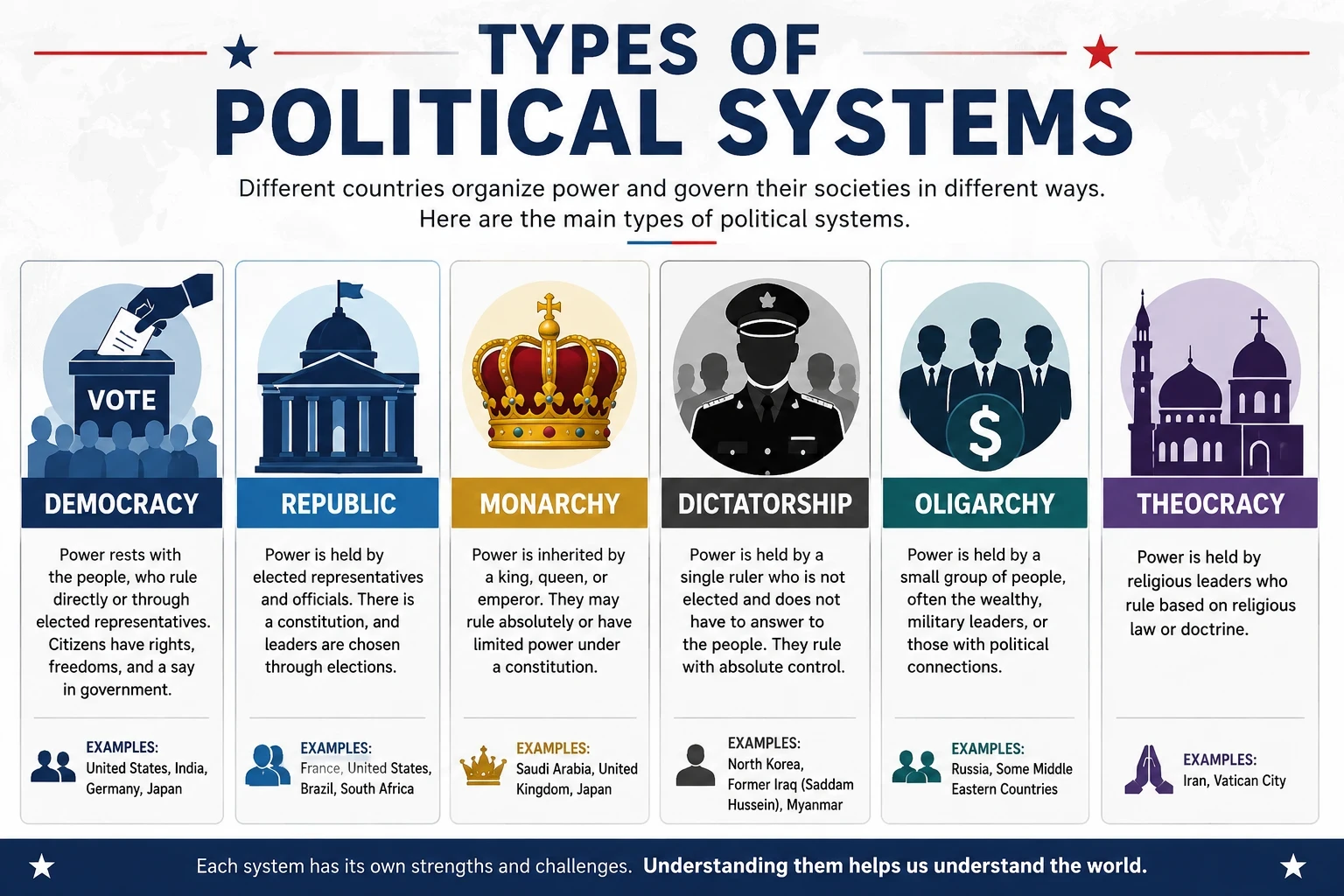
 Political systems, they’re like the invisible hands steering the ship of a society. But what exactly are they? In simplest terms, a political system is the structure, the framework upon which a nation is built, guiding everything from government to citizen interaction and even lawmaking.
So why does this matter? Political systems shape a country’s identity, influence its citizens’ daily lives, and determine the level of social and economic development. From ensuring public order to providing a platform for civic engagement, these systems hold the power to either support or hinder progress.
Now you might be thinking, aren’t all political systems more or less the same? Definitely not. There’s a whole buffet of systems out there, each with its own quirks and characteristics. Some scream freedom, while others lean towards control and order. Understanding these systems is like getting a front-row seat to a live show of human creativity and adaptability.
Comparing different political systems isn’t just an academic exercise. It’s practical. It opens up a window to learning why some countries prosper while others might struggle. It helps us appreciate the variety in governance styles, each molded by history, culture, and philosophy. Gaining this insight empowers us to better grasp global politics and the nuances of international relations.
Democracy: Power to the People
Imagine a world where the people hold the reins of power. That’s democracy in a nutshell. It’s all about citizens having a say in how they’re governed, either directly or through elected representatives. At its core, democracy thrives on freedom, equality, and participation.
When it comes to democratic systems, variety truly is the spice of life. From presidential to parliamentary systems, each has its unique way of ensuring citizen involvement. While presidential systems, like in the United States, separate powers across branches, parliamentary systems, like in the UK, mix things up with executive powers nestled within the legislature.
So what’s the catch with these democratic setups? While they offer inclusivity and accountability, they also come with challenges. Political gridlock, influence of money in politics, and protection of minority rights can all become hurdles. Yet, there’s a lot to admire in the checks and balances these systems often provide, keeping power in check and leaders on their toes.
Take a look at countries like Canada, India, or Norway. Each one has its own democratic spin, shaped by local traditions and unique societal needs. Democracies are far from one-size-fits-all, but they share the common aim of empowering the populace.
Does this mean democracy is perfect? Hardly. It’s more of a work in progress, constantly evolving to better cater to its citizens. The true beauty of democracy is its spirit of adaptability and resilience, always striving for that ever-elusive balance between freedom and order.
Authoritarianism: Rule by a Centralized Authority
In some corners of the world, power isn’t shared but concentrated at the top. Welcome to authoritarianism, where a centralized figure or group holds sway over the government with little input from the populace. Think of it as governance with a strict top-down approach.
Authoritarian regimes often maintain their grip through control over media, restriction of free speech, and limited political freedoms. Security and stability are touted as the main benefits, but these come at the expense of civil liberties and open dissent. Free and fair elections? Not so much on the menu.
The appeal of authoritarianism can stem from its promise of order and rapid decision-making, especially in countries facing internal strife or economic instability. However, that tight control often leads to significant human rights issues and lack of accountability, leaving citizens with little recourse.
Countries like North Korea and Syria are often referenced in discussions about authoritarianism. They showcase the dynamics of power centralized in few hands, impacting everything from public policy to individual freedoms.
What’s the takeaway here? While these systems might boast efficiency in implementing decisions without the bureaucratic slowdown typical of democracies, the cost is high in personal freedoms and societal equality. It’s crucial for anyone exploring political systems to recognize the trade-offs inherent in authoritarian regimes.
Monarchies: The Continuation of Royal Traditions
Monarchies bring visions of crowns and royal pageantry, yet there’s more beyond the pomp. They’re systems where a king, queen, or emperor holds power, often inherited through family lines passed down over generations.
Historically, monarchies were the standard, grounding societies in tradition and continuity. Over time, though, many have evolved, adapting to changing times. Today, you’ll find monarchies split between absolute and constitutional.
Absolute monarchies operate with rulers holding nearly complete power, akin to today’s authoritarian systems. Countries like Saudi Arabia are prime examples, where monarchs exercise significant control over governance.
Then there’s the modern twist: constitutional monarchies. Here, monarchs have become more ceremonial, with political power residing in elected bodies. Think the UK, where the Queen’s role is symbolic, with Parliament steering the ship.
What do monarchies offer their citizens? Stability, a sense of national identity, and a continuous thread of tradition. But those benefits might come at the cost of slower social progress and debates about the relevance of monarchy.
Even in present times, monarchies provide a fascinating lens to view governance structures and how tradition blends with modernity. For those countries, balancing heritage with contemporary political necessities remains an ongoing story.
Communism: Striving for Classless Societies
Communism offers a radically different playbook. Imagine a world without class distinctions, where the community or state owns and controls all property and means of production. That’s the dream underlying communist ideologies.
At its heart, communism aims to eliminate the class divide, advocating for equal wealth distribution. In theory, this leads to a classless society where everyone shares equally in a nation’s wealth. But moving from theory to practice has proven challenging.
Communist states like the former Soviet Union and Cuba have shown us both the potential and pitfalls. These regimes often meet basic citizen needs through state planning, but they also navigate tricky waters of economic stagnation and lack of personal freedoms.
In real-world attempts, the struggle often lies in maintaining efficiency and productivity. The centralized control can lead to bureaucratic nightmares, and the suppression of political opposition becomes all too common.
Despite challenges, countries like China have tweaked the model, blending communist principles with free-market elements. This adaptability shows how ideologies can evolve, striving towards their goals while addressing practical economic needs.
Communism remains a captivating study in ideological zeal versus real-world application. It urges us to reflect on society’s goals – equality versus freedom, centralized control versus individual rights. It’s a debate that’s far from over.
Hybrid Systems: The Best of Both Worlds?
Hybrid political systems are like a mashup of governance styles, blending elements from different systems to tailor solutions for specific national needs. They don’t fit neatly into one category, borrowing from diverse political philosophies to create unique governance approaches.
These systems often combine democratic practices with authoritarian elements, creating a surprising mix where elections happen, but power remains concentrated. Or a monarchy might coexist with democratic bodies, balancing tradition and modern governance.
Pros of hybrids often include flexibility and adaptive governance, allowing them to tackle unique challenges that pure systems might stumble over. By experimenting with governance models, these systems create pathways that can lead to innovation and stability.
However, the cons mirror their complexity. Hybrids can blur the lines of accountability and sometimes mask power grabs as experimental governance tweaks. Finding the balance between competing ideas can lead to instability and confusion among citizens and officials alike.
Countries like Singapore and Russia provide intriguing examples of hybrid political systems in action. Singapore pairs a strong state apparatus with democratic elections, while Russia presents a mix with democratic features underpinned by strong centralized control.
Hybrid systems are worth watching as they continue to evolve, offering lessons on the adaptability of political systems and showing how nations can creatively blend governance models to meet the needs of their people in an ever-changing world.